French President Emmanuel Macron expressed concerns that the United States and the European Union should prioritize stability over tariff threats, following President Trump’s announcement of increased duties on European vehicles.
BRUSSELS — French President Emmanuel Macron criticized the United States on Tuesday for its decision to impose higher tariffs on European vehicles, stating that such actions divert attention from more pressing geopolitical challenges. His remarks came shortly after U.S. President Donald Trump declared plans to raise tariffs on automobiles and trucks imported from the European Union (EU) to 25%. This escalation in trade tensions occurs amid broader concerns about global economic stability, particularly in the context of ongoing conflicts in the Middle East.
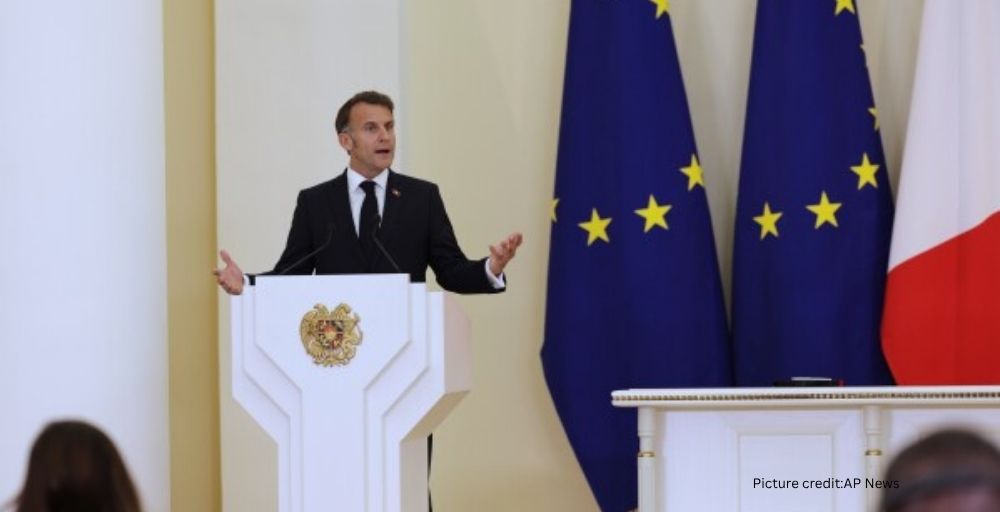
Macron, speaking to reporters during an EU-Armenia summit in Yerevan, emphasized that allies like the United States and the EU should focus on fostering stability rather than engaging in what he termed “threats of destabilization.” He remarked, “For our businesses, our households, our populations, we should rather send a message of stability and confidence.” Macron expressed hope that “reason will prevail soon” as both regions grapple with mounting economic pressures.
Context of the Tariff Announcement
The proposed tariff increase follows a series of diplomatic tensions between the U.S. and its European allies. Trump’s announcement on Friday was partly fueled by his dissatisfaction with Germany, a significant player in the automobile manufacturing sector. Trump accused the EU of failing to adhere to what he described as a “fully agreed to Trade Deal,” although he provided no specific details on these alleged violations.
The timing of the tariff threat is particularly sensitive, as it coincides with U.S. frustrations over remarks made by German Chancellor Friedrich Merz, who recently suggested that the U.S. had been “humiliated” by Iran in negotiations aimed at resolving ongoing conflicts. The potential economic ramifications of increased tariffs are significant; Germany’s automobile industry, already under pressure from various global market dynamics, could face severe financial repercussions from a 25% tariff on exports to the U.S., potentially leading to job losses and decreased production.
Trade Agreements and Legal Challenges
In July 2025, Trump and European Commission President Ursula von der Leyen reached a preliminary trade deal that established a tariff ceiling of 15% on most goods. However, this agreement has since come into question following a ruling by the U.S. Supreme Court that deemed the legal authority used by Trump to impose previous tariffs unauthorized. This ruling has complicated the landscape for trade negotiations, further increasing uncertainty for both U.S. and European businesses.
During the summit, von der Leyen reaffirmed the importance of respecting established trade agreements, stating, “A deal is a deal, and we have a deal. And the essence of this deal is prosperity, common rules, and reliability.” Her comments reflect a commitment from the EU to uphold negotiated agreements despite the current tensions. She also indicated that the European Commission, which negotiates trade on behalf of the 27 EU member states, is prepared for any potential fallout from the tariff dispute, asserting, “We are prepared for every scenario.”
Potential Implications for Transatlantic Relations
Macron’s comments underscore a growing concern among European leaders that escalating trade tensions could undermine transatlantic relations at a time when cooperation is crucial. The geopolitical landscape has shifted dramatically in recent years, with the rise of challenges such as authoritarianism and international terrorism. In this context, Macron’s call for stability and collaboration among allies is particularly relevant.
The potential fallout from the tariff threats is not limited to economic considerations. Increased trade barriers could lead to a deterioration of diplomatic relations, further isolating the U.S. on the global stage. Analysts warn that if the rhetoric around tariffs continues to escalate, it could trigger retaliation from the EU, with the potential for a trade war that might exacerbate existing economic hardships on both sides of the Atlantic.
Conclusion
As the situation develops, the response from both U.S. and EU officials will be critical in determining the future of transatlantic trade relations. Macron’s appeal for a focus on cooperation over confrontation reflects a desire among European leaders to stabilize the economic environment and strengthen alliances. With trade officials from the U.S. and EU scheduled to meet in Paris to discuss the ongoing issues, the outcomes of these discussions may have significant implications for the future of international trade and diplomacy.