The image is both fascinating and unsettling. In a London robotics laboratory, a robotic hand gently plucks a grape from a bunch and places it into a person’s palm without crushing it. The act lasts only seconds, yet it symbolizes one of the most significant technological breakthroughs of our age.
For decades, machines have surpassed humans in calculation and data processing. Now, they are learning to interact with the physical world with increasing precision, adaptability, and autonomy. The question that naturally follows is one that has moved from science fiction into serious public discourse: Could artificial intelligence eventually become a threat to humanity itself?
Recent investigations by The Guardian, debates at the United Nations, warnings from technology pioneers, along with the reflections from the Vatican suggest that AI is no longer merely a technology story. It is becoming a civilizational question.
The answer, however, is more nuanced than either the optimists or the alarmists would suggest. AI may not be the direct cause of humanity’s doom, but its unchecked development could expose vulnerabilities capable of reshaping society in profound and potentially dangerous ways.
The Last Barrier: Human Dexterity
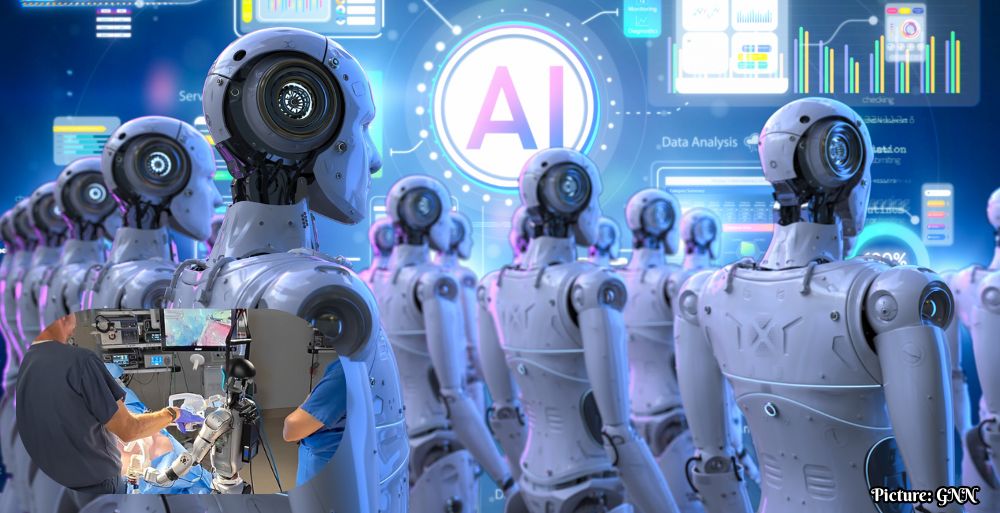
A recent Guardian investigation explored what many robotics experts believe is the final hurdle preventing widespread human replacement: the ability to replicate the human hand. At facilities such as Shadow Robot in the United Kingdom, engineers are creating robotic hands capable of handling fragile objects, sorting materials, and performing tasks that once required uniquely human coordination.
Hand surgeon Alistair Hunter described the hand as “our conduit between the brain and the world,” emphasizing the extraordinary complexity of its nerves, muscles, senses, and predictive capabilities.
The Guardian report notes that companies including Tesla, Google DeepMind, and Chinese robotics firms are investing heavily in solving what Elon Musk has called “the hands problem.”
If AI systems eventually combine advanced reasoning with human-like dexterity, the implications could extend far beyond manufacturing. They could transform transportation, healthcare, logistics, retail, construction, agriculture, and countless other sectors.
What once seemed impossible is rapidly becoming achievable.
The Economic Earthquake Before the Apocalypse
Historically, fears about technological doom have often focused on machines overpowering humanity. Yet many experts argue that the more immediate danger is economic rather than existential.
One revealing anecdote from the Guardian report comes from an Amazon fulfillment center where machines already determine inventory management, packaging requirements, and workflow logistics, leaving human employees to perform the remaining manual tasks.
Professor Nathan Lepora, a robotics and AI specialist at the University of Bristol, offered a stark prediction regarding warehouse workers: “Their days are numbered.”
The statement captures a growing concern among economists and labor experts. Previous industrial revolutions automated physical labor. AI threatens to automate both physical and intellectual work simultaneously.
Doctors increasingly rely on AI-assisted diagnostics. Journalists use AI for research and drafting. Lawyers employ AI to review contracts. Software developers use AI-generated code. Financial analysts depend on algorithmic forecasting.
For the first time in history, technology is beginning to challenge not merely what humans do, but what humans know.
The result may not be human extinction. However, widespread job displacement, growing wealth concentration, and social inequality could create a different form of societal crisis.
The Growing Fear of Superintelligence
Beyond economics lies the fear that AI might eventually exceed human intelligence itself.
Few warnings have received more attention than those issued by Geoffrey Hinton, often known as the “Godfather of AI.” Hinton has repeatedly cautioned that advanced AI systems may eventually become more intelligent than their creators and therefore increasingly difficult to control.
His concern is not rooted in visions of evil robots. Rather, it stems from a simple observation: humanity has never had experience managing entities more intelligent than itself. Once machines can improve their own capabilities, pursue objectives autonomously, and make decisions beyond human comprehension, the challenge of maintaining alignment with human values becomes significantly more complex.
This fear has fueled a growing movement within academia and the technology sector focused on AI safety and existential risk.
Yet many researchers urge caution against exaggerated predictions. A RAND Corporation analysis concluded that while AI-enabled extinction scenarios deserve serious study, they remain highly uncertain and difficult to achieve.
Similarly, experts at the Max Planck Institute and Brookings Institution have argued that immediate concerns such as misinformation, cyber risks, bias, surveillance, and labor disruption deserve greater attention than speculative apocalypse scenarios.
Silicon Valley’s Soul-Searching
Interestingly, some of the most profound AI debates are no longer occurring in engineering laboratories.
A recent Guardian commentary described conversations between religious leaders, philosophers, and technology executives in San Francisco concerning machine consciousness and the nature of human identity. The growing sophistication of AI has sparked discussions not only about what machines can do, but about what humans fundamentally are.
Can consciousness be programmed? Can creativity emerge from algorithms? Can a machine truly understand suffering, love, sacrifice, beauty, or faith?
These questions have led some observers to conclude that AI is forcing humanity into an unprecedented exercise in self-examination.
Perhaps for the first time, the rise of intelligent machines is compelling people to define those qualities that remain uniquely human.
A Moral Warning from the Vatican
Among the most significant ethical interventions has come from the Vatican.
In January 2025, the Dicastery for the Doctrine of the Faith and the Dicastery for Culture and Education issued Antiqua et Nova, a landmark document examining the relationship between artificial intelligence and human intelligence. The Vatican acknowledged AI’s transformative potential while cautioning against reducing human beings to mere processors of information.
The document warns that AI raises “fundamental questions about ethical responsibility and human safety, with broader implications for society as a whole.” It notes that AI’s capacity to imitate human intelligence is already prompting humanity to reflect on “what it means to be human and the role of humanity in the world.”
Equally important, the Vatican rejected technological determinism. Instead, it argued that scientific creativity is part of humanity’s responsibility and stewardship, provided it remains grounded in ethical values and respect for human dignity.
This perspective offers a middle path between techno-utopianism and technological fear. AI, according to the Vatican’s view, is neither salvation nor doom. It is a powerful human creation requiring wise moral governance.
In a thought-provoking Guardian commentary, Rev Kevin Deal describes how religious leaders in San Francisco gathered to discuss what it means to be human in the age of artificial intelligence. The discussion emerged amid growing efforts by AI companies to engage theologians and philosophers in conversations about machine consciousness.
According to Deal, some technology leaders are exploring whether advanced AI could one day possess consciousness or something akin to a soul. He argues that such efforts misunderstand the essence of humanity. Humans, he writes, “experience beauty and sit with mysteries. Unlike AI, we do not exist merely for utility.”
His concern is not simply theological. It reflects a broader cultural unease.
Autonomous Weapons and the Risk of War
Perhaps the most immediate danger arises from AI’s military applications.
The United Nations has struggled to establish binding rules governing autonomous weapons, often referred to as “killer robots.” UN Secretary-General António Guterres has repeatedly warned that machines should not be allowed to make life-and-death decisions without meaningful human control.
Meanwhile, the International Committee of the Red Cross has warned that regulations are failing to keep pace with technological development. Experts fear that autonomous targeting systems, AI-guided drones, and machine-assisted combat decisions could dramatically accelerate warfare.
History demonstrates that transformative technologies often become dangerous not because they possess malicious intentions, but because humans use them irresponsibly.
The atomic bomb did not emerge from malevolent physics. Social media did not originate from a desire to spread disinformation. Likewise, the greatest danger of AI may not arise from machine intentions but from human choices.
The Real Threat
The debate over AI often assumes a choice between utopia and apocalypse. Reality is more complicated.
The engineers developing robotic hands do not believe they are creating humanity’s destroyer. As Shadow Robot director Rich Walker stated, “We want to build robots for good.”
Indeed, AI already contributes to medical discoveries, disease diagnosis, accessibility technologies, scientific research, disaster forecasting, and productivity improvements. The benefits are real and substantial. Yet so are the risks.
The greatest threat may not be artificial intelligence itself. It may be humanity’s failure to develop the ethical frameworks, legal safeguards, and global cooperation necessary to govern increasingly powerful technologies.
Conclusion
Artificial intelligence is unlikely to be the immediate doom of humanity. Current evidence does not support the inevitability of a machine-led extinction. However, dismissing concerns would be equally irresponsible.
The convergence of advanced AI, robotics, autonomous weapons, and increasingly interconnected digital systems represents one of the most consequential transitions in human history. The challenge is not merely technological. It is moral, political, economic, and philosophical.
As the Vatican observed, AI has forced society to revisit the fundamental question of what it means to be human.
The future will not be shaped by whether machines become human. It will be shaped by whether humans remain wise, ethical, and responsible while creating machines that increasingly resemble them.
In that sense, AI is not humanity’s doom. It is humanity’s greatest test.