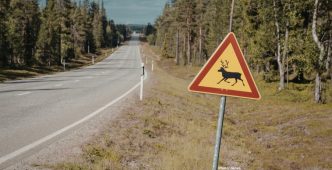

India has inaugurated its first ‘red road’ on National Highway 45 in Madhya Pradesh, implementing innovative design features aimed at reducing wildlife-vehicle collisions and enhancing driver safety.
India has officially inaugurated its first “red road” on National Highway 45 in Madhya Pradesh, a project designed to improve safety for both wildlife and motorists. This initiative, spearheaded by the National Highways Authority of India (NHAI) under the Ministry of Road Transport and Highways, incorporates a series of design elements aimed at minimizing the risk of collisions between vehicles and animals in a key wildlife corridor.
Project Overview
The project encompasses an 11.96-kilometer (approximately 7.4-mile) stretch of NH 45 that traverses the Veerangana Durgavati Tiger Reserve. Central to the initiative is a 5-millimeter (about 0.2-inch) hot-applied thermoplastic red surface layer that has been installed across a 2.0-kilometer (approximately 1.2-mile) designated danger zone. Officials assert that the bright red surfacing and its slightly raised texture are intended to alert drivers subconsciously, thereby reducing their speed without requiring abrupt braking.
Design Features
In addition to the distinctive red markings, the project integrates 25 dedicated animal underpasses strategically located at known wildlife movement areas. These underpasses are crucial; the project’s success depends not only on the visibility of the road surface but also on the ability of wildlife to cross safely beneath the highway. Continuous chain-link fencing has been installed along both sides of the highway to deter animals from entering the roadway. This fencing is designed to guide wildlife toward the underpasses, thereby minimizing the likelihood of collisions.
Additional safety measures include the installation of cameras on minor bridges, which can also serve as crossing points, along with solar lighting at bridges and junctions to enhance visibility while maintaining environmental integrity. These features collectively aim to create a safer passage for both vehicles and wildlife.
Addressing the Wildlife Collision Crisis
The issue of wildlife-vehicle collisions is significant not only in India but globally. In the United States alone, federal research estimates that there are between one to two million collisions each year involving large animals, leading to serious safety concerns for drivers and contributing to wildlife mortality. In response to this pressing issue, research suggests that a combination of fencing and crossing structures can dramatically reduce roadkill. A comprehensive meta-analysis has shown that such measures can lower large mammal roadkill by approximately 83%, while fencing alone can result in a 54% reduction.
Further research indicates that the effectiveness of fencing increases with its length; segments of 5 kilometers (about 3.1 miles) or more tend to yield at least an 80% reduction in collisions, while shorter distances may not be as effective. This underscores the importance of continuous, well-planned infrastructure in mitigating wildlife-vehicle collisions.
Psychological Design and Driver Behavior
In designing this road, NHAI aims to leverage psychological cues to influence driver behavior. The raised red surfacing is intended to provide tactile and audible feedback, reducing noise compared to conventional rumble strips. This design philosophy seeks to encourage drivers to naturally slow down as they approach wildlife areas without resorting to traditional enforcement methods, which can often engender frustration among motorists.
International Context
This initiative is not unique to India. In February 2026, Chile’s Ministry of Public Works announced a significant infrastructure project along Route 5 that includes seven wildlife crossings aimed at protecting the island’s natural environment. This project, with an investment of $594 million, reflects a growing recognition of the need for ecological considerations in transportation planning. The global trend toward incorporating wildlife safety in road design highlights an evolving mindset around the intersection of infrastructure and conservation.
Future Monitoring and Maintenance
As India moves forward with this innovative approach, key indicators of success will include data on vehicle speeds in the marked zones, wildlife collision statistics before and after the project’s implementation, and evidence of wildlife utilizing the underpasses instead of attempting to navigate the fencing. It is critical that ongoing maintenance is prioritized; any failures, such as a compromised fence or a clogged underpass, could undermine the effectiveness of the carefully designed corridor. The durability and reliability of these features will be essential in ensuring the long-term success of the initiative.
Ultimately, the ‘red road’ initiative aims to create a safer transportation network for both humans and wildlife, acknowledging the need for coexistence in regions where natural habitats intersect with human infrastructure. This project represents a proactive step towards balancing development with ecological preservation, a challenge that many countries face as they expand their transportation networks in environmentally sensitive areas.