
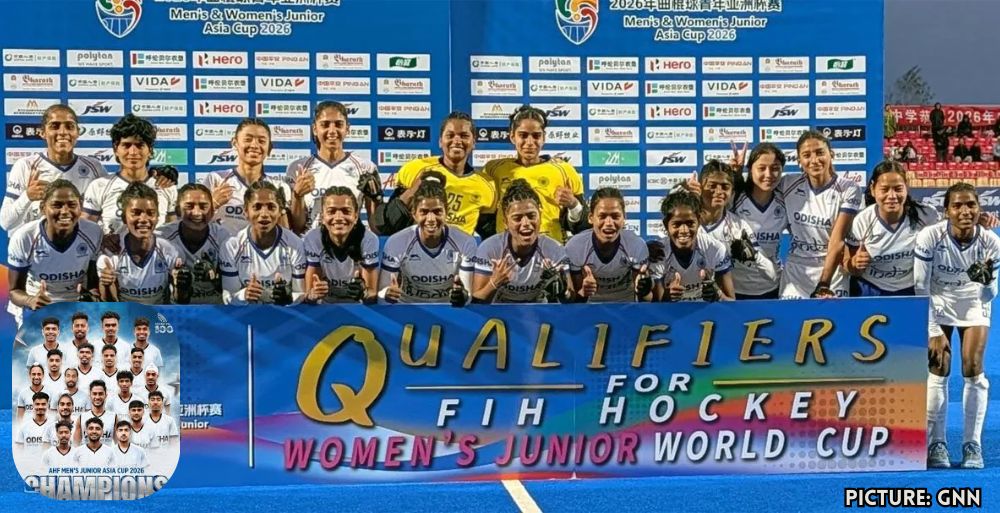
India’s men’s and women’s junior hockey teams both achieved remarkable victories at the AHF Junior Asia Cup 2026 in Moqi, China, successfully defending their titles and qualifying for the FIH Junior World Cup.
India’s national junior hockey teams celebrated a significant achievement on Sunday, winning both the men’s and women’s titles at the AHF Junior Asia Cup 2026, held in Moqi, People’s Republic of China. The women’s team secured a narrow 1-0 victory over the host nation, while the men’s team triumphed with a convincing 4-1 win against the Republic of Korea. This dual victory not only marks a successful title defense for both teams but also highlights India’s growing dominance in Asian hockey.
Women’s Final: A Thrilling Encounter
The Indian women’s team, led by midfielder Khaidem Shileima Chanu, claimed their third consecutive title in the Junior Asia Cup, having previously won in 2016 and 2022. The decisive goal of the final was netted by Sanika Chandrakant Mane in the 17th minute, who expertly redirected a long pass into the circle, allowing the ball to elude Chinese goalkeeper Xu Mengjiao.
Despite India’s lead, the match was intensely contested. China had a potential equalizer ruled out after a penalty corner goal was disallowed due to the ball entering the net above the permitted height. This decision underscored the fine margins that often define high-stakes encounters in hockey. India maintained their defensive composure throughout the second half, ultimately securing the 1-0 win.
Men’s Final: Commanding Performance
In stark contrast to the women’s final, the Indian men’s team showcased a dominant performance against South Korea, establishing a 3-0 lead by halftime. Ajeet Yadav opened the scoring in the ninth minute, followed by captain Anmol Ekka’s successful penalty corner conversion just four minutes later. Prabhdeep Singh added a third goal in the 21st minute, and Ashu Maurya wrapped up the scoring with a fourth goal in the 50th minute. South Korean captain Lee Minhyeok managed to score a consolation goal via a penalty stroke four minutes after Maurya’s goal, concluding the match with a final score of 4-1.
This victory marks India’s sixth title in the men’s Junior Asia Cup, with previous wins recorded in 2004, 2008, 2015, 2023, and 2024. The triumphs of both teams also secure their spots in the FIH Junior World Cup competitions scheduled for next year, further emphasizing India’s status as a powerhouse in junior hockey.
Path to Victory for the Women’s Team
The women’s team, now coached by Tim White, completed the tournament unbeaten. Their campaign began with a decisive 4-1 victory over South Korea, followed by an overwhelming 11-1 win against Malaysia and a commanding 7-0 triumph over Japan. A goalless draw against China allowed India to finish on top of their pool, setting the stage for the knockout rounds.
In the quarter-finals, India showcased their offensive prowess with a staggering 19-0 defeat of Pakistan. The match was dominated by Pooja Malik, who scored a hat-trick, while Pakistan failed to register any goals, penalty corners, or penalty strokes throughout the contest.
Advancing to the semi-finals, India faced South Korea again, securing a 5-1 victory, with Supriya contributing a hat-trick from penalty corners. Sanika’s goal against China in the final solidified India’s third consecutive title, making her the joint-top scorer of the tournament with seven goals.
Men’s Team Journey: Unbeaten and Unyielding
The men’s team, under the guidance of newly appointed coach Frederic Soyez, also maintained an unbeaten record throughout their title defense. India commenced their campaign with a staggering 14-0 win over Indonesia, where Prabhdeep scored five goals and captain Anmol added four. A challenging match against Japan saw India salvage a 3-3 draw, courtesy of a last-minute goal from Ekka.
Continuing their strong performance, the team defeated South Korea 7-3 and Chinese Taipei 15-0 to secure the top position in their pool. In the semi-finals against Malaysia, India emerged victorious with a 3-1 win, where Anmol contributed two goals and goalkeeper Vivek Lakra made a critical penalty stroke save.
Ultimately, Anmol Ekka was crowned the tournament’s top scorer, netting an impressive 17 goals throughout the competition. His contributions included four goals against Indonesia, two against Japan, two against South Korea, six against Chinese Taipei, two against Malaysia, and one in the final.
Future Implications
The successes of both the men’s and women’s teams at the AHF Junior Asia Cup 2026 underline India’s increasing prominence in the sport. The continued development of junior players and the successful integration of coaching strategies are indicative of a robust future for Indian hockey. As both teams prepare for the FIH Junior World Cup, their performances at the AHF Junior Asia Cup will likely serve as a strong foundation for competing against the world’s best.
With these victories, India not only reinforces its status in Asian hockey but also provides a platform for emerging talent to shine on the global stage. The results from the Junior Asia Cup could influence future investments in youth hockey programs and further support the growth of the sport across the nation.