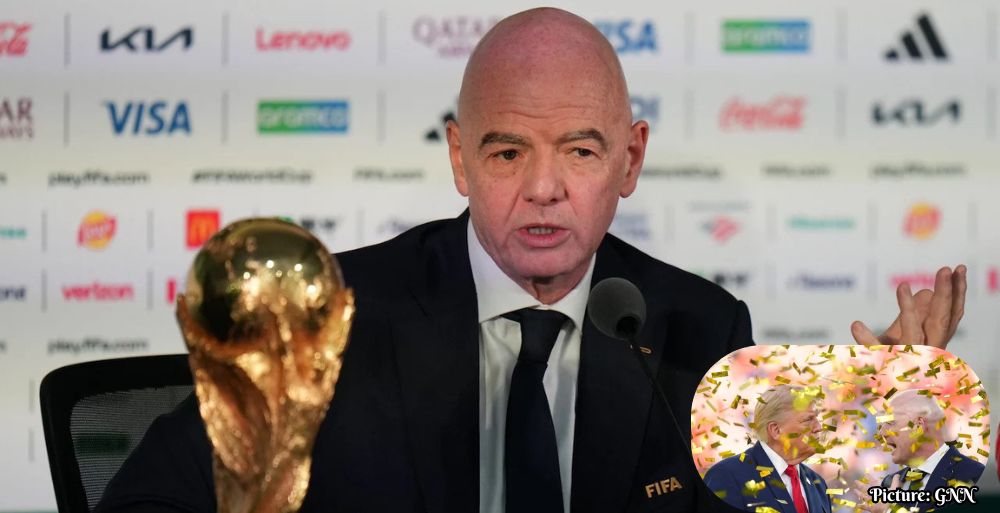
FIFA President Gianni Infantino has retracted a controversial proposal to invite private investment in World Cup operations, a decision influenced by significant backlash from various football associations as he approaches a crucial re-election.
Gianni Infantino, the president of FIFA, announced the withdrawal of a contentious proposal aimed at inviting external investments in the organization’s World Cup operations. This decision comes after intense opposition from key football associations, notably UEFA, Concacaf, and the Asian Football Confederation (AFC). Infantino’s leadership is now under scrutiny as he prepares for his re-election campaign for a fourth term at the FIFA Congress scheduled for March 2024.
On Thursday, UEFA, which represents 55 European member associations, voted overwhelmingly to boycott FIFA World Cups if the investment plan moved forward. This stance reflects deep concerns regarding the implications of such a financial strategy on the integrity and future of the sport. UEFA’s decision was echoed by Concacaf, which oversees football in North, Central America, and the Caribbean, and expressed that member associations within the confederation had ‘lost faith’ in Infantino’s leadership. Additionally, the AFC indicated its solidarity with UEFA and Concacaf, further complicating the political landscape surrounding FIFA.
Details of the Proposal
The proposal, which aimed to establish a commercial subsidiary named FIFA Forward Enterprise (FFE), intended to allow external investors to acquire minority stakes in FIFA’s operations and events. Infantino envisioned that this initiative could generate substantial revenue, with projections estimating a potential influx of around $10 billion (£7.5 billion). A comprehensive 25-page document prepared by investment bank JP Morgan outlined strategies to enhance revenue, suggesting that member associations could receive payouts of approximately 24 million euros (£20.5 million) during the 2035-2039 cycle. The document described the World Cup as the ‘most widely viewed’ sporting event, while labeling FIFA as ‘under-monetised,’ indicating a perceived urgency to attract investment.
However, the proposal faced immediate backlash. Kevin Lamour, FIFA’s chief operating officer, stated that the organization’s administration felt ‘deceived’ regarding the initiative, emphasizing that it appeared to be largely driven by Infantino himself. Reports suggest that Infantino did not adequately inform some of FIFA’s eight vice-presidents about the details of the proposal, leading to allegations of unilateral decision-making.
Resignations and Internal Dissent
The internal dissent reached a peak when Carlos Cordeiro, Infantino’s senior adviser on global strategy and governance, resigned in protest. Cordeiro characterized the proposal as a ‘bad deal for football’ and warned that it would ‘mortgage football’s future.’ He firmly rejected the notion that FIFA needed outside investors to unlock greater value and made it clear that he had no involvement in the proposal’s development. His resignation marks a significant moment in FIFA’s political landscape, indicating fractures within the organization’s leadership.
Political Repercussions and Future Implications
The backlash against Infantino’s proposal raises critical questions about his leadership and the future of FIFA. Prominent figures, including UK Prime Minister Andy Burnham, have publicly criticized Infantino, asserting that he is ‘the wrong man’ to lead the organization. As Infantino approaches the re-election process at FIFA’s 77th Congress in Morocco, the dynamics surrounding his candidacy have shifted dramatically. Candidates must declare their intentions by November 18, and prior to the backlash, Infantino was expected to be re-elected unopposed, with many associations already signaling their support.
In light of the recent developments, it remains uncertain whether this opposition will prompt a mass withdrawal of support for Infantino. His public commitment to bringing ‘all interested parties back together’ in the spirit of collaboration may be tested as tensions persist within FIFA. Infantino has reiterated that his plans aimed to strengthen member associations, particularly in regions where support is most needed, yet the proposal has undeniably created divisions within the organization.
Financial Management and Broader Concerns
The controversy surrounding the investment proposal has also brought attention to FIFA’s financial management practices. Critics argue that the organization is ‘under-monetised’ and has failed to capitalize on the World Cup’s status as a premier sporting event. Additionally, the lack of focus on women’s football within the investment discussions raises ongoing concerns about gender equity in the sport. The exclusion of women’s football from the financial strategy has sparked criticism from advocates who argue that it reflects a broader neglect of women’s participation in sports.
As Infantino navigates this tumultuous landscape, the implications for FIFA’s governance structure, financial strategies, and international relationships remain to be seen. The upcoming Congress will serve as a pivotal moment for both Infantino and FIFA, with the outcomes of the discussions likely to shape the organization’s future direction and leadership. With the current backlash and internal divisions, the road ahead for Infantino and FIFA appears fraught with challenges as they attempt to unify the global football community.