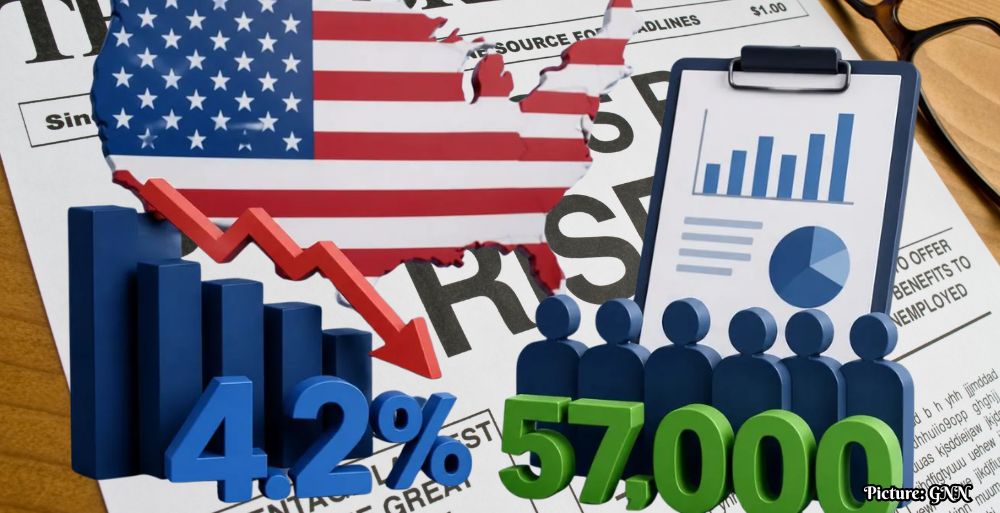
A wave of sobering economic indicators released over the past week has highlighted growing financial strain across American households, marked by a plummet in consumer confidence to its lowest level since 2014, mortgage rates surging to near three-year highs, and a sharp cooling in nonfarm payroll growth. Driven by five consecutive years of elevated inflation, sluggish real wage growth, and energy market volatility linked to the ongoing military conflict with Iran, public dissatisfaction with the economy is mounting. Despite modest gains in second-quarter Gross Domestic Product and a resilient equities market buoyed by artificial intelligence valuations, the combination of a 4.2% unemployment rate and persistent cost-of-living pressures poses a central political challenge for lawmakers heading into the upcoming midterm elections.
Consumer Sentiment Plunges Amid Inflationary Persistence
WASHINGTON — American consumer confidence collapsed this month to its lowest level in over a decade, according to data released Tuesday by The Conference Board, as prolonged inflation and geopolitical instability continued to erode household purchasing power. The organization’s benchmark Consumer Confidence Index tumbled 6.7 points in September to register at 81.9, down sharply from 88.6 in August.
The reading marks the most pessimistic consumer outlook recorded by the survey since April 2014, dropping below the lowest confidence metrics recorded during the height of the COVID-19 pandemic. The downturn was reflected across both current conditions and future expectations. The Present Situation Index fell 7.9 points to 109.3, while the Expectations Index—which measures consumers’ six-month outlook for income, business, and labor market conditions—slid 5.9 points to 63.6.
Qualitative feedback gathered during the survey window of September 1–23 revealed widespread frustration with elevated everyday expenses. Respondents routinely cited high retail gas prices, elevated grocery bills, and compounding service fees as primary sources of financial strain. With the midterm elections just weeks away, the sharp decline in economic morale underscores a fraught political landscape for President Donald Trump and congressional Republicans, who face voters increasingly dissatisfied with five straight years of elevated price levels.
Borrowing Costs Surge as 30-Year Mortgage Rates Hit 7.28%
Housing affordability worsened significantly this week as long-term borrowing costs reached levels not seen in nearly three years. Federal mortgage buyer Freddie Mac reported Thursday that the average rate on a 30-year fixed-rate mortgage jumped to 7.28%, up from 7.03% the previous week. This 25-basis-point increase represents the largest single-week increase in several years and marks the sixth consecutive weekly rate gain.
A year ago, the 30-year benchmark rate stood at 6.34%. The current average is the highest since November 22, 2023, when rates touched 7.29%. The rapid escalation in borrowing costs has effectively priced millions of prospective buyers out of the residential real estate market while locking existing homeowners into current properties.
Shorter-term residential loans experienced parallel increases. The average rate for a 15-year fixed-rate mortgage—frequently utilized by homeowners seeking to refinance existing debt—rose to 6.60%, up from 6.42% last week and 5.55% one year ago. The persistent upward trajectory in mortgage yields reflects ongoing volatility in the U.S. treasury bond market as investors weigh persistent fiscal deficits against Federal Reserve monetary policy targets.
Labor Market Softens as Payroll Gains Slow to 29,000
The U.S. labor market demonstrated notable signs of deceleration in September, with nonfarm payroll growth falling well short of economic forecasts. The Bureau of Labor Statistics reported Friday that employers added just 29,000 net new jobs last month, while the national unemployment rate rose slightly to 4.2%, up from 4.1% in August. Wall Street consensus estimates had anticipated the addition of approximately 90,000 jobs.
The monthly payroll figures were further weakened by downward revisions to prior data. The Labor Department shaved a combined 60,000 jobs off the initial estimates for July and August. In parallel, wage growth continued to moderate: average hourly earnings increased 3% year-over-year, representing the smallest annual wage gain since May 2021 and barely keeping pace with headline inflation metrics.
Complementary labor data from the Job Openings and Labor Turnover Survey (JOLTS) published Tuesday showed that job openings fell to 7.08 million in August from a revised 7.34 million in July—coming in below expectations of 7.2 million and touching the lowest total since March.
While gross hiring ticked up modestly and overall layoffs remained low, hiring velocity remains dramatically depressed compared to historic averages. Current monthly job creation figures sit far below the average 166,000 monthly jobs added in 2023 and 2024, and are a fraction of the 491,000 monthly additions recorded during the post-pandemic hiring surge of 2021–2022.
Moderating Inflation and Second-Quarter GDP Growth
Despite broader economic anxiety, macro-level indicators offered mixed signals regarding underlying stability. The Commerce Department reported Wednesday that the Consumer Price Index (CPI) rose 3.4% year-over-year in August, coming in below the consensus estimate of 3.7%. On a month-over-month basis, prices ticked up 0.3%, rising from the 0.1% monthly clip recorded in July.
Core CPI—which excludes volatile food and energy components—rose 3.0% year-over-year in August and 0.2% month-over-month. The relative stability of core inflation alleviated fears of an immediate inflationary reacceleration, even as raw energy costs remained volatile due to the conflict in the Middle East.
Simultaneously, the Commerce Department updated its official estimate for second-quarter Gross Domestic Product (GDP), reporting that the U.S. economy expanded at a solid 2.2% annualized pace between April and June. The figure was an upward revision from the initial 1.5% estimate, driven primarily by robust business investment and a 3.8% annual surge in consumer spending—up from a sluggish 0.7% in the first quarter.
Financial Markets Stabilize as Rate Expectations Shift
Financial markets responded to the complex data landscape with a notable rally in equities late in the week. The softer-than-expected September payroll report mitigated concerns among bond investors that an overly hot economy would force the Federal Reserve to implement additional interest rate hikes at its upcoming Federal Open Market Committee meeting.
As U.S. Treasury yields eased following the jobs announcement, major stock indexes advanced toward historic highs. The S&P 500 gained ground to close within 0.8% of its all-time high set in August, while the Dow Jones Industrial Average and Nasdaq Composite both logged positive sessions. Market analysts noted that equity valuations have continued to draw strength from sustained capital investments in artificial intelligence and technology infrastructure, creating a distinct divergence between asset market valuations and lower-income consumer sentiment.