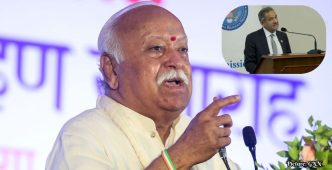
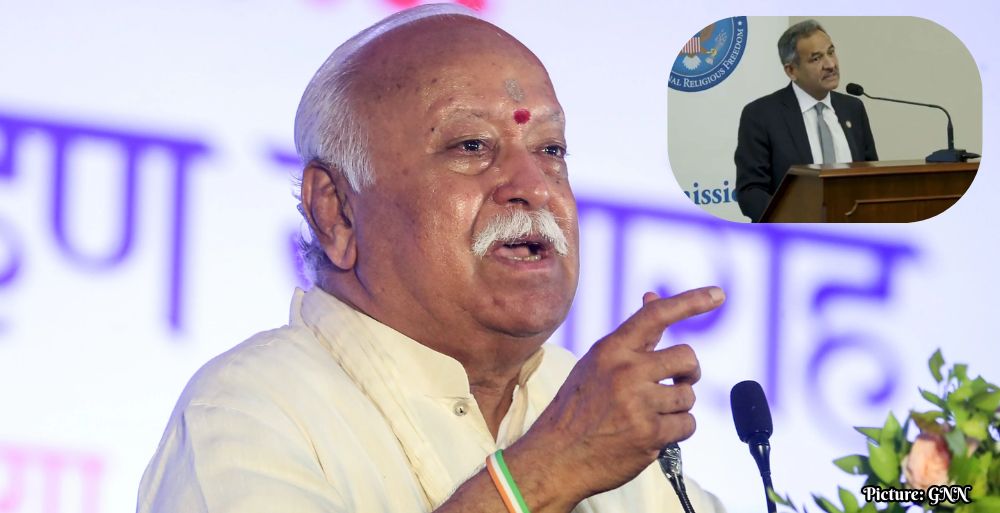
Ahead of Rashtriya Swayamsevak Sangh (RSS) chief Mohan Bhagwat’s international tour, the U.S. Commission on International Religious Freedom (USCIRF) has urged against high-level diplomatic meetings and called for sanctions against the organization.
Washington, DC [US], August 20, 2023 – The United States Commission on International Religious Freedom (USCIRF) has once again drawn attention to its controversial stance by advocating for sanctions against the Rashtriya Swayamsevak Sangh (RSS). This recommendation coincides with the upcoming visit of RSS chief Mohan Bhagwat to the United States, Canada, and the United Kingdom, scheduled to commence on August 25, 2023. The USCIRF has urged the U.S. government to avoid extending diplomatic courtesies or holding high-level meetings with leaders of the RSS, which has been under scrutiny for its alleged role in religious discrimination in India.
Bhagwat’s visit marks a significant milestone as it aligns with the RSS’s centenary celebrations, a period during which the organization aims to engage with the Indian diaspora and local community organizations in the host countries. The invitation for Bhagwat’s international engagements has been extended by various Indian community groups, underlining the RSS’s intent to strengthen ties with its members abroad. While the specifics of his itinerary have yet to be disclosed, the significance of this visit is compounded by the RSS’s deep-rooted influence on Indian society and politics.
In a statement shared via the social media platform X, RSS Prachar Pramukh Sunil Ambekar confirmed the details of Bhagwat’s travel plans: “Rashtriya Swayamsevak Sangh’s (RSS) Sarsanghachalak (Chief) Dr. Mohan Bhagwat will be visiting the USA, Canada, and the UK from August 25, 2023, on the invitation from overseas local associations and organisations. This coincides with the occasion of the ongoing Centenary year of RSS.”
USCIRF’s Concerns Over Religious Freedom
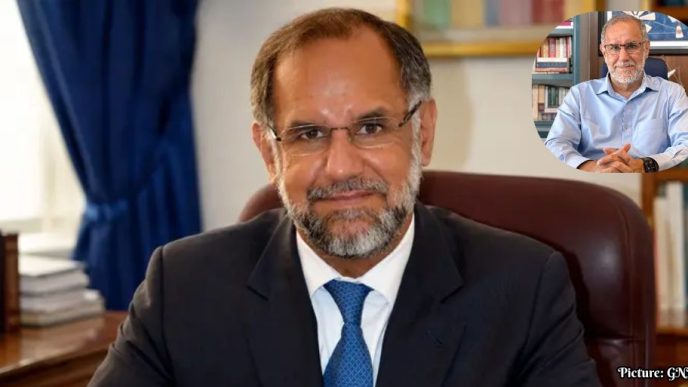
The USCIRF’s call for sanctions and its critical stance towards the RSS were further elaborated by Commissioner Gene Mills. In a recent post on X, Mills highlighted comments made by USCIRF Chair Asif Mahmood, noting that Indian Prime Minister Narendra Modi is a member of the RSS, which has been linked to a series of violent incidents targeting religious minorities, including Christians and Muslims. Mills stated, “India’s PM Modi is a member of the Rashtriya Swayamsevak Sangh (RSS), an Indian umbrella organization whose sub-groups have perpetrated attacks on religious minorities, incl. Christians & Muslims. Now the RSS leader, Mohan Bhagwat, plans to visit the US.”
Mills further emphasized that RSS leaders should not be granted high-level diplomatic meetings, suggesting instead that the U.S. government should impose sanctions on RSS members found responsible for violations of religious freedom. He asserted, “RSS leaders, even when affiliated with the Indian government, should not be honored with high-level meetings or diplomatic courtesies. Instead, the USG should focus on imposing sanctions on RSS members found responsible for FoRB violations.” This statement encapsulates the USCIRF’s ongoing concern regarding the treatment of religious minorities in India, a theme that has gained traction in international discourse.
Historical Context and Diplomatic Tensions
The USCIRF’s recent comments come in the wake of its annual report released in March 2023, which criticized India for its alleged violations of religious freedom. The report suggested targeted sanctions against various individuals and organizations, including the RSS and the Research and Analysis Wing (RAW), India’s external intelligence agency. The Indian government has firmly rejected these allegations, describing the USCIRF’s assessments as distorted and based on unreliable sources.
In a statement issued on March 16, 2023, Indian External Affairs Ministry spokesman Randhir Jaiswal condemned the USCIRF’s focus on India, urging the commission to redirect its attention to what he characterized as “selective criticism.” Jaiswal pointed out the need for the USCIRF to acknowledge “disturbing incidents of vandalism and attacks on Hindu temples in the US, selective targeting of India, and growing intolerance and intimidation of members of the Indian diaspora in the US, which merit serious attention.” This exchange underscores the ongoing diplomatic tensions between the USCIRF and the Indian government, particularly regarding issues of religious freedom and the treatment of minority communities.
Implications of Bhagwat’s Visit
As Bhagwat’s visit approaches, the discourse surrounding U.S.-India relations and the USCIRF’s stance on religious freedom is likely to intensify. The dynamics between the U.S. policy towards India and the recommendations put forth by the USCIRF will be under scrutiny from both policymakers and observers. With the RSS celebrating its centenary, the implications of Bhagwat’s visit extend beyond immediate diplomatic interactions; they raise fundamental questions about the role of the RSS in shaping contemporary Indian society and its impact on the perception of India in the international arena.
The RSS, established in 1925, has played a pivotal role in Indian politics and cultural identity, advocating for a Hindu nationalist perspective. Critics argue that its ideology fosters division and intolerance, particularly towards religious minorities. Conversely, supporters assert that the RSS is a cultural organization focused on national pride and unity. Bhagwat’s visit serves as a litmus test for how these divergent narratives are perceived internationally and how they will influence India’s bilateral relationship with the United States.
In conclusion, the upcoming visit of Mohan Bhagwat is poised to be a significant event, not only for the RSS but also for the broader context of U.S.-India relations. The interplay between the USCIRF’s recommendations, India’s response, and the international community’s views on religious freedom will likely shape future diplomatic engagements and the narrative surrounding religious tolerance in India.