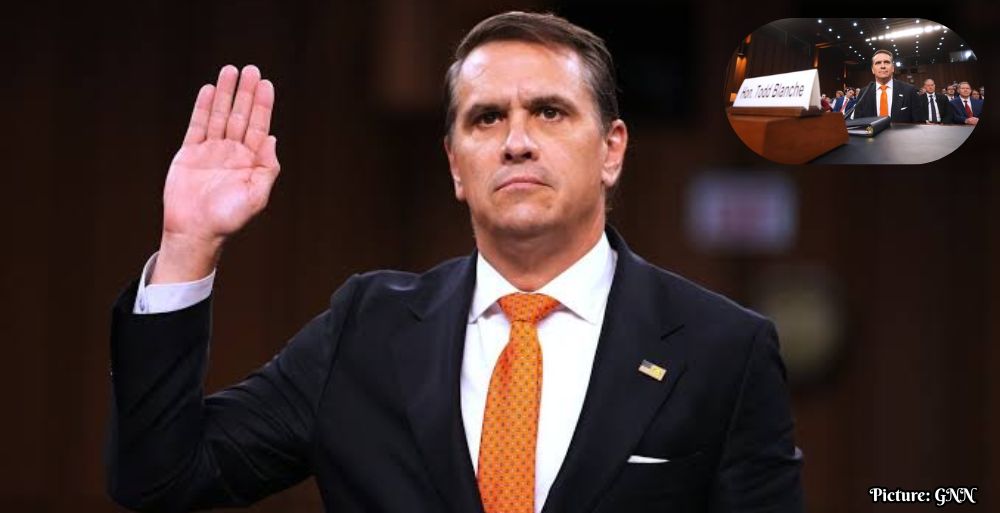
In a strategic move to secure his confirmation as attorney general, Todd Blanche has rescinded a contentious $1.8 billion fund intended for compensating political allies of President Donald Trump. However, a significant audit immunity agreement shielding Trump and his family from scrutiny regarding back taxes remains in effect, raising concerns from both sides of the political aisle.
WASHINGTON (AP) — Todd Blanche, in an effort to ease his confirmation process as attorney general, has officially rescinded a contentious $1.8 billion fund designed to compensate political allies of President Donald Trump. However, a substantial audit immunity plan, part of a settlement relating to Trump’s $10 billion lawsuit against the IRS, continues to persist, albeit with modifications aimed at addressing concerns from Republican senators.
On Sunday, in a communication directed at GOP senators, Blanche clarified that the audit immunity would not extend to future tax filings. Instead, it would apply retroactively to claims that were active at the time of the lawsuit’s settlement. This change is anticipated to assuage the worries of Republican lawmakers, thereby smoothing the path for Blanche’s confirmation.
Background on the Audit Immunity Agreement
The audit immunity arrangement was established as part of a controversial settlement intended to address Trump’s lawsuit against the IRS, which was prompted by the unauthorized disclosure of his tax returns. The initial terms of the agreement sparked bipartisan outrage, primarily due to the proposed $1.8 billion “anti-weaponization fund.”
According to the original agreement, as documented in a one-page outline signed by Blanche, the United States government would be “forever barred and precluded” from examining or prosecuting Trump, his sons, and the Trump Organization regarding their current tax filings, as well as any affiliated individuals. The revised terms communicated to Senators John Cornyn and Thom Tillis limit the audit immunity to Trump, his sons Eric Trump and Donald Trump Jr., and the Trump Organization, effectively narrowing the scope of those protected.
While the exact amount Trump owes in back taxes remains unclear, previous investigations by The New York Times and ProPublica suggested that the total could exceed $100 million. The implications of the audit immunity agreement have raised significant questions regarding its legality and ethicality, particularly in light of IRS regulations.
Legal and Ethical Implications
Critics, including legal experts, have raised concerns about the legality of the audit immunity protections. Dan Greenberg, a senior legal fellow at the Cato Institute, expressed that while it is positive Blanche confirmed the termination of the anti-weaponization fund, the tax immunity for Trump and his family remains troubling. Greenberg characterized the immunity deal as “the product of an illegal settlement.”
In July, U.S. District Judge Kathleen Williams ruled that Trump’s lawsuit against the IRS was filed for an “improper purpose.” While the judge did not invalidate the immunity deal, she indicated that the government could not assert that the agreement resulted from legitimate legal proceedings. Trump has since appealed this ruling, and its future implications remain uncertain.
Despite Blanche’s assurances to GOP lawmakers that the Trump administration is not pursuing the compensation fund, Trump has publicly indicated his intention to revive the fund if Blanche’s confirmation does not proceed. In a post on his Truth Social platform, Trump stated, “It will immediately be back on the table, and I will get it done.”
Concerns Over Future Administration Actions
Legal and tax experts express skepticism regarding the finality of the fund’s rescission. Brandon DeBot, policy director at the NYU Tax Law Center, emphasized the necessity for congressional action to ensure that the fund cannot be reinstated. DeBot argued that Blanche’s order does not sufficiently prevent the administration from potentially resuming plans for the fund post-confirmation.
Democratic lawmakers have echoed similar concerns, asserting that Blanche’s assurances do not guarantee that the administration cannot compensate Trump allies through existing avenues. This includes a previously established process allowing individuals who believe they were wronged by the government to file claims for damages, which could theoretically include those involved in the January 6, 2021, Capitol insurrection.
Greenberg commented on the overall situation, suggesting that while Blanche’s assurances may serve as a strategic maneuver for senators to demonstrate their negotiating power, the reality of the arrangement reveals a lack of substantial concessions. The complexities and implications of this situation continue to resonate within the political landscape, raising pressing questions about the integrity of tax enforcement and the protections afforded to individuals in positions of power.
Broader Implications for Tax Policy
The ongoing developments surrounding the audit immunity agreement and the anti-weaponization fund highlight significant tensions within the U.S. tax system. The legal framework governing taxpayer audits was strengthened in the wake of the Watergate scandal, when the misuse of the IRS for political purposes became a national concern. This historical context underscores the importance of maintaining strict boundaries between governmental authority and taxpayer rights.
Nina Olson, founder of the Center for Taxpayer Rights, characterized the settlement as “the lowest point for the IRS since the 1970s,” reflecting deep concerns about the erosion of trust in the agency’s ability to operate without political interference. The implications of these developments extend beyond Trump, potentially affecting public perception of the IRS and its enforcement capabilities in the future.
As the political landscape evolves, the interplay between tax policy, legal accountability, and political maneuvering remains a critical focus for lawmakers and the public alike. The ongoing scrutiny faced by Todd Blanche as he seeks confirmation as attorney general serves as a reminder of the enduring complexities surrounding governance and the rule of law in America.