Spain’s success at the World Cup has sparked discussions on the critical role of midfield strength in international soccer, as they triumphed without traditional star players in key positions.
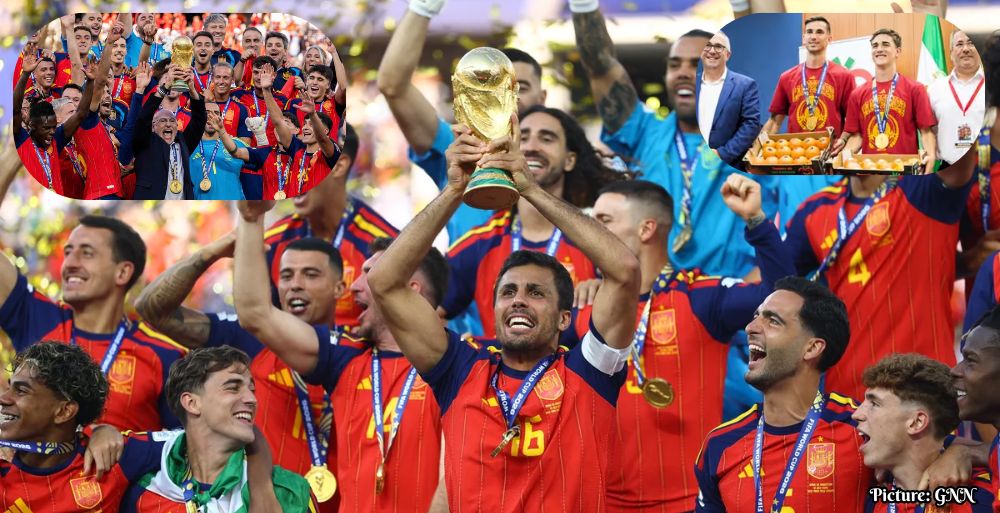
In a stunning conclusion to the 2026 FIFA World Cup held on July 23, 2026, in East Rutherford, New Jersey, Spain emerged victorious over Argentina, further solidifying its status as a dominant force in international soccer. This win has ignited a debate among analysts and fans alike about Spain’s unique composition, which lacked marquee goal scorers and elite defenders, yet resulted in a historically significant achievement.
Spain’s performance throughout the tournament has raised questions about the characteristics that define a successful team in modern soccer. Despite not having the most renowned players on their roster, Spain captured its second World Cup title by employing a cohesive midfield strategy that outmatched their opponents. The team has not lost a match since March 2024, marking the longest unbeaten streak in men’s international soccer history, as reflected by Elo ratings, which indicate Spain as the highest-rated team historically.
Strategic Midfield Dominance
Spain’s road to victory included a crucial semifinal match against France, the tournament favorites, who boasted some of the world’s top attacking talent. However, Spain’s tactical approach effectively neutralized France’s offense, allowing only ten shots without conceding any goals. In the final against Argentina, the defending champions led by Lionel Messi, Spain once again showcased its ability to control the game, limiting Argentina’s chances and emerging victorious.
Interestingly, many of Spain’s key players do not fit the mold of traditional superstars. For instance, Pedro Porro and Marc Cucurella, Spain’s starting fullbacks, played for Tottenham and Chelsea during a challenging season. Similarly, senior center back Aymeric Laporte had transferred to the Saudi Pro League, while Pau Cubarsí, named the tournament’s best young player, remains a developing talent at Barcelona. In attack, Álex Baena had minimal playing time with Atlético Madrid, and Mikel Oyarzabal had not scored double-digit non-penalty goals in La Liga for eight years.
The Rodri Theory
The success of Spain at the World Cup can be attributed to what some analysts are calling the ‘Rodri Theory.’ Named after the tournament’s Golden Ball winner, this theory posits that the team with the strongest midfield often prevails in international soccer. This assertion is supported by the observation that midfield play has become increasingly vital as the pace of international matches has slowed, allowing these players to exert greater influence over both offensive and defensive play.
Despite the perception that midfield is a less critical area in club soccer, where investments tend to favor attackers and defenders, the dynamics shift at the international level. The slower pace of play allows midfielders to dictate the tempo and create scoring opportunities. This trend has been evident in past World Cup winners, including Italy in 2006, Spain in 2010, Germany in 2014, France in 2018, and Argentina in 2022, all of which featured formidable midfields that played a pivotal role in their success.
Analyzing Historical Trends
Historically, World Cup-winning teams have boasted strong midfielders who excel in both attacking and defensive roles. Italy’s victory in 2006 was anchored by a robust midfield, with players like Andrea Pirlo and Gennaro Gattuso leading the charge. Similarly, Spain’s triumph in 2010 came from the legendary midfield trio of Xavi, Andrés Iniesta, and Sergio Busquets.
Recent champions have also demonstrated this trend. France’s midfield in 2018, featuring N’Golo Kanté and Paul Pogba, was instrumental in their success, while Argentina’s midfield in 2022 provided the necessary support for Messi to flourish. Spain’s midfield in 2026 continued this pattern, with Rodri, Fabián Ruiz, and Dani Olmo dominating the center of the pitch, effectively controlling the flow of the game.
Future Implications
As fans and analysts look ahead to the 2030 World Cup, the implications of Spain’s victory are likely to influence how teams approach the tournament. The emphasis on a strong midfield may lead future squads to prioritize developing midfield talent over acquiring high-profile attackers. This strategy could reshape recruitment policies at clubs and national teams alike, as the focus shifts toward building cohesive units capable of executing complex strategies.
Spain’s triumph at the 2026 World Cup serves as a reminder that success in international soccer often hinges on tactical acumen and teamwork rather than individual brilliance. As the landscape of soccer continues to evolve, the lessons learned from this tournament may reverberate for years to come, potentially redefining what it means to be a champion in the world of soccer.