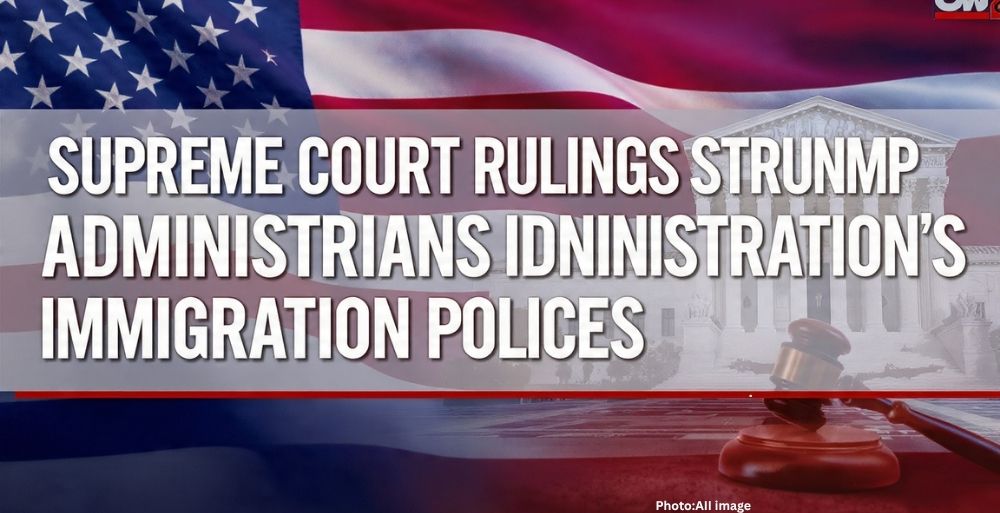
The Supreme Court’s recent decisions support the Trump administration’s immigration policies by allowing the termination of temporary legal protections for certain populations and reviving a controversial asylum policy.
On Thursday, the Supreme Court delivered two significant rulings that bolster the Trump administration’s approach to immigration, affirming its authority to terminate temporary legal protections for thousands of Haitians and Syrians while also reviving a contentious policy regarding asylum seekers known as ‘metering.’ These decisions come amidst ongoing debates about immigration practices in the United States and are seen as a substantial shift in the legal landscape governing the treatment of migrants.
The rulings were issued with a 6-3 majority in both cases, highlighting a clear ideological divide among the justices. The implications of these decisions are profound, affecting not only the individuals directly involved but also the broader discourse on immigration policy in the United States.
Termination of Temporary Protected Status
The first ruling addresses the administration’s decision to remove Haiti and Syria from the list of countries eligible for Temporary Protected Status (TPS). Established to provide deportation protection and work authorization to individuals from designated countries experiencing conflict or natural disasters, TPS has been a critical safety net for many vulnerable populations. The Supreme Court’s decision affirms the administration’s authority to make such removals, which the White House views as a victory.
White House spokesperson Abigail Jackson characterized the ruling as a ‘tremendous win’ for the Trump administration, asserting that it aligns with President Trump’s long-held belief that TPS is inherently temporary. “Today, the Supreme Court affirmed what President Trump has always maintained: temporary protected status is, by definition, temporary,” she stated. Jackson emphasized that TPS was never intended to serve as a pathway to permanent residency, and underscored the administration’s commitment to addressing what it perceives as abuses within the immigration system that negatively impact American citizens.
Republican Senator Tom Cotton of Arkansas praised the court’s ruling on the TPS case, framing it as a triumph for ‘common sense and our national sovereignty.’ He argued that TPS should not function as a means for individuals to secure permanent residency through what he described as an ‘abuse’ of taxpayer dollars.
Criticism from Democratic Leaders
In stark contrast to the administration’s praise, Democratic leaders quickly condemned the court’s ruling regarding TPS. Senate Minority Leader Chuck Schumer of New York decried the decision as ‘cruel and inhumane,’ arguing that it disregards the ongoing dangers faced by thousands of Haitians and Syrians. Schumer asserted that TPS exists precisely to protect individuals from returning to unsafe conditions, stating, ‘Haiti and Syria remain unsafe today. Instead of showing basic humanity, Donald Trump and this Court have chosen fear, chaos, and cruelty.’
This divide reflects broader tensions in U.S. immigration policy debates, particularly regarding the treatment of vulnerable populations and the legal protections afforded to them. Critics argue that the loss of TPS for these individuals could lead to significant humanitarian consequences, as many could face deportation to countries still grappling with instability and violence.
Revival of Metering Policy
The second ruling allows the Trump administration to reinstate ‘metering,’ a policy that permits border officials to limit the number of asylum seekers allowed to present their claims at the U.S.-Mexico border each day. This practice, initially implemented during the Obama administration and later rescinded, has drawn criticism from human rights advocates who argue that it effectively denies migrants the opportunity to seek asylum—a right protected under U.S. and international law.
Justice Sonia Sotomayor voiced her dissent from the bench, expressing grave concerns about the implications of the ruling. She warned that the revival of metering would likely result in ‘more people will die’ due to the increased barriers to asylum access. This poignant remark elicited a rare response from Justice Samuel Alito, who noted that he would have elaborated further in his opinion had he anticipated the nature of Sotomayor’s comments.
Jackson reiterated the administration’s commitment to reforming the immigration system, stating, “President Trump remains committed to lawfully restoring integrity to our immigration system, which includes tackling the egregious abuses to our asylum system that the prior administration encouraged. We will always put the American people first.”
Implications Going Forward
The Supreme Court’s rulings represent a significant shift in immigration policy that could impact thousands of individuals currently residing in the United States under TPS. Legal experts and advocates predict that the termination of TPS will lead to increased deportations and further exacerbate the challenges faced by individuals from Haiti and Syria. As the Trump administration moves to implement these rulings, the political ramifications are likely to ripple through the upcoming elections and influence public opinion on immigration reform.
As legal challenges to immigration policy continue to unfold, the administration’s ability to execute its agenda may shape the national conversation on immigration, particularly in the context of humanitarian responsibilities. The decisions underscore the contentious nature of immigration policy in the United States, a topic that remains deeply divisive among the American public and lawmakers.
Looking ahead, both supporters and critics of these rulings are expected to mobilize their bases, as the implications of the Supreme Court’s decisions become clearer. The rulings may also prompt further legislative efforts to address immigration reform, as both parties seek to clarify their positions on these critical issues in the lead-up to future elections.