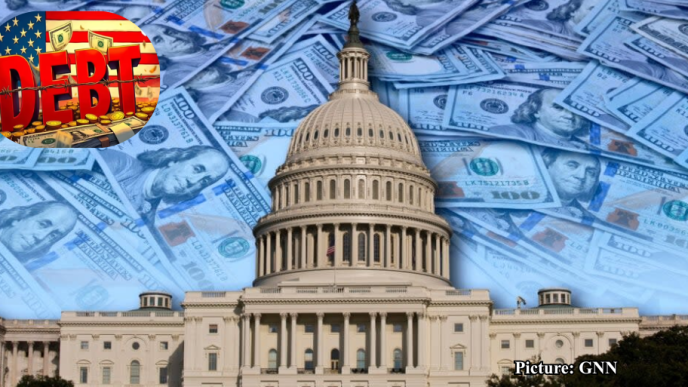
Interest payments on the U.S. national debt are projected to exceed $1 trillion in 2026, igniting concerns among economists and policymakers about the nation’s geopolitical stability and economic future.
As of April 2026, interest payments on the United States’ national debt are anticipated to surpass $1 trillion, translating to approximately $88 billion per month. This figure is notable as it equals the combined spending on defense and education, raising alarms regarding the sustainability of the nation’s fiscal policies and their implications for national security.
This alarming trend is not entirely unprecedented; there have been historical instances where debt service payments eclipsed military spending, particularly during the post-World War I era in the 1920s. However, those periods were generally brief and did not occur in the context of a fully established advanced economy like the current U.S. situation. In 2024, under President Joe Biden’s administration, the U.S. Treasury crossed this threshold for the first time in recent memory, marking a sustained period where interest payments on the national debt have outstripped military expenditures.
Historical Context and Economic Implications
Both major political parties, Republicans and Democrats, have significantly contributed to the growing national debt, which has reached alarming levels in recent years. With former President Donald Trump returning to the Oval Office, the onus now lies on him to address this escalating crisis. The implications of exceeding what economic historian Sir Niall Ferguson has dubbed ‘Ferguson’s Law’ are significant. Ferguson’s Law posits that any great power that spends more on debt servicing than on defense risks losing its status as a great power. This relationship between national debt and military capability has been a longstanding concern among economists and historians alike.
Ferguson articulates that a high debt burden diverts scarce resources from essential national security expenditures, thereby increasing vulnerability to military challenges. The historical ramifications are evident in the cases of the Spanish Empire in the 16th century and Bourbon France in the late 18th century. In both instances, an over-reliance on debt financing ultimately led to a decline in their geopolitical influence, contributing to significant national upheaval.
Contemporary Warnings from Economic Leaders
Amid these concerns, prominent economic figures are voicing alarm over the potential consequences of this fiscal trajectory. Ray Dalio, founder of Bridgewater Associates, has warned of a looming ‘economic heart attack,’ where rising debt-service payments crowd out vital public investments. Jamie Dimon, CEO of JPMorgan Chase, has echoed these concerns, highlighting the risk of an impending market ‘reckoning’ should policymakers fail to take corrective measures. Even Federal Reserve Chair Jerome Powell has called for an ‘adult conversation’ regarding the nation’s deficit levels and fiscal health.
Despite the grim outlook, Ferguson offers some historical context that could provide a glimmer of hope. He notes that even nations that have violated Ferguson’s Law—such as Great Britain—did not necessarily experience a decline in geopolitical standing. Britain’s ability to access lower borrowing costs during various historical periods has allowed it to navigate challenges without significant detriment to its global position. Ferguson suggests that the U.S. might still have options to avert a decline.
Potential Solutions and Future Outlook
The Committee for a Responsible Federal Budget recently reported that if interest rates were to rise by just 1 percentage point, it would add an additional $3.5 trillion to the national debt over projections. Such a scenario underscores the precarious nature of current fiscal policies and the urgent need for reform. Ferguson posits that unless the United States undertakes radical reforms—especially concerning its principal entitlement programs—the only viable path to maintaining its status as a great power may hinge on a ‘productivity miracle.’
Interestingly, Ferguson points to the emerging potential of artificial intelligence (AI) as a possible catalyst for such a productivity boost. Both Wall Street and Fed chairman nominee Kevin Warsh are reportedly betting on AI’s transformative capabilities to alleviate some of the economic pressures currently faced by the U.S. economy. As Ferguson notes, ‘the real contest of the second quarter of the 21st century may be between artificial intelligence—and history.’
The Path Forward
Looking ahead, the trajectory of U.S. national debt and its implications for military spending raises critical questions about the country’s future as a global power. Policymakers now face pressing challenges in addressing these fiscal imbalances. The effectiveness of proposed solutions will be closely scrutinized in the coming years, particularly as the U.S. navigates a complex international landscape marked by rising geopolitical tensions.
The potential for economic stagnation or decline looms large, particularly if interest payments continue to rise unchecked. Experts caution that if the U.S. does not strategically manage its fiscal policy, it may find itself at a disadvantage compared to strategic rivals who are not similarly burdened by excessive debt. The stakes are high, as the balance between maintaining national security and managing fiscal responsibility becomes increasingly difficult.
In conclusion, the current state of U.S. debt and the implications for military spending and national security highlight a critical juncture for the nation. The need for a comprehensive approach to fiscal policy reform is urgent, as failure to address these challenges could undermine America’s standing as a global leader. The path forward must involve not only immediate measures to stabilize the economy but also long-term strategies that prioritize both national security and economic growth.