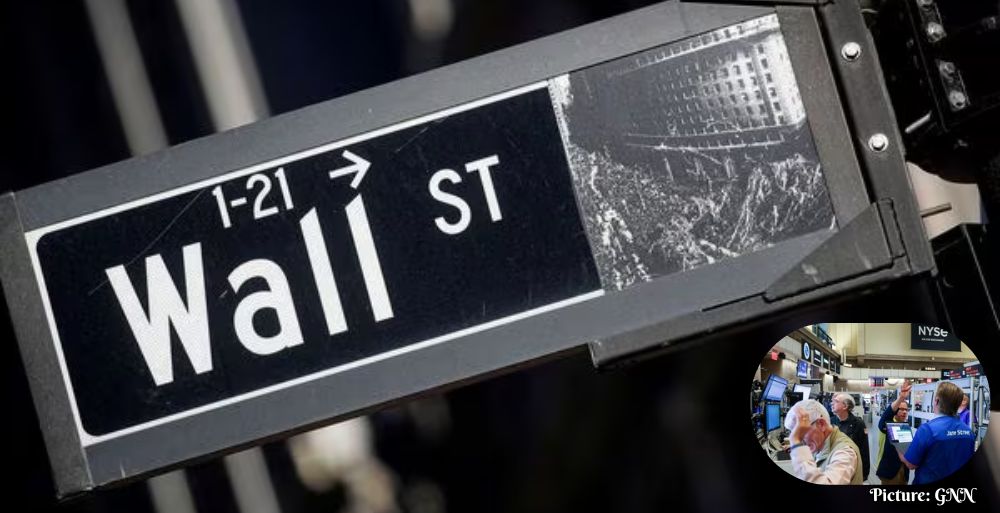
Wall Street experienced a steep sell-off on Wednesday after the Federal Reserve voted 9–3 to keep the benchmark interest rate target steady at 3.50% to 3.75%, defying the three dissenting policymakers who pushed for an immediate rate increase to combat ongoing inflation. Investor sentiment was further dampened by growing anxieties over the immense capital expenditures required for artificial intelligence development, highlighted by Meta Platforms revising its 2026 spending outlook upward to as much as $145 billion. The tech-heavy Nasdaq 100 index fell 2.1%, bringing its cumulative drop to 11% from its June record peak as markets reevaluated whether massive AI infrastructure investments will yield near-term cash flow. Despite strong projected second-quarter earnings growth across the broader S&P 500, major indices across the board ended significantly lower while heavy trading volume reflected widespread portfolio rebalancing. With global oil prices surging and disinflation progress stalling above the central bank’s target, market analysts now expect mounting pressure on the Fed to enact a rate hike at its upcoming September policy meeting.
WASHINGTON — Major U.S. stock indices closed sharply lower on Wednesday after the Federal Reserve elected to maintain its benchmark interest rate target at 3.50% to 3.75%, marking the fifth consecutive meeting without a rate adjustment as central bankers wrestle with persistent inflationary headwinds. The policy decision was marked by significant internal disagreement, with three Federal Open Market Committee members dissenting in favor of an immediate rate hike amid rising geopolitical energy shocks and elevated corporate capital spending. Financial markets reacted with broad-based declines, driven by mounting investor skepticism regarding heavy capital expenditures in artificial intelligence infrastructure, shifting rate expectation timelines, and broader macroeconomic uncertainty.
Federal Reserve Division and Inflationary Dynamics
WASHINGTON — The Federal Reserve’s Federal Open Market Committee (FOMC) concluded its two-day policy review on Wednesday by keeping the federal funds target rate unchanged in the 3.50% to 3.75% range. While the outcome was broadly anticipated by financial markets, the vote underscored a deepening divide among monetary authorities over how forcefully to address inflation that has remained above the central bank’s 2% annual target for more than five years.
The 9–3 decision featured formal dissents from Cleveland Fed President Beth Hammack, Minneapolis Fed President Neel Kashkari, and Dallas Fed President Lorie Logan, all of whom advocated for a 25-basis-point interest rate increase. The three officials expressed concern that price pressures are stalling well above preferred levels, fueled by energy price volatility tied to ongoing conflict in the Middle East, foreign trade tariffs, and massive private-sector demand for data center capacity and power infrastructure.
Speaking during a post-meeting press conference at the Federal Reserve building in Washington, Fed Chair Kevin Warsh addressed reporters with a deliberate, calm tone, standing firm on the central bank’s singular focus despite market volatility. He emphasized that the central bank retains no implicit tolerance for elevated price indexes.
“For some households, businesses, and market professionals, five years of high inflation have left a mistaken impression that is hard to shake: that the Fed’s implicit inflation target was somehow above 2 percent,” Warsh said, looking directly across the quiet briefing room. “Let me reiterate: There is no soft inflation target, there is no soft implicit target — not on this Committee’s watch. There is only a target, and it is 2 percent. Not one of my FOMC colleagues is under any illusion.”
Warsh added that corporate investment in technology and artificial intelligence is laying critical groundwork for future economic productivity, though he acknowledged that rapid capital accumulation presents unique analytical challenges for monetary policy.
“The Fed held pat, as expected. The bigger question now though becomes, how much pressure will they have to hike in September?” noted Ryan Detrick, chief market strategist at Carson Group. “Inflation is running hot and with surging crude oil, the market expects the next hike to indeed be in September.”
Broad Equity Market Decliners and Index Performance
Equities posted substantial losses across all three major market benchmarks following the policy statement and subsequent press briefing. The benchmark S&P 500 index dropped 1.52%, or 112.80 points, to close at 7,316.15 points, marking its lowest closing level in a month. The Dow Jones Industrial Average slid 2.19% to finish at 51,594.14 points, while the tech-heavy Nasdaq Composite Index declined 1.74% to end at 24,442.94 points.
Market breadth was decisively negative across Wall Street. Within the S&P 500, declining issues outpaced advancing ones by a 1.8-to-1 ratio. Eight of the 11 primary S&P 500 sector groups posted negative returns, led by a 3.24% fall in industrial equities and a 2.50% drop in information technology stocks. Across the S&P 500, 32 securities touched new 52-week highs while four registered new lows; on the Nasdaq, 121 stocks recorded new highs against 230 establishing new lows.
Trading activity was robust across domestic trading venues. Total volume reached 17.7 billion shares, exceeding the 20-day moving average of 17.3 billion shares, reflecting heightened institutional portfolio realignments following the rate decision.
Technology Sector Retrenchment and AI Capital Spending
A primary driver of Wednesday’s downward market pressure was a pronounced retrenchment in artificial intelligence and semiconductor equities. The Nasdaq 100 index—comprising the 100 largest non-financial enterprises listed on the exchange—fell 2.1% during regular session hours. The index has now retreated approximately 11% from its record high established in June, entering formal correction territory.
Investors have shown growing concern regarding the escalating capital expenditure plans of major technology entities. Market participants are questioning whether the hundreds of billions of dollars channeled into AI chips, server architecture, and energy supply arrangements will generate near-term free cash flow commensurate with valuation multiples.
Those anxieties played out explicitly in extended trading session activity. Shares of Meta Platforms fell 4% after the social media giant revised its full-year 2026 capital expenditure guidance upward to a range of $130 billion to $145 billion, compared to its prior projection of $125 billion to $145 billion. Conversely, Microsoft shares edged up 0.6% in post-market trading after reporting quarterly cloud infrastructure revenue growth that topped analyst projections, providing a counter-example of monetization progress.
“Investors worry that major U.S. companies are deepening a web of AI-linked investments and continuing to funnel billions into the emerging technology at the expense of free cash flow,” observed market equity analysts following the releases.
International hardware suppliers also fed into the cautious trading environment. South Korean semiconductor manufacturer SK Hynix saw its shares fall 10% overseas despite reporting a sixfold increase in quarterly net profit, as the results failed to satisfy high market expectations. Domestic infrastructure supplier Vertiv Holdings plunged 17% after missing Wall Street’s second-quarter revenue forecasts.
Corporate Earnings Divergence and Historical Context
Despite the day’s broad equity declines, broader corporate earnings fundamentals remain relatively robust. Analysts surveyed by LSEG I/B/E/S anticipate aggregate second-quarter earnings for S&P 500 companies to expand by 40% year-over-year, with hardware, cloud compute, and AI-adjacent enterprises accounting for the vast majority of that growth. Following recent pullbacks, the S&P 500 is trading at approximately 20 times forward earnings expectations, slightly above its 10-year historical average of 19 times.
Selected corporate earnings reports outside the technology sector highlighted divergent fundamental conditions across consumer and manufacturing lines:
- Ford Motor Co. gained 2.1% after management raised its full-year profit outlook for the second time this calendar year, citing durable demand for commercial fleet vehicles and hybrid powertrains.
- Visa Inc. rose 0.6% after exceeding consensus earnings targets, supported by strong international transaction volumes linked to global soccer tournament travel demand.
- Lennox International Inc. tumbled 21% after the heating, ventilation, and air conditioning equipment manufacturer revised its annual profit forecast downward due to residential construction headwinds.
Macroeconomic conditions continue to be heavily influenced by external cost shocks and historical rate tightening cycles. After peaking near 9% in mid-2022, inflation moderated following 11 rate increases executed by the Federal Reserve through late 2023. However, disinflation progress has stalled in 2026 as global energy price spikes tied to Middle Eastern geopolitical instability pass through to consumer transport and logistics channels.
As financial markets look toward late summer, traders are assigning an increased probability to policy action at the Fed’s next scheduled meeting on September 15–16. Prior to that session, market analysts will scrutinize Chair Warsh’s scheduled keynote address at the annual Jackson Hole Economic Symposium in late August for further indicators regarding the central bank’s rate trajectory and balance sheet policy.