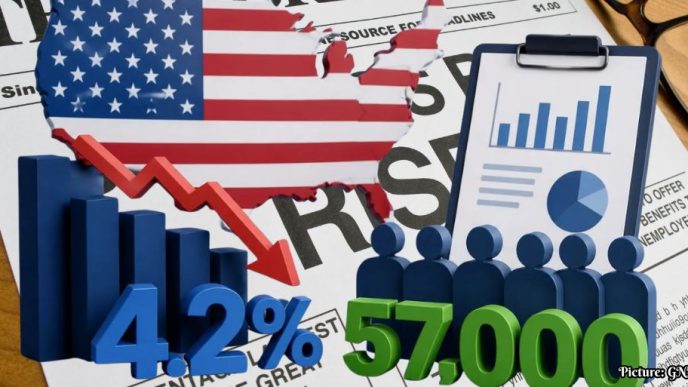

A pronounced deceleration in federal payroll expansion saw the United States economy add just 29,000 jobs in September, according to figures released by the Bureau of Labor Statistics. The headline rate of national unemployment ticked upward to 4.2 percent, marking the final major labor report before voters head to the polls for the high-stakes midterm elections. While private economists point to structural shifts driven by artificial intelligence technology and temporary administrative headwinds in immigration policy, the dramatic decline from August’s revised gains underscores a cooling broader economic landscape that is likely to alter the Federal Reserve’s monetary policy path.
A Sharp Deceleration in Payroll Growth
WASHINGTON — Nonfarm payroll employment grew by a modest 29,000 positions in September, representing a substantial slowdown in hiring across the American economy during the final month of the third quarter, according to data published by the U.S. Bureau of Labor Statistics (BLS). The monthly total fell considerably below historical averages and consensus market expectations, following downwardly revised gains of 133,000 jobs recorded in August.
Concurrently, the national unemployment rate rose from 4.1 percent in August to 4.2 percent in September. The labor report—the final comprehensive snapshot of the nation’s employment conditions scheduled for release before the upcoming midterm congressional elections—indicates that major economic sectors have largely paused net expansion. Headcounts across key industries ranging from retail trade to technology demonstrated little overall net movement, reflecting a cautious approach by employers navigating shifting macroeconomic conditions.
In addition to the weak September figures, net historical revisions by the BLS further illustrated a subdued labor environment throughout late summer. Total employment gains for August were revised downward from an initial reading of 162,000 to 133,000, while July’s initially reported gain of 21,000 jobs was flipped to a net loss of 10,000 jobs. The average monthly job creation rate over the trailing 12-month period now stands at approximately 45,000, pointing to a persistent moderating trend rather than a single sudden anomaly.
Federal Reserve and Monetary Policy Implications
The deceleration in job creation has led financial market analysts and policy experts to recalibrate expectations regarding interest rate decisions by the Federal Reserve. Prior to the release, discussions within the central bank centered on balancing persistent cost-of-living pressures against signs of broader economic softening.
Economic commentators noted that the muted labor figures significantly diminish the likelihood that central bank officials will pursue additional benchmark interest rate hikes in the near term. The cooling job market provides monetary policymakers with evidence that elevated borrowing costs have succeeded in reining in demand without causing widespread layoffs, though wage growth has simultaneously moderated to a 3.0 percent year-over-year rate.
Market reaction across interest rate futures indicated an immediate shift, with traders pricing in an increased probability that the Federal Reserve will maintain its current policy target rate at its upcoming Federal Open Market Committee meeting. Benchmarks for government borrowing retreated following the release, with key U.S. Treasury yields falling across short-term and medium-term maturities as investors adjusted to the prospect of prolonged monetary easing or rate stability.
Economic Analysts Weigh Underlying Forces
Despite the steep decline in top-line monthly figures, chief economists evaluating the data cautioned against drawing overly alarmist conclusions regarding the overall health of the macroeconomy. They noted that underlying structural dynamics, administrative factors, and sector-specific bifurcations played a distinct role in shaping the September numbers.
George Brown, senior economist at Schroders, observed that while monthly payroll variations have exhibited significant volatility throughout the year, a single subdued reading does not inherently signal an impending economic contraction.
“Job gains have been a rollercoaster this year, but a single soft report is unlikely to point to a lasting collapse,” Brown remarked, emphasizing that broader economic fundamentals remain structurally resilient despite short-term fluctuations.
Analysis from Capital Economics further contextualized the slowdown, pointing toward temporary public-sector adjustments and external regulatory policy changes as key drivers of the soft top-line number.
“The lower figure is not disastrous,” said Bradley Saunders, North America economist at Capital Economics, pointing out that a noticeable drop in government roles and temporary visa policy changes weighed heavily on overall growth figures during the survey period.
Furthermore, sectoral performance highlighted a pronounced divergence within the private market, driven in part by rapid technological transformation and infrastructure buildouts. While service industries experienced hiring stagnation, physical production sectors connected to emerging technology infrastructure posted minor net gains.
Jeffery Roach, chief economist at LPL Financial, highlighted this growing internal divergence: “The data shows tension between goods-producing sectors that support the AI boom and service industries feeling the effect of changes brought about by the technology.”
Political Landscape and the Upcoming Midterm Elections
The release of the September employment snapshot carries immediate political implications, arriving in the final weeks before voters cast ballots in the national midterm elections. Economic performance remains a central issue for the electorate, with both political parties attempting to frame the latest figures to support their respective legislative and executive agendas.
Administration officials and campaign representatives have focused on the underlying stability of the unemployment rate, which at 4.2 percent remains historically moderate by long-term standards. Congressional leadership within the governing party highlighted that labor force participation edged up as 485,000 individuals entered or re-entered the job market in September, suggesting continued worker confidence despite a slower pace of immediate hiring.
Conversely, opposition leaders pointed to the sharp drop from August’s numbers and the ongoing downward revisions to previous months as evidence of macroeconomic cooling. Congressional campaign committees have increasingly centered their messaging on voter anxieties surrounding persistent cumulative inflation, elevated interest rates for home mortgages, and reduced mobility in the labor market.
With lawmakers returning to their districts to make their final arguments before Election Day, the September jobs report ensures that the trajectory of the American economy will remain the primary focal point of the political debate through the close of the campaign season.