A fragile early-April ceasefire between the United States and Iran faced severe strain on Wednesday after the U.S. military conducted preemptive airstrikes against an active Iranian drone operation near the strategic Strait of Hormuz. The military action unfolded hours after President Donald Trump publicly dismissed Iranian state television reports alleging an imminent draft agreement to restore commercial maritime shipping under a joint Iranian-Oman administrative framework. During a televised cabinet meeting, Trump asserted that no single nation would control the international waterway, issuing a stark warning to Oman to align with American interests or face military destruction. The escalation abruptly halted progress in ongoing peace talks, driving global crude oil futures up by nearly 2% to $90.38 a barrel and prompting the U.S. Treasury to levy fresh national security sanctions against Tehran’s newly formed shipping authority.
WASHINGTON — The United States military executed a series of targeted airstrikes in southern Iran on Wednesday, intercepting a fleet of unmanned aerial vehicles and destroying a regional command node that American defense officials claimed posed an immediate tactical threat to naval forces and commercial shipping corridors. The kinetic engagement represents a significant military disruption to the tenuous bilateral truce enacted on April 8, highlighting a deep strategic deadlock between Washington and Tehran over the economic and legal management of the Strait of Hormuz.
A senior U.S. defense official, speaking on the condition of anonymity to discuss sensitive operational intelligence, confirmed that American forces shot down four Iranian attack drones over international waters. Concurrently, U.S. assets struck a ground control facility situated within the coastal port city of Bandar Abbas as personnel prepared to launch a fifth one-way combat drone.
The defense official sought to characterize the engagement as a localized enforcement mechanism rather than an explicit return to large-scale combat operations. “These actions were measured, purely defensive, and intended to maintain the ceasefire,” the official stated, emphasizing that the military retains the inherent right of self-defense under current rules of engagement.
Conflicting Field Dispatches and Maritime Interdictions
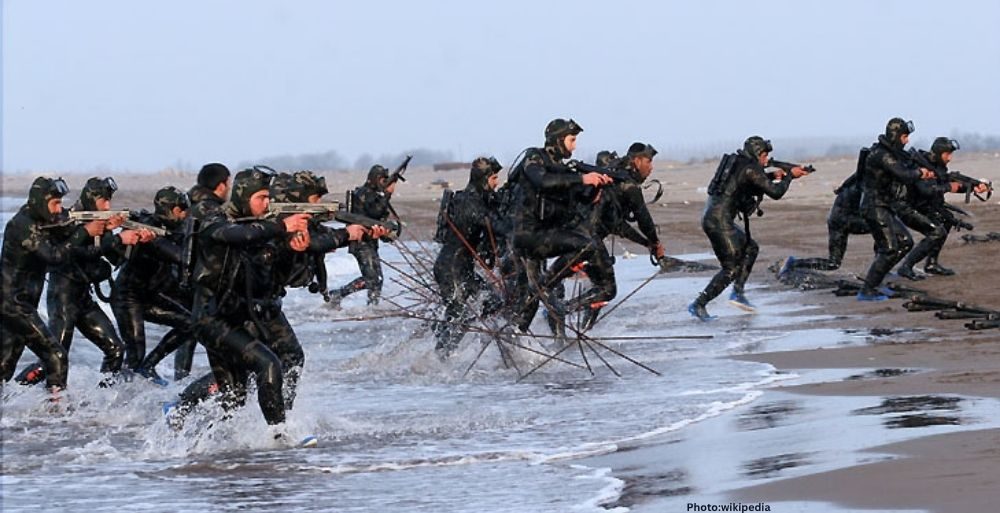
The official account from Washington conflicted sharply with narrative summaries broadcast by state-affiliated media in Tehran. Iran’s semi-official Tasnim news agency, quoting senior naval commanders from the Islamic Revolutionary Guard Corps (IRGC), asserted that its maritime forces initiated the encounter by firing warning shots toward an American-flagged oil tanker. Iranian military officials claimed the commercial vessel was attempting to transit the Strait of Hormuz covertly by turning off its transponders and automated identification radar networks, forcing the ship to alter its course away from Iranian territorial waters.
According to the IRGC report, subsequent U.S. retaliatory airstrikes hit unpopulated open terrain on the periphery of Bandar Abbas without yielding structural degradation or military casualties. However, by early Thursday morning, Iranian state media reported a secondary maritime standoff, noting that an IRGC coastal patrol unit had fired live warning shots to turn back four unidentified commercial vessels attempting to force entry into the strait without localized administrative clearance.
The mid-week skirmishes followed an earlier round of U.S. precision strikes in southern Iran on Monday, which the Pentagon classified as an unavoidable defensive response to maritime mining threats, but which the Iranian Foreign Ministry formally labeled a “gross and unprovoked violation” of the standing ceasefire.
Diplomatic Rupture Over the Strait of Hormuz Draft Accord
The flare-up in physical hostilities arrived immediately after President Donald Trump used an afternoon Cabinet meeting at the White House to aggressively dismantle a public diplomatic trial balloon floated by Iranian state broadcasting. Tehran had publicized an unofficial, preliminary draft framework allegedly designed to restore commercial shipping volumes through the Strait of Hormuz to prewar levels within 30 days. According to the leaked document, the plan proposed an administrative compromise wherein the governments of Iran and Oman would jointly manage maritime traffic and collect transit fees, while the United States would dissolve its naval blockade of Iranian ports and withdraw forward-deployed forces from the immediate Persian Gulf theater.
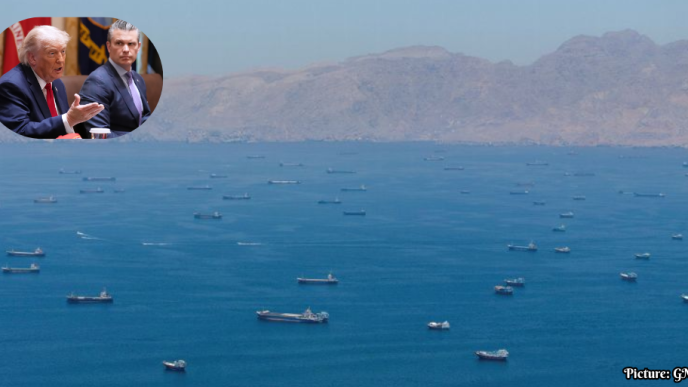
Seated before reporters in the Cabinet Room, President Trump flatly rejected the Iranian terms, declaring that the United States would tolerate no structural compromise regarding international freedom of navigation.
“Nobody’s going to control the strait,” Trump said, leaning forward and speaking with a stern, unyielding demeanor. “It’s international waters, and Oman will behave just like everybody else or we’ll have to blow them up. They understand that, they’ll be fine.”
The administration’s explicit military threat directed at Oman shocked regional observers. Muscat has maintained close economic and security ties with the United States for over 50 years, frequently serving as the primary neutral intermediary and diplomatic backchannel for sensitive prisoner swaps and nuclear negotiations between Washington and Tehran. While the White House and the Omani Embassy in Washington declined immediate requests to clarify the president’s statements, the U.S. Treasury Department followed the meeting by formally blacklisting the Persian Gulf Strait Authority—the regulatory body recently established by Tehran to oversee the waterway—designating it a vital threat to U.S. national security.
Historical Context of the Strategic Deadlock
The current military and economic crisis stems from the outbreak of a wider war that commenced on February 28, 2026, initiated by highly synchronized U.S. and Israeli precision airstrikes targeting domestic Iranian infrastructure. Over the subsequent three months, the conflict has claimed thousands of lives, disrupted global supply chains, and forced a massive restructuring of regional alignments.
At the center of the diplomatic impasse is the legal status of the Strait of Hormuz. Prior to the February 28 escalation, the narrow chokepoint accommodated more than 20% of global petroleum and liquefied natural gas (LNG) commerce. Under long-established international maritime laws, foreign vessels possess an unrestricted right of transit passage. However, because the narrowest shipping lanes fall directly within the territorial seas of Oman and Iran, Tehran has long sought to project regulatory sovereignty over the passage as leverage against international sanctions.
Key Sticking Points in U.S.-Iran Peace Negotiations:
1. Total Dismantling of Iran's Nuclear Enrichment Infrastructure
2. Immediate Lifting of the U.S. Naval Blockade on Iranian Ports
3. Legal and Regulatory Sovereignty Over Strait of Hormuz Shipping Lanes
4. Timeline for the Withdrawal of 15,000 U.S. Blockade Enforcement Troops
Responding directly to Trump’s public rejection of the maritime draft, Ebrahim Azizi, the chairman of the Iranian Parliament’s National Security Committee, stated that American military posturing would fail to alter Tehran’s core bargaining positions.
“It is obvious Trump, seeking a way out of this strategic deadlock, alternates between issuing threats and appealing for an agreement,” Azizi published in an analytical statement on the social media platform X. He reiterated that Iran would not compromise on its foundational demands, which require the comprehensive lifting of economic sanctions, international recognition of its domestic uranium enrichment rights, and localized administrative authority over the Persian Gulf.
Regional Force Postures and Economic Fallout
The return to localized kinetic activity sent immediate shockwaves through global commodity exchanges. After experiencing a steep 5% drop earlier in the week on optimism surrounding a potential peace breakthrough, U.S. crude futures rebounded sharply in early Asian trading on Thursday, gaining roughly 2% to lock at $90.38 per barrel. Market analysts warned that prolonged disruption to the waterway risks locking global energy costs at elevated levels, adding sustained inflationary pressure to domestic Western economies.
The scale of the economic slowdown inside the strait was illuminated by official declarations from the IRGC Navy on Wednesday. According to Iranian port authorities, only 23 commercial vessels—including container ships and supertankers—successfully transited the chokepoint over the previous 24 hours, all requiring explicit administrative authorization from Iranian coastal stations. This volume represents a mere fraction of the 125 to 140 daily vessel transits recorded prior to the outbreak of hostilities in February.
| Strategic Metric | Pre-War Status (Pre-Feb 2026) | Current Status (May 2026) |
| Daily Shipping Traffic | 125 – 140 Vessels | 23 Vessels (Requires IRGC Clearance) |
| Global Energy Flow | ~20% of Global Petroleum & LNG | Heavily Interdicted / Diverted |
| U.S. Regional Footprint | Distributed Base Personnel | 15,000 Blockade Enforcement Troops |
| U.S. Crude Price | ~$74.00 / Barrel | $90.38 / Barrel |
The Pentagon continues to maintain an expansive military presence to back its economic and political objectives. Approximately 15,000 U.S. service members are deployed directly to enforce the naval blockade of Iranian ports, supported by tens of thousands of additional personnel stationed at deep-water installations and airbases located in Qatar, the United Arab Emirates, and Bahrain.
Concurrently, U.S. Secretary of State Marco Rubio affirmed during Wednesday’s cabinet session that the administration’s final goals extend far beyond maritime transit rules, noting that any durable peace agreement remains contingent upon the permanent termination of Tehran’s atomic aspirations. “The bottom line is Iran’s never going to have a nuclear weapon,” Rubio stated before the assembled press corps.
While Iranian negotiators have suggested separating the maritime transit arrangements from long-term nuclear inspections to expedite a shipping resolution, Trump’s core domestic political allies have strongly opposed any piecemeal sanctions relief. With military units on both sides trading tactical blows while diplomatic channels fracture, the prospects for an imminent resolution to the three-month-old war appear increasingly remote.