Union Finance Minister Nirmala Sitharaman on Sunday clarified the structural mechanisms governing the Indian rupee’s valuation against the U.S. dollar, emphasizing that contemporary currency fluctuations are driven by an intricate matrix of macro-environmental variables rather than domestic policy failures. Speaking at a high-level policy briefing marking 12 years of the Prime Minister Narendra Modi-led National Democratic Alliance (NDA) government, Sitharaman explicitly outlined the Reserve Bank of India’s (RBI) restricted regulatory footprint, confirming that central bank interventions are deployed exclusively to mitigate erratic market volatility rather than defend a predetermined exchange rate floor. Concurrently, the Finance Minister utilized the economic forum to mount a direct political counter-offensive against Leader of the Opposition Rahul Gandhi, accusing the Congress leadership of systematically undermining India’s macroeconomic achievements to score domestic political points.
Macroeconomic Drivers and the Foreign Exchange Framework
Addressing economic analysts and media personnel in Devanahalli, near the technology hub of Bengaluru, Finance Minister Sitharaman contextualized the rupee’s current trading trajectory within the broader global financial architecture. The Indian currency has faced persistent headwinds, influenced by shifting international capital distributions, protracted geopolitical conflicts in Western Asia and Eastern Europe, and the hawkish monetary stance maintained by the United States Federal Reserve.
Sitharaman detailed a tripartite grouping of domestic structural import dependencies that directly impact India’s current account balance and exert structural pressure on the foreign exchange reserves. Foremost among these is India’s structural reliance on crude oil imports, which accounts for more than 80 percent of the nation’s domestic petroleum consumption, followed by substantial import bills for chemical fertilizers and bullion. When global commodity indexes surge, the localized demand for U.S. dollars accelerates to clear international trade invoices, naturally driving down the rupee’s relative spot value.
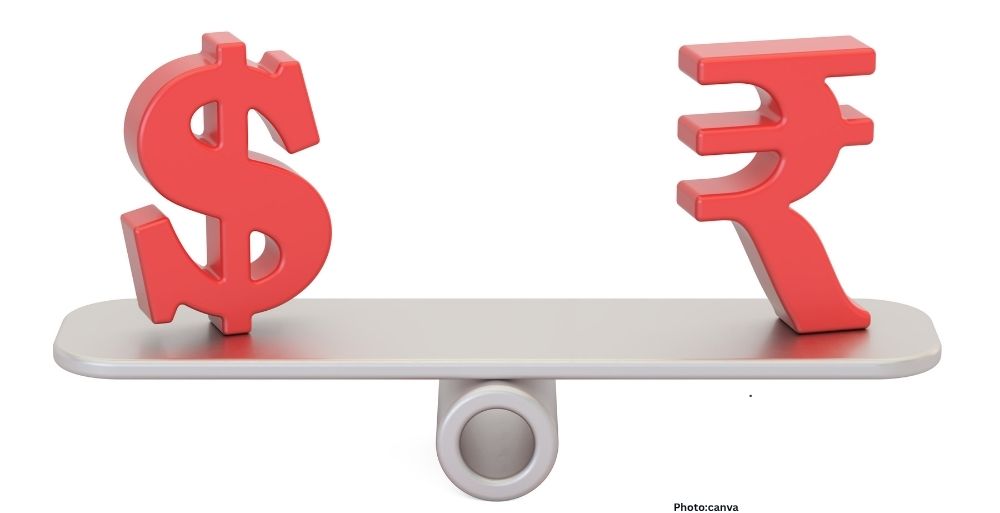
“The rupee’s movement against the U.S. dollar is shaped by several factors, including global economic uncertainties, U.S. Federal Reserve policy decisions, fluctuations in major international currencies, and foreign capital inflows and outflows,” Sitharaman stated. Her delivery was analytical and calculated as she addressed the press corps, relying on internal ministry briefs to reinforce her points.
To clarify India’s monetary policy position, the Finance Minister separated the government’s approach from artificial currency pegging models. She stated that India adheres to a managed floating exchange rate regime. Under this framework, the market serves as the primary price-discovery mechanism, with central bank intervention reserved solely for extraordinary liquidity adjustments.
“The Reserve Bank of India intervenes in the foreign exchange market only to curb excessive volatility and not to maintain a fixed exchange rate,” Sitharaman clarified, seeking to assure institutional investors that the central bank acts sparingly. This strategy preserves foreign exchange reserves—which stood at historic highs earlier this quarter—to insulate the domestic banking sector from sudden external shocks.
The Political Economy of “Viksit Bharat” and Opposition Critiques
Following her technical briefing on macro-finance, Sitharaman transitioned to a political platform, addressing an assembly of party workers and economic stakeholders at the Viksit Bharat Sankalp Samavesha (Developed India Resolution Assembly) held in Bengaluru. The convention was organized to review the legislative and economic trajectory of the NDA administration since its initial ascension to power in May 2014.
The Finance Minister directly criticized the rhetorical strategies employed by Leader of the Opposition in the Lok Sabha, Rahul Gandhi. Over the past legislative session, the opposition coalition, under the newly unified I.N.D.I.A. banner, has targeted the government over issues of structural unemployment, persistent rural inflation, and the widening wealth gap. Sitharaman argued that these critiques have crossed the line from standard partisan oversight into a systematic devaluing of India’s broader economic progress.
| Macroeconomic Metric (India) | Status as of Q2 2026 | Primary Underlying Drivers |
| GDP Growth Velocity | 7.2% Annualized Pace | Robust manufacturing, infrastructure spending, digital trade |
| Foreign Exchange Reserves | ~$642 Billion (Stable) | Prudent RBI dollar buying, steady foreign direct inflows |
| Banking Non-Performing Assets | Historic Lows (<3.2%) | Aggressive corporate deleveraging, rigorous balance sheet cleanup |
| External Debt-to-GDP Ratio | Approximately 18.4% | Low exposure to short-term foreign currency debt |
“Whenever the Leader of the Opposition speaks in the Lok Sabha, he only criticises developments and downplays the achievements of the people of India, thinking that he is attacking the Prime Minister or the Central government,” Sitharaman argued. The audience of party workers responded with loud applause. She maintained that the opposition’s narrative creates an inaccurate impression of instability that does not align with core economic data.
Institutional Resilience vs. Forecasts of Crisis
Refuting ongoing claims from opposition-aligned think tanks that suggest India’s corporate and consumer sectors are facing an impending structural crisis, Sitharaman emphasized that the country’s economic fundamentals remain remarkably strong. She pointed to a series of institutional reforms implemented over the 12-year NDA tenure—such as the digitization of tax administration via the Goods and Services Tax (GST) portal, the Insolvency and Bankruptcy Code (IBC), and targeted production-linked incentive (PLI) schemes—as structural buffers against global downturns.
State banking data supports the government’s position, showing that scheduled commercial banks have reduced their Gross Non-Performing Assets (GNPAs) to historic lows under 3.2 percent. Furthermore, corporate balance sheets have undergone a comprehensive cycle of deleveraging over the past four years.
This financial health has allowed Indian industries to maintain capital expenditures despite high global interest rates. While acknowledgment was made that high food and commodity prices require continued watchfulness by the Ministry of Finance and the Ministry of Consumer Affairs, Sitharaman concluded that India’s domestic growth trajectory remains the fastest among major global economies.