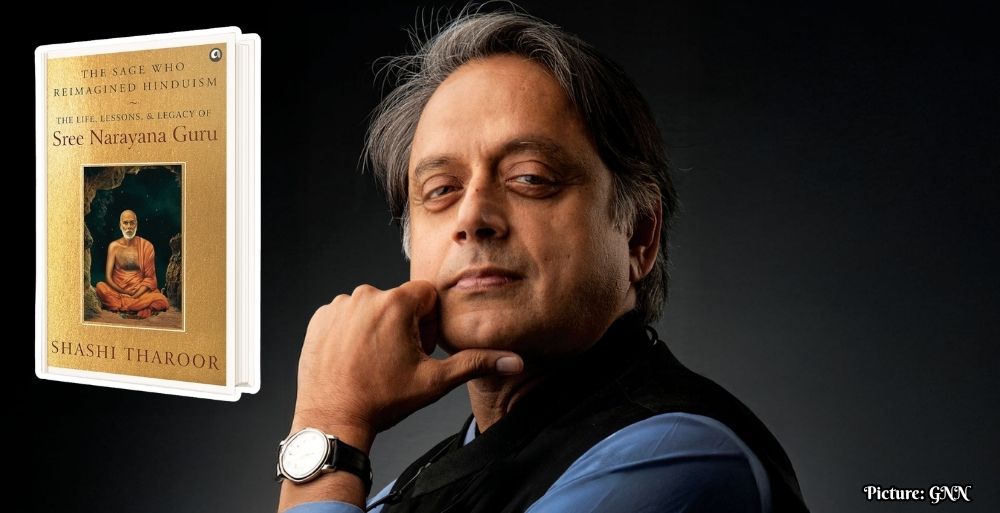
Shashi Tharoor’s ‘The Sage Who Reimagined Hinduism’ provides a comprehensive introduction to Sree Narayana Guru, a pivotal figure in India’s anti-caste movement, highlighting his contributions to social reform and the broader implications of his philosophy.
In his latest book, The Sage Who Reimagined Hinduism, author Shashi Tharoor delves into the life and legacy of Sree Narayana Guru, a significant yet often overlooked figure in India’s anti-caste reform movement. Published on August 28, 2026, the book seeks to illuminate the impact of Narayana Guru, particularly in his home state of Kerala, while extending his vision of equality and social justice to a broader national audience.
Sree Narayana Guru emerged as a prominent reformer during the late 19th and early 20th centuries, revered for his efforts to combat the entrenched caste system within Hindu society. His assertion — ‘One Caste, One Religion, One God for Man’ — serves as a powerful repudiation of the caste hierarchy long supported by traditional Brahmanical thought. Tharoor articulates how this declaration was not merely a slogan but an embodiment of a transformative vision aimed at empowering the oppressed and challenging social exclusion.
Narayana Guru’s Practical Reforms
The book emphasizes Narayana Guru’s pragmatic approach to social reform, particularly through the establishment of the Sree Narayana Dharma Paripalana Yogam (SNDP), an organization aimed at uplifting the Ezhava community and other marginalized groups in Kerala. Tharoor effectively portrays the Guru not just as a spiritual leader but as a practical reformer who understood the necessity of education and social organization for genuine empowerment. This perspective counters the tendency to view Narayana Guru solely as a mystical figure disconnected from the pressing issues of caste oppression.
Tharoor’s narrative recounts pivotal moments in Narayana Guru’s life, particularly the consecration of a Shiva idol at Aruvippuram in 1888. This act not only challenged the monopoly of Brahmins over sacred rituals but also asserted the right of the oppressed to religious self-determination. Such moments underscore the Guru’s commitment to transforming the socio-religious landscape of Kerala, making his legacy essential in understanding the evolution of social reform in India.
Contextualizing Anti-Caste Movements
Tharoor situates Narayana Guru within the larger context of anti-caste movements throughout India, tracing a lineage that includes influential figures such as Jotirao Phule and B.R. Ambedkar. Each of these leaders approached the challenge of caste in unique ways, with Narayana Guru advocating for reform from within Hinduism, as opposed to Ambedkar’s call for a complete break from the religion. This distinction raises important questions about the efficacy of reformist strategies in dismantling deeply ingrained social hierarchies, prompting readers to consider the complexities surrounding the fight against caste oppression.
While Tharoor admires Narayana Guru’s universalist philosophy, he also hints at the limitations of a reformist approach that operates within a Hindu framework. Despite the Guru’s inclusive message, the movement largely attracted support from the Ezhava community, illustrating the tension between universal ideals and the practicalities of caste-based mobilization. This duality reflects a broader challenge faced by various social reformers attempting to navigate the intricate relationship between religion and social justice.
Interactions with Other Movements
The book could have further explored Narayana Guru’s relationship with other anti-caste leaders in Kerala, such as Ayyankali, who fought for civil rights and material emancipation for the Pulayar community. While both leaders shared a commitment to social justice, their methodologies differed significantly—Narayana Guru focused on religious reform, whereas Ayyankali emphasized civic rights and access to public resources. Together, they represented complementary currents in the broader spectrum of Kerala’s social transformation, each addressing distinct aspects of caste oppression.
Tharoor also draws parallels between Narayana Guru’s philosophy and significant historical events, such as the Vaikom Satyagraha of 1924-1925, which sought to challenge untouchability in access to temple roads. Although Gandhi framed the struggle primarily as a campaign against untouchability, Narayana Guru recognized that true equality must extend beyond mere access to roads leading to temples, advocating for a more profound transformation that included entry into temples themselves. This perspective foreshadows the Temple Entry Proclamation of 1936, which marked a significant step toward dismantling caste-based restrictions.
Legacy and Modern Relevance
Despite some limitations in critical engagement with certain historical contradictions, Tharoor’s work serves as a timely and accessible introduction to Narayana Guru’s philosophy. In an era where religious identity is often weaponized for exclusion, the Guru’s vision of spirituality grounded in equality and dignity is particularly relevant. Tharoor’s narrative not only recovers this legacy but also invites contemporary readers to reconsider the implications of Narayana Guru’s teachings in today’s socio-political landscape.
Overall, The Sage Who Reimagined Hinduism stands out as a vital contribution to the discourse surrounding social reform in India, offering a nuanced perspective on one of the nation’s most original social philosophers. Priced at ₹799, this book is poised to reach a diverse readership, further expanding the dialogue around caste, religion, and social justice in modern India. As the nation grapples with ongoing issues of caste and identity politics, Narayana Guru’s teachings provide a framework for fostering inclusion and equality, making Tharoor’s work not just a biography but a call to action for social change.