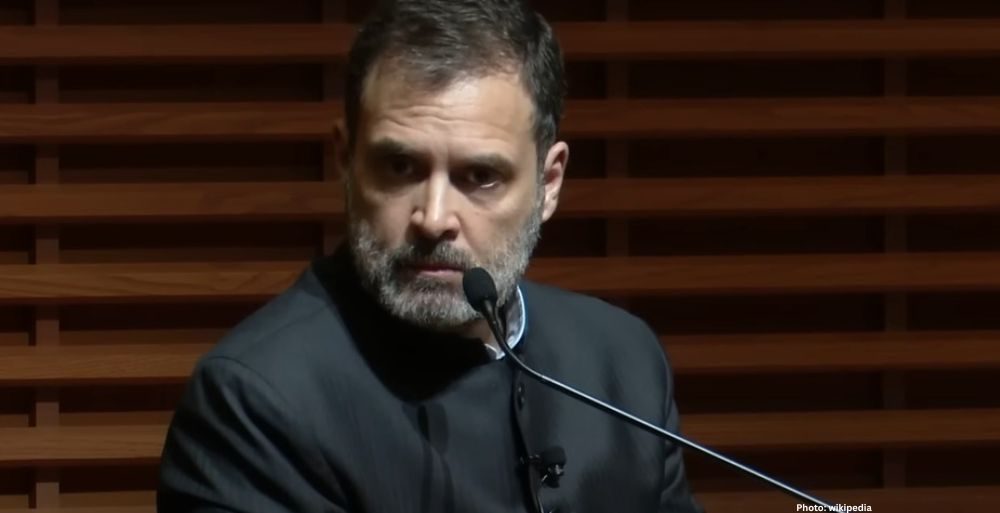
During a speech at the Bharat Summit in Hyderabad, Congress leader Rahul Gandhi raised serious concerns about the legitimacy of the 2024 Lok Sabha elections, citing the Election Commission’s declaration of millions of voters as illegal.
NEW DELHI: In a pointed address at the Bharat Summit held in Hyderabad on Saturday, Congress leader Rahul Gandhi cast doubt on the legitimacy of the 2024 Lok Sabha elections, alleging that the Election Commission of India (ECI) had declared approximately 140 million voters as either “non-existent voters or non-voters.” These claims come as part of a broader critique of the electoral system in India, raising concerns about the integrity of upcoming elections.
As the leader of the opposition in the Lok Sabha, Gandhi questioned, “If the Election Commission declares 140 million voters illegal, how is the election possibly legitimate?” His remarks reflect growing discontent among opposition parties regarding the transparency and reliability of electoral processes in India. According to Gandhi, this alarming assertion implies that nearly 13% of Indian voters who participated in the elections have been rendered illegal, thereby undermining the overall legitimacy of the electoral results.
Historical Context of Electoral Changes
Gandhi attributed the erosion of democratic norms in India to the 2014 Lok Sabha elections, which he characterized as a watershed moment that introduced transformative changes in the country’s electoral landscape. He asserted that these elections were marked by a significant influx of financial resources, which he believes has fundamentally altered the nature of electoral competition in India.
“In 2014, we witnessed a completely new election, something we had never seen before. Millions and millions and millions of dollars were injected into the political system,” he stated. This infusion of money, according to Gandhi, has shifted the electoral environment from one characterized by close contests and coalition governments to a more polarized and financially-driven political landscape.
The Congress leader noted that the opposition was initially taken by surprise by these changes, taking nearly a decade to acclimate to the new dynamics of Indian politics. The introduction of substantial financial backing has contributed to a political environment where traditional methods of campaigning and communication have become less effective.
Allegations Against Political and Business Nexus
Continuing his critique, Gandhi specifically targeted Prime Minister Narendra Modi, alleging that he has created a troubling nexus between political power and big business. He pointed to the meteoric rise of businessman Gautam Adani, who, according to Gandhi, was around 600th in the global wealth rankings prior to the BJP coming to power. Adani’s ascent to become the second-richest person in the world is cited as evidence of the intertwining of business and politics.
“How did he become the richest man? By a fusion between politics and business. The line between business and politics, between Adani and PM Modi, has evaporated. It does not exist anymore,” Gandhi asserted, highlighting concerns regarding the erosion of ethical boundaries between political and economic interests.
Moreover, Gandhi alleged that the financial assets of the BJP have increased elevenfold over the past decade, suggesting a direct correlation between the party’s financial growth and the concentration of political power in India. This assertion underscores broader concerns about the influence of money in politics and the potential implications for democratic processes.
Concerns Over Democratic Institutions
Gandhi further criticized the BJP for allegedly undermining democratic institutions in India. He argued that the Congress party has faced significant challenges in countering the ruling party’s narrative, as traditional methods of political communication have become less effective in the current political climate. Despite these challenges, he expressed a renewed confidence in the opposition’s ability to challenge Prime Minister Modi in the upcoming elections.
“The Congress is determined to remove PM Modi from power, and I believe this outcome is a certainty,” he declared, reflecting a palpable sense of resolve among opposition leaders as the 2024 elections draw nearer. His comments highlight a growing momentum within the opposition, which aims to harness public dissatisfaction with the ruling party.
During the summit, Gandhi also took a moment to apologize to foreign delegates who were unable to attend the event in Hyderabad, emphasizing the importance of fostering international relationships amid ongoing political discourse. This gesture indicates a recognition of the global implications of India’s political landscape, particularly as the country approaches a pivotal electoral moment.
As the 2024 elections loom on the horizon, the allegations raised by Gandhi regarding voter legitimacy and the intertwining of politics and business are likely to resonate with a public increasingly aware of the challenges facing Indian democracy. The coming months will be critical as India navigates this complex political terrain, and the opposition’s ability to address these issues may significantly shape the electoral outcome.