“India cannot be understood by looking at political parties alone. It has to be understood as a network,” Tiwary wrote, arguing that the country’s deeper political architecture lies in the connections between social, spiritual and institutional networks.
Political analyst Abhishek Tiwary has argued that India’s political landscape cannot be fully understood by studying political parties or election results alone, saying the country should instead be viewed as a complex network of interconnected institutions, communities and social relationships.
In a social media post published on Tuesday, June 30, Tiwary said that while most political analysts focus on elections, few examine the networks that shape political outcomes long before votes are cast.
“Most political analysts study elections. Very few study the networks that produce election outcomes.”
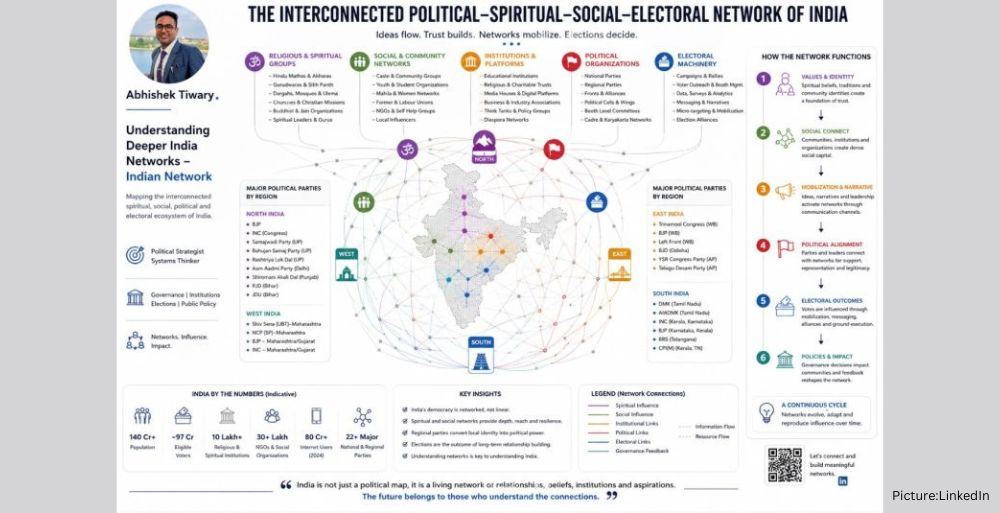
According to Tiwary, India functions as a multi-layered network in which political parties interact continuously with religious institutions, social organisations, community leaders, educational institutions, businesses, media, and local influencers—not only during elections, but every day.
“India cannot be understood by looking at political parties alone. It has to be understood as a network.”
Tiwary argued that Network Science provides a more effective framework for analysing political influence. Rather than asking who won an election, he said the discipline examines deeper structural questions, including who the central actors are, how information spreads, which institutions serve as bridges between communities, and where trust originates before becoming political support.
He described India’s spiritual and religious institutions as one of the country’s most overlooked networks, saying they play a far broader role than simply serving as places of worship.
Referring to recent public discussions surrounding donations to the Ram Mandir, Tiwary said religious institutions also function as networks of trust, identity, philanthropy, volunteerism, education and social influence. He added that similar dynamics exist across multiple religious traditions in India, each contributing differently to public life.
According to him, many political developments become easier to understand when viewed through these interconnected relationships rather than as isolated events.
Recalling a religious gathering he attended in Varanasi, Tiwary said he observed politicians, spiritual leaders and community figures sharing the same space. He cited the presence of politician Aparna Yadav as an example, while clarifying that his observation was not about any individual’s political decisions but about how such gatherings create opportunities for trust-building, signalling and long-term relationship development.
He argued that influence is rarely exercised directly, but instead flows through trusted intermediaries, institutions, shared identities and community networks built over decades.
“Influence rarely moves in straight lines. It moves through trusted intermediaries. Through institutions. Through shared identities. Through repeated interactions.”
Tiwary concluded that understanding Indian politics requires looking beyond manifestos, election campaigns and television debates to examine what he described as the country’s broader Political–Spiritual–Social–Electoral Network.
“Politics is only one layer. The deeper architecture lies in the connections.”
The analyst said this network-based approach forms the basis of his current research, which seeks to better understand India’s interconnected institutions and social structures through the lens of Network Science.