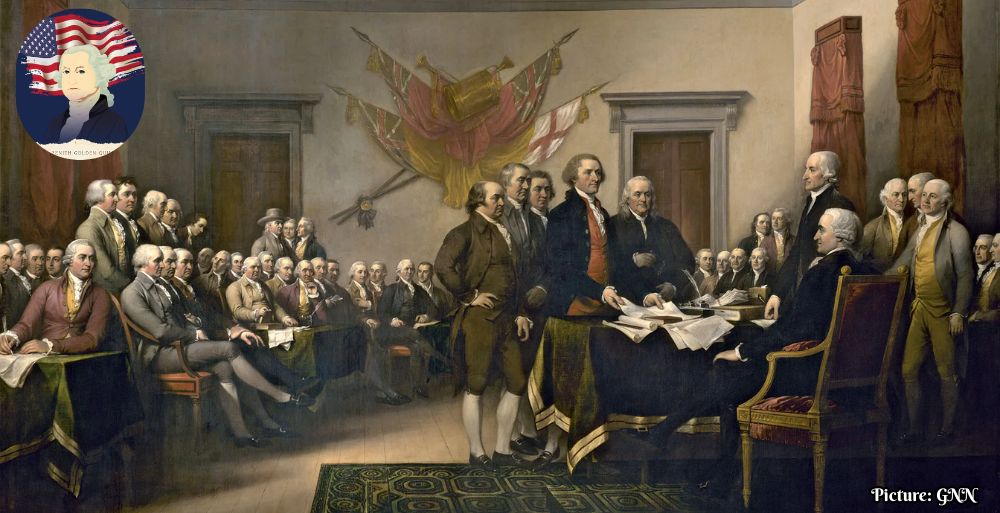
The Declaration of Independence, adopted on July 4, 1776, articulates the American colonies’ grievances against British rule and establishes the philosophical foundation for their quest for autonomy.
In Congress, on July 4, 1776, the delegates of the thirteen united States of America came together to affirm their intention to dissolve the political ties that bound them to Great Britain, declaring their status as independent states. This monumental document, known as the Declaration of Independence, not only articulated the colonies’ grievances against King George III but also laid down the philosophical underpinnings of American democracy.
The opening lines proclaim a profound assertion: “We hold these truths to be self-evident, that all men are created equal, that they are endowed by their Creator with certain unalienable Rights, that among these are Life, Liberty and the pursuit of Happiness.” This assertion has been pivotal in shaping democratic ideals not only in the United States but across the globe. The Declaration emphasizes that governments are established to secure these rights and that their legitimacy derives from the consent of the governed. When a government becomes destructive to these ends, it is the right of the people to alter or abolish it.
Grievances Against the Crown
The document meticulously lists grievances against King George III, presenting a case for independence that aimed to resonate with the international community. Among the allegations, the Declaration states that the king has refused to assent to necessary laws, dissolved legislative bodies, and imposed taxes without consent, all actions that exemplify what the authors described as “absolute Tyranny.”
This list of grievances served a dual purpose: it justified the colonies’ break from Britain while also appealing to the moral sensibilities of the world. The Declaration asserts that the king’s actions created a situation where the colonies had no choice but to seek independence. The phrase “He has kept among us, in times of peace, Standing Armies without the Consent of our legislatures” highlights a core grievance that resonated deeply with colonists, who felt that their rights were being trampled by a distant monarch.
Philosophical Foundations
At its core, the Declaration of Independence is not merely a list of complaints; it is a philosophical treatise arguing for the rights of individuals and the role of government. The authors, influenced by Enlightenment thinkers such as John Locke, posited that people have inherent rights that cannot be surrendered. This idea of unalienable rights forms the backbone of American political thought and continues to influence legal and political debates today.
Furthermore, the Declaration’s insistence on the idea that “Governments long established should not be changed for light and transient causes” indicates a recognition of the importance of stability and the rule of law, even as it calls for significant political change. The balance between maintaining order and the right to revolt against tyranny remains a critical theme in American political discourse.
Collective Responsibility and Unity
The Declaration also embodies a spirit of unity among the colonies, as it concludes with a pledge among the signers: “And for the support of this Declaration, with a firm reliance on the protection of divine Providence, we mutually pledge to each other our Lives, our Fortunes and our sacred Honor.” This statement underscores the collective commitment of the colonies to the cause of independence, highlighting that the struggle for freedom was not merely a political endeavor but also a deeply personal sacrifice for those involved.
The Declaration of Independence has not only become a cherished symbol of American freedom but also a foundational document that has inspired various movements for civil rights and liberties throughout history. Its ideals continue to resonate, reminding citizens and leaders alike of the importance of equality, rights, and the role of government.
Historical Impact and Legacy
Since its adoption, the Declaration has been celebrated annually on July 4, known as Independence Day, a testament to its lasting significance in American culture. The document has also undergone various interpretations over the years, reflecting the changing values and struggles of the nation. As America has grappled with issues such as slavery, civil rights, and immigration, the principles enshrined in the Declaration have served as both a guide and a challenge, urging the country to live up to its founding promises.
In conclusion, the Declaration of Independence stands as a pivotal moment in history, marking the birth of a nation committed to the ideals of freedom and equality. As the United States continues to navigate complex social and political issues, the Declaration remains a guiding light, reminding all citizens of their rights and responsibilities in the ongoing pursuit of liberty and justice.