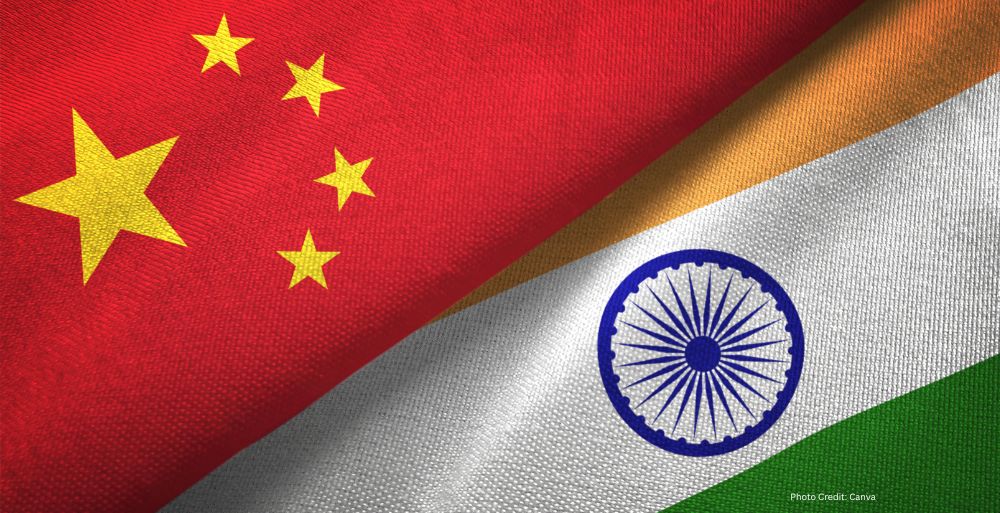
India and China continue to hold fundamentally different views on how their broader relationship should be managed, particularly over the unresolved border question, according to former Indian Ambassador to China Gautam Bambawale.
Bambawale, who served four tenures in China and spent 15 of his 34-year diplomatic career dealing with the country, said India regards peace and stability along the border as the foundation of the wider bilateral relationship. If peace on the border is disrupted, he argued, the impact inevitably extends to other areas of ties between the two countries.
China, by contrast, has sought to separate the border issue from other aspects of the relationship, according to Bambawale. In this approach, economic, diplomatic and other bilateral ties could continue to develop even when border-related incidents occur.
“These differing perspectives indicate a fundamental difference of approach of the two sides. It shows our differences run deep,” Bambawale said.
The former envoy’s assessment comes as India and China have taken steps toward stabilising relations following the severe deterioration caused by the 2020 military confrontation in Eastern Ladakh.
Chinese President Xi Jinping’s visit to India on September 12-13, 2026, for the BRICS Summit, along with his bilateral meeting with Prime Minister Narendra Modi, marked an important diplomatic engagement. Bambawale described the visit and the Modi-Xi meeting as a welcome development, while cautioning against viewing the encounter as a rapid solution to years of strained relations.
The military confrontation in Eastern Ladakh in 2020 represented a major setback to bilateral ties, and Bambawale said the relationship could not be repaired through one or two meetings, even at the highest political level.
He estimated that the 2020 crisis had pushed the relationship back by roughly 10 steps, while the two sides had so far taken only about four steps forward since the Galwan confrontation. As a result, he said, India-China relations remain in a deficit compared with the situation in 2019.
“Trust can only be rebuilt slowly, step by step, with a lot of effort and work from both sides,” Bambawale said.
At the same time, he noted that both governments appear to be demonstrating a willingness to rebuild the relationship and continue diplomatic engagement. That, he said, is itself a development that should be welcomed.
Border Talks Offer Limited Progress
The recent meetings between the Special Representatives of India and China have also generated attention, particularly following a rare joint statement outlining an eight-point consensus related to the boundary question.
Bambawale cautioned, however, against interpreting the agreement as evidence of an imminent resolution of the boundary dispute.
The Special Representatives’ process addresses two distinct issues: the search for a final boundary settlement and the management of the border while the dispute remains unresolved.
On the question of a permanent boundary settlement, Bambawale said the two sides still appear to be a considerable distance apart.
Border management presents a different but equally important challenge. Measures that had helped maintain stability along the border for roughly two decades were disrupted following the People’s Liberation Army’s actions in Eastern Ladakh in 2020.
India and China therefore need to examine which of the earlier border-management mechanisms remain effective and acceptable to both sides, while also considering whether additional measures are necessary, Bambawale said.
The eight-point consensus should consequently be viewed with caution until its practical implications become clearer.
“Caution is the right word in taking our relations with China forward,” Bambawale said, while adding that the diplomatic efforts underway should nevertheless receive support as both sides work to repair and rebuild ties.
LAC Remains a Major Challenge
Despite the diplomatic engagement, Indian and Chinese forces continue to maintain forward positions along portions of the Line of Actual Control, with tensions persisting in some areas, including Arunachal Pradesh.
Bambawale stressed the importance of distinguishing routine patrol encounters along the disputed boundary from the large-scale military mobilisation witnessed in Eastern Ladakh in 2020.
Because India and China have not reached agreement on a common Line of Actual Control or a final boundary, patrols from the two militaries can sometimes come into close proximity at certain points. Improved infrastructure on both sides has also increased the ability of troops to reach forward areas.
Such encounters, he noted, generally involve relatively small numbers of troops and are different in scale from the 2020 developments in Eastern Ladakh, when the PLA deployed large numbers of personnel across a substantial stretch of the LAC.
In Eastern Ladakh, the Indian Army responded to the Chinese military deployment, Bambawale said. Although disengagement has subsequently taken place in that sector, he noted that broader de-escalation and the withdrawal of troops from forward positions have not yet been completed.
Both the Indian Army and the PLA therefore continue to maintain significant forces in forward areas.
Diplomatic and military-level efforts to further normalise the situation along the LAC remain underway. For India-China relations more broadly, Bambawale’s assessment suggests that recent high-level meetings and border negotiations represent steps toward stabilisation, but that rebuilding trust will require sustained engagement and progress on the underlying border and security concerns.