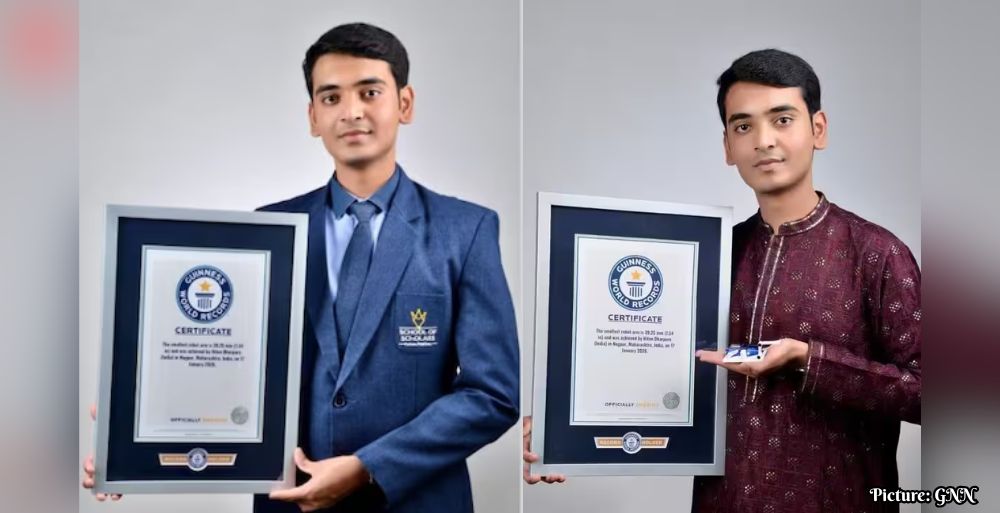
A 17-year-old from Nagpur, Hiten Dharpure, has garnered international acclaim for creating the world’s smallest robotic arm, showcasing the potential for innovation from humble beginnings.
NAGPUR, Maharashtra — Hiten Dharpure, a 17-year-old innovator from Nagpur, has made headlines by earning two prestigious Guinness World Records in the field of micro-robotics. His achievements highlight the potential for groundbreaking inventions to emerge from modest settings, demonstrating that determination and creativity can lead to significant advancements in technology.
A Record-Breaking Achievement
In January 2026, Dharpure secured his second Guinness World Record by designing the world’s smallest electro-mechanical robotic arm, which measures just 39.25 mm (1.54 inches) in size, surpassing the previous record by more than 5 mm. This remarkable device is not only diminutive in size; it is also fully functional, capable of performing three-axis movements, picking up miniature objects, and executing precise motions that showcase the capabilities of advanced micro-engineering.
Dharpure articulated his motivation for this project, stating that his aim extended beyond simply breaking a record. He wanted to illustrate that “ultra-precision micro-manufacturing does not require a big, high-level laboratory,” emphasizing that world-class engineering can originate from a home workspace equipped with accessible technology. This perspective resonates with many young innovators who may feel limited by their resources.
The Design and Development Process
Creating the robotic arm was a meticulous process that involved months of planning, designing, and iterative trial and error. Dharpure began by utilizing advanced computer-aided design (CAD) software to create the mechanical structure, followed by the fabrication of miniature components through high-precision Fused Deposition Modeling (FDM) 3D printing. He programmed Arduino microcontrollers using C/C++, applying Pulse Width Modulation (PWM) to synchronize tiny servo motors that control the arm’s movements.
The journey was fraught with challenges, as many prototypes failed due to fragile components breaking under motor torque or internal parts becoming too cramped for effective movement. Each setback, however, provided valuable lessons that allowed him to refine his design with precision, ultimately leading to a successful working prototype. The iterative nature of engineering is often a critical learning process, and Dharpure’s experience exemplifies this principle.
Previous Record and Other Innovations
Hiten’s recent accomplishment marks his second Guinness World Record. In April 2025, he designed the world’s smallest AI weather station, measuring just 74 mm × 44 mm × 60 mm, compact enough to fit in the palm of a hand. This device employs AI-powered algorithms to monitor temperature, humidity, and atmospheric pressure in real-time, showcasing his versatility and innovation in technology. The ability of this device to operate independently while providing critical environmental data underscores the potential applications of micro-technology in everyday life.
In addition to these record-breaking inventions, Dharpure has developed HastaVaani, a mobile application for offline Indian Sign Language (ISL) translation, aimed at bridging communication gaps for individuals with hearing and speech impairments. This project reflects his commitment to using technology for social good, demonstrating how innovations can not only push boundaries in engineering but also enhance accessibility and inclusivity in society. His extensive academic pursuits in robotics, artificial intelligence, and embedded systems have resulted in over 800 certifications and accolades from organizations, including recognition from the India Book of Records. He has also been publicly acknowledged by Union Minister Nitin Gadkari for his contributions to technology.
A Vision for the Future
Dharpure believes that innovation should be accessible to all, regardless of available resources. His work holds practical implications across various fields, from enabling ultra-precision microsurgeries in healthcare to advancing the manufacturing of electronic components. The ability to create sophisticated devices from a home lab not only democratizes technology but also inspires a new generation of inventors to break free from conventional constraints.
Now a two-time Guinness World Record holder, he has set ambitious goals for himself, aspiring to create a new global innovation record each year. His aspirations reflect a growing trend among young innovators to challenge the status quo and strive for excellence in their fields. His message to aspiring young innovators is clear: with patience, persistence, and curiosity, even a home workshop can become a catalyst for groundbreaking achievements. Dharpure’s journey serves as an inspiring example for students across India and beyond, encouraging them to think beyond limitations and embrace a spirit of experimentation and innovation.
As the landscape of technology continues to evolve rapidly, stories like Hiten Dharpure’s remind us that the next big breakthrough could come from anyone, anywhere. His achievements not only set a benchmark in the field of micro-robotics but also serve as a beacon of hope for young aspirants looking to make their mark in STEM (science, technology, engineering, and mathematics) disciplines.
Hiten’s work exemplifies a shift in how innovation is perceived in India, particularly among the youth. With increasing access to information and tools, young inventors are more equipped than ever to transform their ideas into reality, making significant contributions to both local and global communities.