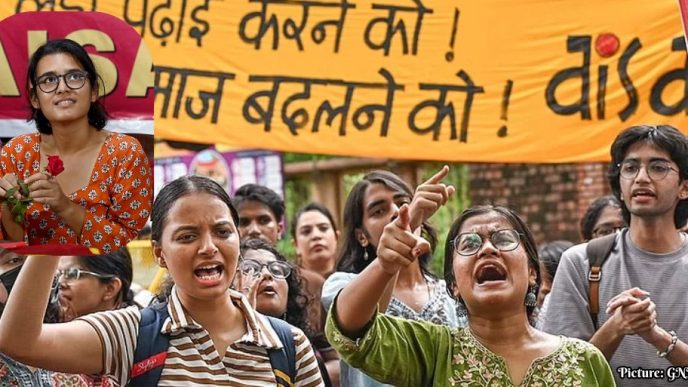
Students across India allege sustained police harassment and intimidation following their participation in protests, raising concerns about civil liberties and state surveillance.
Students who have participated in various protests across India in recent years are alleging ongoing harassment and intimidation by police, extending far beyond the demonstrations themselves. These claims highlight concerns over state surveillance and the potential infringement of civil liberties in a democratic society.
One such student, Gurkirat, a former Delhi University student currently pursuing a Master’s in Sociology at Panjab University in Chandigarh, has voiced significant concern for her family’s safety. Gurkirat, a former president of the Bhagat Singh Chhatra Ekta Manch, alleges that Delhi Police personnel have been visiting her parents’ home in Shivaji Enclave, New Delhi, every seven to ten days for several months. During these visits, police have reportedly inquired about her whereabouts and served notices related to past defamation cases.
“Sometimes they come in civil dress with no ID,” Gurkirat stated, recounting an instance where police allegedly warned her parents, “If you can’t control your daughter, then we will do it in our way,” urging them to restrict her movements. This pattern of intimidation appears to be part of a broader strategy employed by police against students involved in protests against government policies.
On August 6, 2026, Gurkirat was arrested during a protest related to the University Grants Commission’s Equity Regulations at Delhi University. Although she was granted bail the same day, reports indicate that police warned her that while she might have secured bail in one case, “the next case will be a big Maoist case.” This statement underscores the perceived severity with which authorities are treating dissent among students.
Gurkirat’s experiences echo those of other students across India who have been involved in protests over the past three years. These protests include significant gatherings such as the demonstration at Jantar Mantar on July 20, 2026, and the December 2025 protests concerning Delhi’s deteriorating air quality, as well as the 2023 agitation over the BBC documentary *India: The Modi Question*. Students report a systemic pattern of police surveillance and harassment that persists long after the protests have concluded.
Widespread Allegations of Intimidation
Another student, Ilakkiya, 24, who completed her Master’s in Psychology and is now preparing for a PhD in Delhi, recounted a similar experience. She claimed that police officers visited her family in a remote village in Erode district, Tamil Nadu, twice, identifying themselves as members of the Intelligence Bureau (IB) and warning her family that she was an “urban Naxalite.” Ilakkiya noted that her father, a small-scale farmer who does not speak English or Hindi, felt intimidated by the police’s use of complex terminology and threats.
Ilakkiya alleged that the police not only contacted her parents but also reached out to distant relatives, discussing personal financial matters and warning them of potential police action. Additionally, she reported that her sister, living in Bengaluru and uninvolved in protests, was approached by individuals claiming to be from the IB who warned her of serious consequences related to Ilakkiya’s activism.
In March 2026, Ilakkiya was among several students detained by the Delhi Police while preparing for a public event organized by the Bhagat Singh Chhatra Ekta Manch. Following their detention, which lasted three days in an undisclosed location and involved allegations of continuous harassment, the students were released after legal action was taken. Despite their release, Ilakkiya expressed ongoing fear of being followed and monitored by police, noting an encounter with an officer during her National Eligibility Test examination that left her feeling threatened.
Impact on Families and Communities
The situation has not only affected the students but also instilled fear within their families. Avinash, a 21-year-old MSc Mathematics student at Sri Guru Tegh Bahadur Khalsa College in Delhi University, reported that police visited his parents in Nimapada, Odisha, questioning them about the number of First Information Reports (FIRs) filed against him. This visit occurred while his father was unwell and not present at home, leading to anxiety within his family regarding potential repercussions.
Avinash stated that his family was advised to “keep him away from such activities,” reflecting the chilling effect of police intimidation on student activism and family dynamics. These experiences illustrate how police actions not only target individuals but also create an environment of fear that permeates communities far removed from the epicenter of protests.
The Hindu has reached out to the Delhi Police for comments regarding these allegations. An update will follow upon receipt of their response. As these reports emerge, they raise pressing questions about the balance between maintaining public order and respecting the rights of citizens to peacefully protest and express dissent.