A new analysis of nucleosynthetic isotope anomalies in meteorites has provided definitive evidence that Earth was constructed almost exclusively from materials originating in the inner Solar System. For decades, planetary scientists have debated whether the “building blocks” of our world were sourced locally or delivered via long-range debris from the cold, outer reaches of the solar nebula. Research led by Paolo Sossi and Dan Bower of ETH Zurich suggests that the rapid formation of Jupiter created a formidable gravitational barrier, effectively bifurcating the early Solar System and preventing outer-system carbonaceous material from reaching the proto-Earth. This isotopic “homogeneity” redefines our understanding of planetary accretion and raises new questions regarding how the essential ingredients for life, such as carbon and water, eventually arrived on a planet made primarily of inner-system rock.
ZURICH, Switzerland — Earth is often described as a “Goldilocks” planet, but new research suggests its chemical composition wasn’t just a matter of being in the right place—it was a matter of being on the right side of a cosmic fence. According to a study published in Nature Astronomy, the materials that formed Earth 4.6 billion years ago were almost entirely sourced from the inner Solar System, with the gas giant Jupiter serving as a massive gatekeeper that blocked alien debris from entering our neighborhood.
The study, conducted by planetary scientists Paolo Sossi and Dan Bower of ETH Zurich, utilizes a forensic approach to space chemistry known as nucleosynthetic isotope analysis. By examining the “fingerprints” left by stardust in the early solar nebula, the team has mapped out the provenance of the rocks that collided and coalesced to form the terrestrial planets.
The Great Isotopic Dichotomy
To understand the origin of Earth, scientists look at isotopes—variants of chemical elements that have the same number of protons but different numbers of neutrons. In the early Solar System, the distribution of these isotopes was not uniform. Different “flavors” of stardust from exploding stars were scattered across the protoplanetary disk, creating distinct chemical signatures depending on the distance from the Sun.
Researchers have long identified a “dichotomy” in the Solar System, classifying meteorites into two primary groups:
- Non-Carbonaceous (NC): Low-carbon rocks that originated in the inner Solar System (near the Sun).
- Carbonaceous (CC): High-carbon, water-rich rocks that originated in the outer Solar System (beyond the current orbit of Jupiter).
By comparing the isotopic signatures of Earth’s mantle to fragments of the asteroid Vesta and meteorites from early Mars, Sossi and Bower found that Earth is an isotopic match for the inner-system “NC” population. Despite the planet’s immense size and its 30- to 40-million-year accretion period, almost no material from the carbon-heavy outer regions appears to have been incorporated into its core structure.
Jupiter: The Solar System’s Gravitational Wall
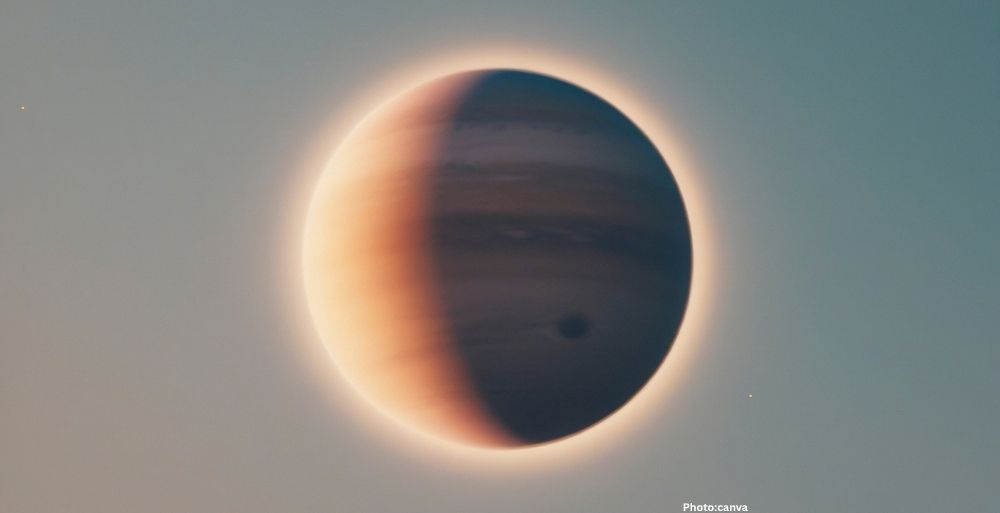
The primary reason for this lack of “outer-system” material is believed to be the rapid growth of Jupiter. As the first and largest planet to form from the Sun’s leftover gas and dust, Jupiter’s gravity became so extreme that it physically tore a gap in the molecular cloud.
This gap acted as a barrier. While the early Solar System was a chaotic shooting gallery of debris, Jupiter’s mass created a gravitational “shield” that prevented carbonaceous chondrites—the water-rich rocks from the cold outer reaches—from drifting inward toward the sun.
“The identification of two, distinct populations of meteorites… has precipitated a revolution in our understanding of the provenance of planetary materials,” the research team noted. This “isotopic dichotomy” suggests that the Solar System was effectively split into two isolated chemical laboratories very early in its history.
The Mystery of Life-Giving Carbon
If Earth is a “homogeneous” product of the inner Solar System—a region naturally depleted of carbon and water—it presents a paradox: how did carbon-based life-forms emerge?
Inner Solar System materials are typically rocky and volatile-poor. The ETH Zurich analysis confirms that Earth is isotopicially “homogeneous” across all elements, regardless of their geochemical character. This implies that the bulk of the planet’s mass is made of “dry” rock.
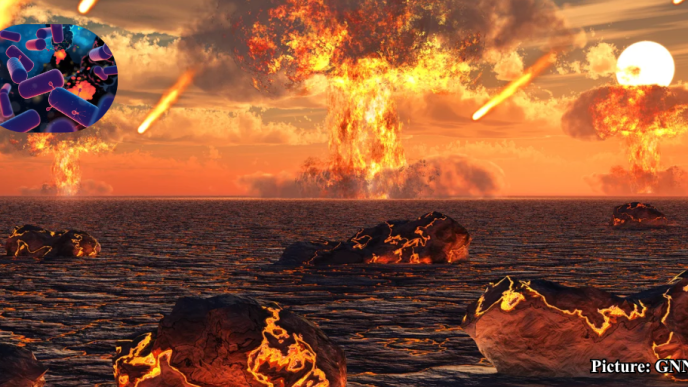
The prevailing theory, supported by the lack of initial carbon in the ETH Zurich data, is that the ingredients for life arrived as a “late veneer.” Once Earth had mostly finished accreting its inner-system mass, a small number of carbonaceous impactors from the outer Solar System may have managed to leap over Jupiter’s barrier during a later, more unstable period of the Solar System’s evolution. These late-stage arrivals likely delivered the oceans and the carbon necessary for biological chemistry.
Historical and Scientific Context
The debate over Earth’s origins has historically vacillated between the “local” and “delivered” models. Early 20th-century theories often assumed Earth was formed from a uniform cloud. However, the advent of precision mass spectrometry in the late 20th and early 21st centuries allowed scientists to detect “anomalies”—minuscule differences in atomic nuclei—that tell a much more complex story of migration and segregation.
“Our analysis shows that all elements… record the same isotopic [origin],” the researchers stated. This high level of precision suggests that the “inner-system only” model is more robust than previously thought. It challenges models of planetary formation that suggest a high degree of mixing between the inner and outer Solar System.
As scientists look toward other star systems to find “Earth 2.0,” this research highlights the critical role of gas giants. The presence and timing of a “Jupiter” may be the determining factor in whether a rocky planet becomes a dry, barren world or one capable of eventually catching the wandering, water-rich debris required for life.
Tags: Earth Formation, Jupiter Gravity, Isotope Analysis, Nucleosynthetic Anomalies, Planetary Accretion, Solar System History, Carbonaceous Chondrites, ETH Zurich, Space Chemistry, Protoplanetary Disk