
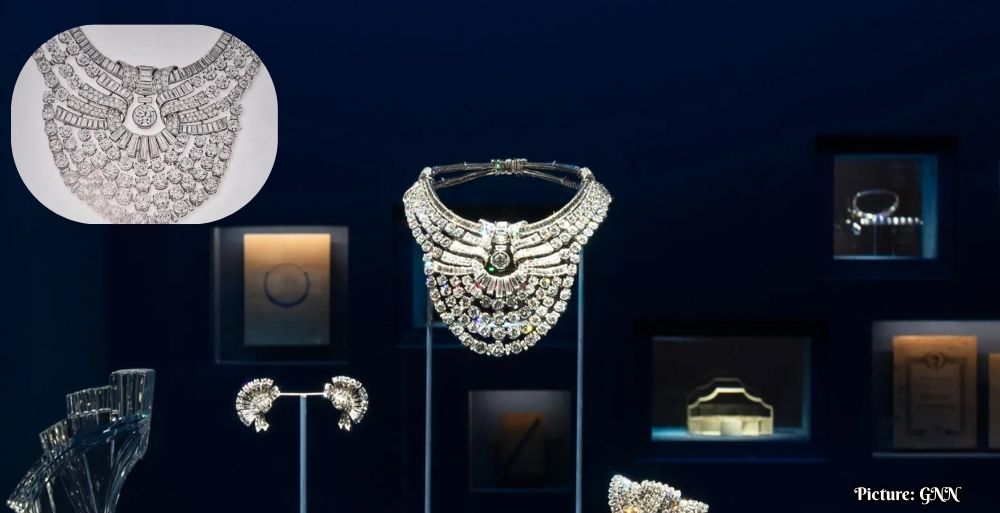
An international manhunt has been initiated following the audacious theft of a diamond necklace valued at over $4 million from the Museum of Applied Arts (MAK) in Vienna, raising significant concerns about the security of cultural institutions across Europe.
An international manhunt is currently underway for two suspects following a brazen theft that occurred at the Museum of Applied Arts (MAK) in Vienna, Austria, on Thursday afternoon. The two men, who reportedly purchased tickets to the exhibition, smashed a glass display case to seize a platinum and diamond necklace valued at more than $4 million (€3.5 million or £3 million). The necklace, which features over 600 diamonds, was part of a special exhibition dedicated to the renowned jeweler Van Cleef & Arpels, slated to run until September 2023.
The necklace holds historical significance, having been designed for the former Egyptian royal family and worn by Queen Nazli in 1939 during her daughter Fawzia’s marriage to Mohammad Reza Pahlavi, the future Shah of Iran. Lilli Hollein, the general director of MAK, expressed her distress over the incident, stating, “The theft of a highly valuable piece of jewellery… has hit us hard.”
Details of the Theft
According to Vienna police, the suspects were captured on CCTV, unmasked during the theft. They smashed the display case and swiftly fled toward the nearby Vienna Stadtpark, located just south of the museum. Authorities have released images of the suspects and are appealing to the public for assistance in their capture. Police reports indicate that one of the assailants was believed to be carrying what appeared to be a real firearm.
In response to the incident, police dog units have been deployed throughout Vienna and the province of Lower Austria to aid in the search. Forensic teams are actively analyzing evidence and reviewing CCTV footage to gather more information about the suspects and the circumstances of the theft. The swift response from law enforcement underscores the seriousness with which this crime is being treated.
Security Measures and Reactions from Museum Officials
In the wake of the theft, Lilli Hollein emphasized that the museum had developed a comprehensive security plan in collaboration with Van Cleef & Arpels specifically for the exhibition. She stated that all security measures were carefully prepared and that staff reacted calmly and followed established procedures during the armed incident, ensuring that no injuries occurred among visitors or staff. Hollein noted that MAK had conducted a thorough review of its security protocols ahead of the exhibition, particularly in light of similar high-profile thefts of cultural artifacts in recent years.
Despite the traumatic experience, the exhibition at MAK reopened on the following day, albeit without the stolen necklace. This decision reflects the museum’s commitment to preserving cultural heritage and continuing its programming, even in the face of security challenges.
The Broader Context of Museum Thefts in Europe
The theft at MAK is part of a disturbing trend of significant heists targeting cultural institutions across Europe. Just hours before the incident in Vienna, a major trove of prehistoric jewelry and artifacts was stolen from a museum in Spain. Earlier this month, four Renaissance paintings were taken from a museum in Sicily, and earlier this year, three paintings by renowned artists Renoir, Cézanne, and Matisse were stolen from a museum in Parma, collectively valued at millions of euros.
These incidents have raised alarm about the security of European cultural institutions. Europol has noted that museum thefts are becoming increasingly aggressive, with a shift towards more violent and forceful methods. This trend may indicate the involvement of new criminal networks specifically targeting art and cultural artifacts. The increase in high-profile thefts has prompted calls for enhanced security measures and collaboration among cultural institutions to protect invaluable heritage.
Historical Significance of the Stolen Necklace
The stolen necklace is not only a valuable piece of jewelry, weighing in excess of 200 carats, but it also embodies a rich historical narrative. It was auctioned approximately a decade ago with an estimated worth ranging from $3.6 million to $4.6 million. The artistic and cultural significance of such items underscores the importance of safeguarding them within cultural institutions. The necklace’s association with the former Egyptian royal family adds to its allure and value, making its theft a significant loss not only for the museum but also for cultural heritage.
Implications for Cultural Institutions
The recent thefts raise critical questions about the security infrastructure in place at museums and galleries across Europe. As the threat of theft becomes more pronounced, institutions may need to reevaluate their security protocols and consider investing in advanced technology and training for staff. The collaboration between law enforcement agencies and cultural institutions will be essential in developing strategies to deter future thefts and protect invaluable artifacts.
As the investigation into the Vienna theft continues, the art world remains on high alert, grappling with the implications of such brazen crimes on public trust and the preservation of cultural heritage. The theft serves as a stark reminder of the vulnerabilities faced by cultural institutions and the ongoing challenges in safeguarding history against criminal activity.