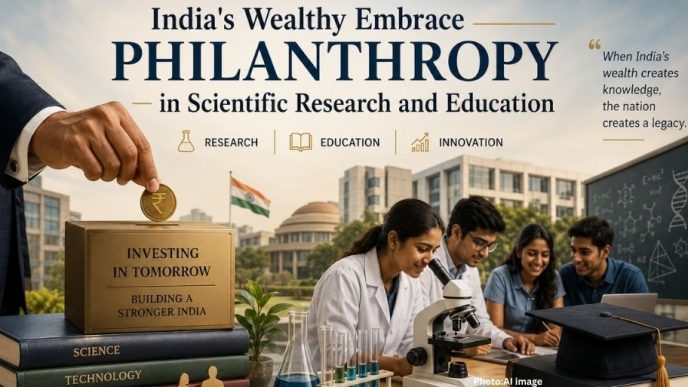

The recent trend among India’s wealthy to invest in scientific research marks a significant shift in philanthropic priorities, with major contributions aimed at enhancing the nation’s scientific infrastructure and innovation capabilities.
In a notable development for India’s philanthropic landscape, a growing number of wealthy individuals are redirecting their giving from religious institutions to scientific research and education. This shift was exemplified last year when Indian-American physicist Jainendra Jain received an unexpected call from Abhishek Lodha, CEO of the Lodha Group. Lodha, known for his high-profile real estate projects, including the Trump Tower in Mumbai, invited Jain to lead a new theoretical physics institute in the city, highlighting a burgeoning interest among affluent Indians in supporting fundamental sciences.
At the launch of the Lodha Theoretical Physics Institute, Jain expressed his surprise at this initiative, stating, “I was pleasantly surprised someone building skyscrapers would suddenly be interested in putting money into fundamental sciences. It’s a common thing to do for very rich people in the US, but not so much in India.” This sentiment underscores a pivotal moment in Indian philanthropy, as notable business figures begin to prioritize scientific advancement over traditional charitable practices.
Further illustrating this trend, Rajiv Bajaj, heir to one of India’s oldest business dynasties, recently announced the establishment of India’s largest scholarship program for women pursuing core engineering degrees. This initiative provides financial support of up to 800,000 rupees (approximately $8,411) to female scholars attending select universities, emphasizing the commitment to fostering a new generation of women in science and technology.
Historical Context of Philanthropy in India
Historically, Indian philanthropy has been heavily influenced by religious and cultural traditions, with nearly half of all donations directed toward temples and religious organizations. However, the recent surge in commitments to scientific research signals a transformative shift in the approach of India’s wealthy. Prominent figures in the tech and business sectors, such as Infosys co-founder Kris Gopalakrishnan and pharmaceuticals entrepreneur Kiran Mazumdar-Shaw, have made significant contributions to various scientific initiatives, including brain research and frontier biology laboratories.
This new wave of philanthropy is driven by a recognition among the affluent that a robust scientific foundation is essential for national competitiveness. Lodha commented, “No great nation has thrived without a deep scientific base. And we believe India produces great minds. So it’s not for a shortage of talent that this has not yet taken off, but a shortage of infrastructure.” His commitment of $100 million over the next eight to ten years to establish the Lodha Institute demonstrates the potential for substantial investments in scientific research.
Challenges in Indian Scientific Research
Despite these promising developments, experts note that India’s gross expenditure on research and development (R&D) remains low, at approximately 0.6-0.7% of GDP. This figure lags behind countries such as China, South Korea, and the United States, where the private sector contributes over 70% of R&D funding. In contrast, India’s private sector accounts for only 36%, highlighting a significant gap in investment.
Shaw has pointed out the historical shortcomings in India’s philanthropic support for pure sciences, stating, “All great academic institutions in the world from Harvard to MIT and Stanford have been built with philanthropic support. In India, the whole approach so far has been that this is the government’s job.” This perspective is slowly changing, as new generations of philanthropists seek to fill the void left by insufficient governmental funding.
The Role of Generational Change in Philanthropy
The current shift in philanthropic trends is largely attributed to the emergence of what Neera Nundy, co-founder of Dasra, refers to as “Inter-Gen” and “Now-Gen” givers. These individuals are characterized by their tech-savvy, data-driven approaches to philanthropy, which align closely with investments in science and research. Nundy emphasizes that while high-value commitments have been made, funding for science and innovation remains relatively modest compared to sectors like education and healthcare, which continue to dominate philanthropic efforts.
As India grapples with competing developmental priorities and a low per-capita income, the potential for science-led philanthropy remains significant. Estimates suggest that families could collectively increase their giving by $14-15 billion by fiscal year 2030, contingent upon the evolution of the philanthropic ecosystem and the establishment of credible pathways for long-term scientific investments.
The Future of Philanthropy in Science
Experts argue that sectors with direct synergies to business, such as pharmaceuticals, should take the lead in supporting scientific research. Shaw asserts that India’s pharmaceutical companies have yet to engage in cutting-edge research, but the next wave of value creation lies in innovative drug development, necessitating enhanced funding for research institutions.
As India continues to ascend on the development ladder, the shift toward philanthropy that emphasizes scientific excellence is expected to gain momentum. Lodha encapsulates this evolution, stating, “A society in need of upliftment was met with philanthropy of service, and now naturally you’ll see the trend shift to philanthropy of excellence.” This evolving narrative reflects a broader recognition of the critical role that scientific research and education play in shaping India’s future.