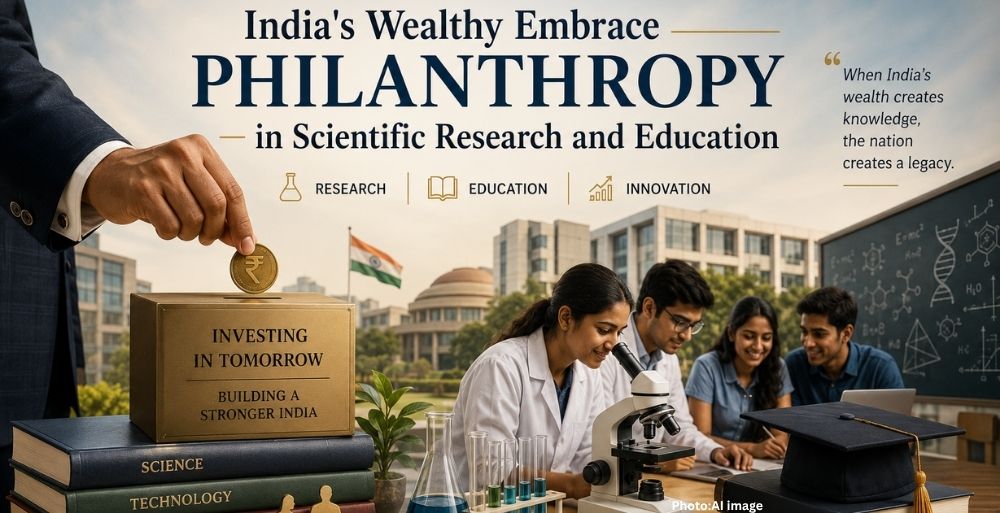
Recent philanthropic initiatives by India’s wealthiest individuals signal a significant shift towards funding scientific research and education, traditionally overshadowed by donations to religious organizations.
In a notable development for India’s philanthropic landscape, prominent business leaders are increasingly directing their financial support towards scientific research and education. This trend was exemplified in 2023 when Indian-American physicist Jainendra Jain, a co-recipient of the distinguished 2025 Wolf Prize, was approached by Abhishek Lodha, head of the Lodha Group, to lead a new theoretical physics institute in Mumbai. Jain, a professor at Penn State University, expressed his surprise at the interest shown by a real estate mogul in supporting fundamental sciences, an initiative he described as uncommon in India compared to the United States.
The launch of the Lodha Theoretical Physics Institute marks a pivotal moment in the evolution of philanthropic priorities among India’s affluent. Traditionally, Indian philanthropy has been heavily focused on religious institutions, with nearly half of all donations directed toward temples and religious organizations. However, the emerging commitment to scientific advancement signals a shift in how the wealthy perceive their role in societal development.
Growing Investments in Science
Following the establishment of the theoretical physics institute, Rajiv Bajaj, a member of one of India’s oldest business families, initiated the country’s largest scholarship program aimed at women pursuing core engineering disciplines. This program offers financial support of up to 800,000 rupees (approximately $8,411 or £6,293) for female scholars attending select prestigious universities.
The wave of financial commitments from India’s elite extends beyond these two initiatives. Notable figures such as Kris Gopalakrishnan, co-founder of Infosys, have made significant contributions towards brain research, while pharmaceuticals entrepreneur Kiran Mazumdar-Shaw has launched a laboratory focused on frontier biology. These efforts are part of a broader trend among tech billionaires, especially those based in Bengaluru, often referred to as India’s Silicon Valley, who have pledged substantial amounts for a variety of scientific endeavors, from robotic astronomy to multi-specialty medical research.
The Link Between Philanthropy and National Competitiveness
Experts suggest that this increasing recognition among India’s wealthy of the interconnection between scientific investment and national competitiveness is driving this shift. As India seeks to enhance its position in the global economy, the need for robust scientific research and development becomes increasingly apparent. The transformation in philanthropic priorities reflects a growing understanding that investment in science is essential for fostering innovation and long-term economic growth.
Moreover, this shift may also be influenced by a changing cultural landscape in India, where the younger generation of entrepreneurs and business leaders is often more globally minded and aware of the pivotal role that science and technology play in modern society. This generational change could signify a move away from traditional forms of charitable giving towards more impactful investments in education and research.
As these initiatives gain momentum, they not only promise to enhance India’s research capabilities but also aim to inspire a new generation of scientists and innovators. The commitment of India’s wealthy to fund scientific endeavors could potentially lead to breakthroughs in various fields, helping to position the country as a leader in global research and innovation.
Historical Context of Philanthropy in India
The tradition of philanthropy in India is deeply rooted in its cultural and historical context. While donations to temples and religious entities have long been the primary focus, this new trend in funding scientific research marks a significant departure. The Indian philanthropic landscape has been characterized by a strong inclination towards charitable giving for social causes, health, and education, yet it has often overlooked the critical area of scientific endeavor.
Historically, the Indian elite, including industrialists and business magnates, have contributed to various causes, primarily in alignment with community welfare and religious institutions. For instance, the Tata Group has a long history of philanthropy, but much of it has been directed towards education and health rather than research sciences. In this context, the recent shift towards funding scientific research can be seen as a response to both global trends and domestic needs.
Implications for the Future of Indian Science
The implications of this philanthropic shift are profound. With increased funding for scientific research, India is poised to make significant strides in areas such as health technology, environmental science, and artificial intelligence. This could not only elevate India’s status on the global scientific stage but also contribute to solving pressing national challenges, such as public health crises and climate change.
Furthermore, the establishment of research institutes and scholarship programs can foster a culture of innovation and critical thinking among students and researchers. This is particularly important in a country where educational infrastructure in science and technology has historically lagged behind other sectors. By directing funds towards education in core engineering and the sciences, these philanthropic efforts could nurture a new generation of scientists who are equipped to tackle future challenges.
Conclusion
The recent philanthropic commitments by India’s affluent towards scientific research represent a significant paradigm shift. As these trends continue to evolve, they could reshape the landscape of Indian philanthropy, encouraging further investments in education and technological advancement, and ultimately contributing to the nation’s long-term competitiveness on the global stage. If sustained and expanded, this movement could lay the groundwork for India’s emergence as a global leader in scientific research and innovation, aligning its philanthropic practices with the pressing needs of the 21st century.