As the 2026 US midterm elections approach, Indian-American voters emerge as a significant demographic, with distinct political preferences and an array of candidates vying for their support.
The upcoming midterm elections on November 3, 2026, will see all 435 seats in the House of Representatives and 35 Senate seats contested, alongside numerous gubernatorial and state legislative races. These elections will shape the political landscape for President Joe Biden’s final two years in office, making the role of key voting blocs, including Indian Americans, particularly crucial.
Demographics of Indian-American Voters
According to a 2023 report by the Pew Research Center, approximately 5.2 million individuals of Indian origin reside in the United States, based on data from the US Census Bureau. Notably, nearly half of this population is concentrated in four states: California (20%), Texas (12%), New Jersey (9%), and New York (7%). Major metropolitan areas such as New York City, the San Francisco Bay Area, and Dallas serve as significant hubs for Indian Americans.
However, it is essential to note that population size does not directly translate to electoral influence. As of 2022, roughly 2.2 million Indian Americans were eligible to vote, reflecting the importance of voter turnout and the political dynamics within specific congressional districts. Areas with a concentrated Indian-American electorate can wield significant influence in closely contested races, while a larger but dispersed population may have diminished impact.
Political Leanings of Indian Americans
Historically, Indian-American voters have leaned towards the Democratic Party, but recent polling indicates a shift in political allegiances. A survey conducted by Pew Research Center revealed that 68% of registered Indian-American voters identified with or leaned toward the Democrats, while 29% aligned with the Republicans. This survey was based on interviews conducted in 2022 and 2023.
Further insights from the 2026 Indian American Attitudes Survey by Carnegie, conducted in partnership with YouGov, indicated that 46% of respondents favored the Democratic Party, compared to 19% supporting the Republican Party. Notably, the percentage of respondents identifying as independent increased to 29%. These statistics highlight a community that, while predominantly Democratic, shows signs of political diversity.
Additionally, a 2026 Asian American Voter Survey conducted by AAPI Data and APIAVote found that 66% of Indian-American participants preferred a Democratic candidate for the US Senate, with only 22% supporting a Republican candidate. For the House of Representatives, the Democratic preference remained at 66%, compared to 18% for Republicans. These results should be interpreted as a snapshot of current preferences rather than predictive of future voting behavior, given differences in methodology and questioning across surveys.
Key Issues for Indian-American Voters
Central to the political decisions of Indian-American voters are issues concerning the economy, immigration, and healthcare. Economic pressures, particularly the rising cost of living, resonate deeply within the community. An AP-NORC poll from October 2026 indicated that 80% of registered voters viewed reducing living costs as a top priority for the next Congress, reflecting a broader national concern.
Immigration policy holds particular significance for many Indian-American families, especially regarding changes to skilled-worker visas, permanent residency options, and family migration policies. Disapproval of former President Donald Trump’s handling of immigration and economic issues was widespread among Indian Americans, according to the Carnegie survey. Furthermore, while many expressed concerns regarding his management of US-India relations, a significant portion of respondents indicated they had no opinion on the matter.
Indian-Origin Candidates in the 2026 Elections
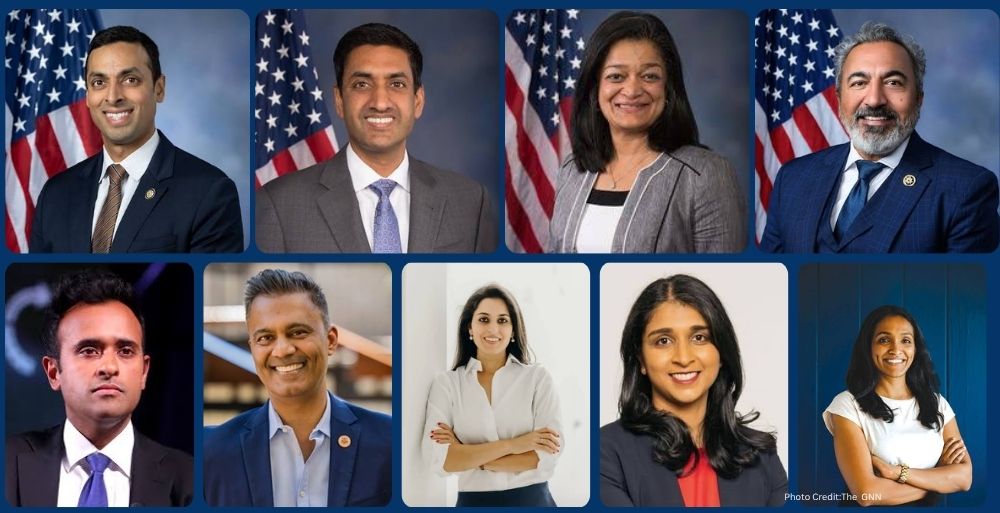
In the 2026 midterm elections, Indian-origin candidates are competing across various political offices, representing both the Democratic and Republican parties. Prominent races include:
- Vivek Ramaswamy: The Republican candidate is contesting for governor of Ohio against Democrat Amy Acton. Ramaswamy, whose parents emigrated from India, previously ran for the Republican presidential nomination in 2024.
- Ro Khanna: The Democratic representative is seeking re-election in California’s 17th district, which encompasses parts of Silicon Valley. He faces Republican challenger Ritesh Tandon.
- Pramila Jayapal: The Democratic representative is running for re-election in Washington’s 7th district, known for her progressive stances on immigration and economic inequality. Her opponent is Republican Nirav Sheth.
- Ami Bera: The Democratic incumbent in California’s 3rd district is running for re-election, having served in Congress since 2013.
- Suhas Subramanyam: The Democratic representative is seeking re-election in Virginia’s 10th district.
- Amish Shah: The Democratic candidate is contesting Arizona’s 1st district.
- Pia Dandiya: The Democrat is running in South Florida’s 22nd district.
- Saritha Komatireddy: The Republican candidate is challenging incumbent Letitia James for New York attorney general.
- Nithya Raman: The Los Angeles city council member is running against incumbent Mayor Karen Bass.
Other Indian-origin candidates are also contending in state legislative races, including Pooja Sethi and Sandeep Srivastava in Texas, further broadening the representation of Indian Americans in the electoral landscape.
Potential Influence of Indian-American Voters
The political influence of Indian-American voters extends beyond the mere presence of candidates of Indian origin. Key factors include the number of eligible voters in each constituency, their turnout rates, and the competitiveness of races. Districts with concentrated Indian-American populations may exhibit different electoral dynamics compared to states with larger but more dispersed populations.
Historically, Indian Americans demonstrate high levels of civic engagement and voter participation. Data from the AAPI Data/APIAVote 2026 Survey indicates that 90% of registered Indian-American voters intend to vote, with 71% expressing absolute certainty about their participation. This engagement positions Indian-American voters as a potentially decisive force in tightly contested races across critical battleground states during the upcoming midterm elections.