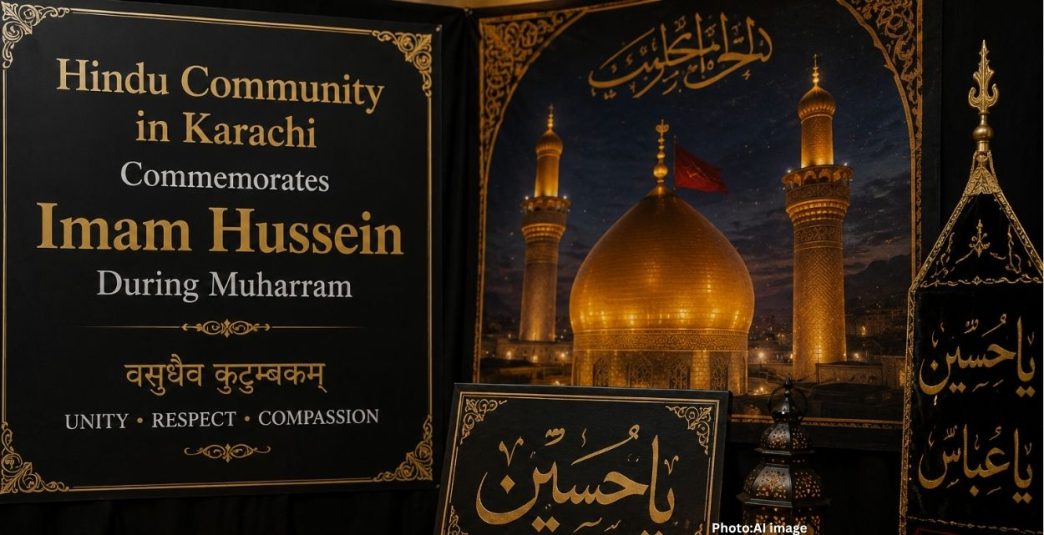
The Hindu community in Karachi actively engages in the observance of Muharram, honoring Imam Hussein’s legacy through rituals and cultural practices, reflecting a historical intertwining of Hinduism and Shiite Islam.
KARACHI, Pakistan — In a remarkable display of interfaith respect and cultural integration, members of the Hindu community in Karachi are participating in rituals commemorating the martyrdom of Imam Hussein during Muharram, one of the most sacred months in the Islamic calendar. This unique participation highlights long-standing historical ties between Hinduism and Shiite Islam, particularly in the context of South Asian cultural practices.
Raju Rathore, a Hindu resident of Karachi, expressed his deep commitment to honoring Imam Hussein, stating, “Muharram is very important to me and I want to keep participating in it for as long as I live.” Rathore’s family migrated from Gujarat, India, during the Partition in 1947, and his dedication to Imam Hussein is rooted in a personal vow made by his mother at the shrine of Masoom Shah Bukhari. She promised that if she had children, they would honor Hussein’s martyrdom by crafting tazias—temporary replicas of his mausoleum that are carried in processions during Muharram.
The Historical Context of Imam Hussein’s Martyrdom
The story of Imam Hussein, who was killed alongside his family during the Battle of Karbala in present-day Iraq in the seventh century, is a defining moment in Islamic history. His martyrdom not only symbolizes the struggle against tyranny but also marks a significant event in the schism between Sunni and Shiite branches of Islam. The rituals of mourning peak on Ashoura, the 10th day of Muharram, which is observed by millions around the world.
The involvement of non-Shiite communities in these rituals is not a recent phenomenon; it has historical roots that extend back centuries. Justin Jones, a professor of religious studies at the University of Oxford, notes that many ruling dynasties in South Asia were Shi’a, which facilitated the integration of Hussein’s martyrdom into public life. This involvement helped transform Muharram observances into civic events that attracted participation from diverse communities, including Hindus.
Over the years, however, the nature of participation has evolved. Although many Hindus historically engaged in Muharram rituals, the last century has seen a trend toward more separate observance of religious practices among different communities. This shift reflects broader sociopolitical changes in South Asia, where sectarian identities have grown more pronounced.
Current Practices and Cultural Significance
According to the 2023 census, Hindus comprise nearly 3.9 million individuals in Pakistan, making them the country’s largest religious minority. Despite facing challenges related to religious freedom, including reports of discrimination and violence as noted by organizations like the Minority Rights Group, many Pakistani Hindus continue to practice their faith openly. Rathore, for instance, has found a space within the Shiite community in Karachi to participate in Muharram rituals. “Yes, I am Hindu, but this is not about religion,” he asserts. “Many of my fellow Hindus also hold Imam Hussein in great respect.”
Rathore’s sentiments are echoed by Bharat Kumar, another member of the Hindu community in Karachi, who emphasizes the importance of respecting others’ traditions. “Our religion has never taught us that because we are Hindus we should not participate in or respect others’ traditions,” Kumar explains. He highlights the shared human experience of devotion, stating, “We celebrate our own festivals with great enthusiasm and grandeur, and we approach this in the same way during Muharram.”
During the month of Muharram, Rathore and Kumar actively engage in Shiite congregation halls, participating in prayers and rituals, including the practice of chest beating, which is an expression of grief for Hussein’s martyrdom. They also join processions, marking their respect for the event with their presence. The crafting of tazias remains a vital aspect of their observance. Rathore has dedicated nearly 45 years to this tradition, creating these replicas from various materials such as paper, glass, and cardboard, often collected over time with the help of his family members.
Passing Down Traditions to Future Generations
As Rathore prepares to pass on the traditions surrounding Muharram to his son, he reflects on the personal and communal significance of these rituals. “I have been doing this not just for a few years but for about 45. I am now 52 years old, and as long as I have the strength to continue, I will keep making them,” he shares. This commitment underscores the importance of intergenerational transmission of cultural and religious practices, even amidst changing societal dynamics.
Rathore’s story exemplifies the potential for interreligious solidarity in a complex societal landscape marked by both diversity and division. His experience, while unique, also serves as a reminder of the historical coexistence of different religious communities in South Asia and the continued relevance of shared cultural practices. Despite challenges, the enduring legacy of Imam Hussein resonates across religious boundaries, fostering a sense of community and mutual respect that transcends sectarian divides.