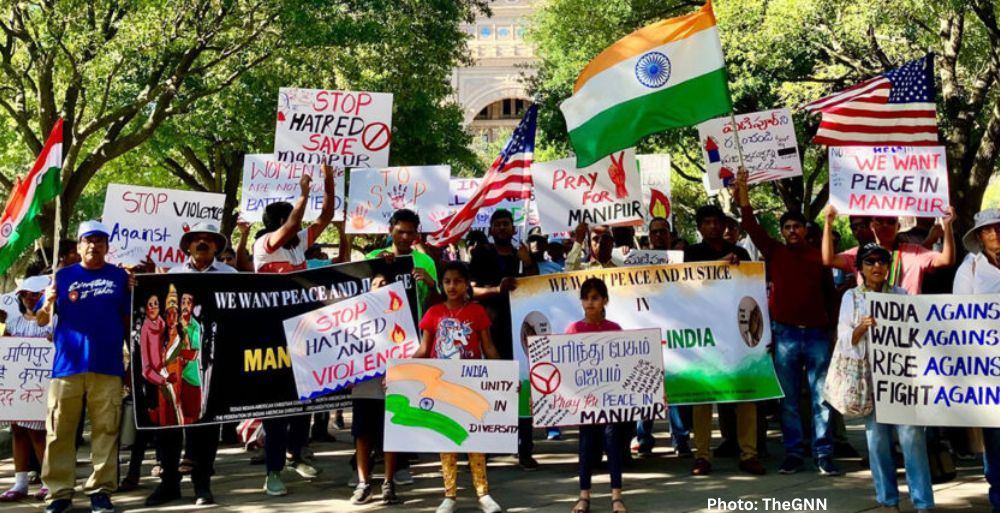
When FIACONA President Bimal John walked into Ambassador Sam Brownback’s office on September 9, he carried more than a written appeal. He carried the weight of a community increasingly fearful that India’s democratic promises are slipping away. In his hands was the story of Arun Pannalal, a 76yearold Christian leader whose detention in Chhattisgarh has become a symbol of the rising pressures faced by India’s Christian minority.

“We are grateful to Ambassador Brownback for meeting with us and listening to our concerns regarding Mr. Pannalal,” John said, emphasizing FIACONA’s central plea: “We ask only that Mr. Pannalal’s fundamental rights, health, safety, dignity, access to counsel, and right to a fair judicial process receive appropriate attention.”
A Lifetime of Service Now Shadowed by Detention
For decades, Mr. Pannalal served as President of the Chhattisgarh Christian Forum, often traveling to remote tribal villages where Christians faced “violence, displacement, arrests, threats, and other religious-freedom challenges.”
One pastor from Bastar recalled how Pannalal once arrived unannounced after a church was burned down. “He sat with us on the ground,” the pastor said. “No cameras, no speeches. He just listened and prayed.” That quiet solidarity made him a trusted figure among thousands of believers.
Today, that same man sits in judicial custody—arrested on August 7, produced before a magistrate on August 8, and denied bail twice. His alleged offense: a disputed socialmedia comment.
A Case That Mirrors a National Pattern
According to FIR No. 415/2026, Mr. Pannalal was charged under Sections 196, 299, and 353(2) of the Bharatiya Nyaya Sanhita. His defense has questioned whether he authored or published the comment and stressed the need for proper electronic evidence review.
But the deeper concern is not the allegation—it is the speed and severity of the state’s response. Across India, Christian communities report:
∙ Churches attacked during prayer
∙ Families displaced from tribal regions
∙ Pastors arrested under anticonversion laws
∙ Criminal complaints filed over WhatsApp messages
∙ Bail routinely denied, prolonging pretrial detention
In village after village, believers describe a climate where suspicion has replaced trust. A schoolteacher in Madhya Pradesh shared how police arrived at her home after a neighbor accused her of “forced conversion” for praying with a grieving family. “I was terrified,” she said. “I kept thinking—if they can arrest someone like Mr. Pannalal, what chance do ordinary people have?”
Humanitarian Concerns Hidden in Legal Procedure
FIACONA’s appeal to Ambassador Brownback was not a political maneuver—it was a humanitarian plea. Mr. Pannalal’s age and health make his continued detention particularly troubling. As FIACONA notes, the organization seeks only “lawful and appropriate attention to Mr. Pannalal’s age, health, safety, access to counsel, religious-freedom concerns, and due-process rights.”
One FIACONA volunteer described the emotional toll on Pannalal’s family: “His wife keeps asking why a man who spent his life helping others is now behind bars. We have no answer.”
International Recognition of a Growing Crisis
The United States Commission on International Religious Freedom (USCIRF) has included Mr. Pannalal in its Frank R. Wolf Freedom of Religion or Belief Victims Database, identifying him as a Christian detained for religious expression and listing his status as ‘Not Released.’
This designation is not a verdict—it is a warning. It signals that India’s treatment of religious minorities is drawing global scrutiny.
Respect for India’s Judiciary—And a Call for Justice
FIACONA is careful to respect India’s sovereignty and judicial independence. As the organization states, “Our request is not that anyone tell an Indian court what decision it should make.”
But it also insists that justice must be humane. “Respect for judicial independence and advocacy for fundamental human rights are not conflicting principles,” John said.
This balance—firm advocacy without interference—defines FIACONA’s approach.
A Moment of Decision for India
Mr. Pannalal’s case is more than a legal proceeding. It is a test of India’s commitment to religious freedom. It raises a difficult question: Is India drifting toward a system where minority religious expression is treated as a criminal act?
For India’s Christians, the answer will shape their future. For the global Church, it is a call to stand with those who suffer for their faith. And for Mr. Pannalal, it is a moment that reveals the strength of a lifetime spent serving Christ and His people.
FIACONA will continue to monitor developments, advocate responsibly, and protect the privacy of Mr. Pannalal’s family. The organization remains committed to ensuring that justice—prompt, fair, impartial, and evidencebased—prevails.
About FIACONA
The Federation of Indian American Christian Organizations of North America is a coalition of Indian American Christian churches and organizations dedicated to advancing religious freedom, human rights, community unity, and responsible advocacy for persecuted Christians and other vulnerable faith communities.