In a landmark move, the European Union has invited Canada to become its first-ever ‘associate member,’ reflecting shared democratic values and strategic interests amid global geopolitical challenges.
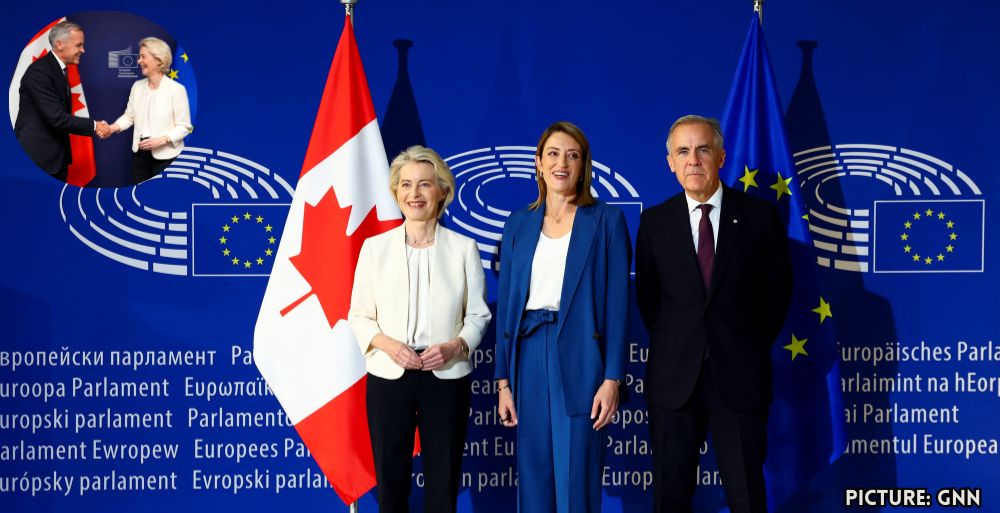
The European Union (EU) has made a significant step toward deepening its relationship with Canada by inviting the country to become its first ‘associate member.’ This unprecedented offer was made by European Commission President Ursula von der Leyen during a speech in Strasbourg on Wednesday, where she emphasized that both the EU and Canada share a vision on critical global issues such as artificial intelligence, climate change, the ongoing war in Ukraine, and broader geopolitical dynamics.
During the event, which was attended by Canadian Prime Minister Mark Carney, von der Leyen stated, “We want to bring the relationship with Canada to the highest level possible. We must urgently reimagine our partnerships. So, I would like to work with you on opening the door for Canada to be the first associate member of the EU.” This invitation comes at a time when Canada is actively seeking to diversify its trade relationships, particularly in light of its heavy reliance on the United States.
Context of the Invitation
Prime Minister Carney, who is scheduled to address the European Parliament on Thursday, has been vocal about establishing a “unique alliance” with the EU. He tweeted on Wednesday, “Canada and the EU are natural partners, united by shared values. With President von der Leyen and [European Parliament] President [Roberta] Metsola, we focused on what comes next: a deeper partnership that reinforces our mutual sovereignty to create more opportunities and prosperity for our peoples.”
This invitation is particularly notable given the backdrop of changing U.S. trade policies under President Joe Biden, who, upon taking office, reinstated tariffs on several allies, including Canada. The EU and Canada already share a comprehensive trade agreement and various bilateral agreements, but their relationship has intensified since recent tensions with the U.S. emerged during the Trump administration, which included discussions about Canada becoming the 51st U.S. state.
Future Developments and Strategic Goals
Von der Leyen indicated that existing trade agreements between Canada and the EU would be upgraded to form an “alliance for the future,” aimed at fostering a “common prosperity and economic security space.” This proposed alliance could see the two parties collaborating more closely in sectors such as energy, critical minerals, battery technology, artificial intelligence, quantum computing, cybersecurity, and overall economic security.
The EU, composed of 27 member states, has never had an associate membership framework. While countries like Norway, Iceland, and Switzerland maintain close ties with the EU and comply with many of its regulations, the specific implications of this new associate membership category for Canada, particularly regarding its relationship with the EU single market, remain unclear.
Historically, EU officials have been resistant to creating an arrangement where a non-member country can enjoy partial benefits of the single market, particularly following the UK’s departure from the EU. The four freedoms of the EU internal market—freedom of goods, services, people, and capital—are foundational principles that the EU has staunchly defended.
Reception and Criticism
Carney is anticipated to receive a warm welcome when he delivers his address to the European Parliament, particularly in light of his approach to international relations, which has garnered praise from many Members of the European Parliament (MEPs). Last month, he announced the suspension of trade negotiations with the U.S. after expressing that Canada would not accept being subjugated to U.S. demands, subsequently implementing retaliatory tariffs on billions of dollars of U.S. imports.
In contrast, the EU accepted a 15% tariff on several European goods last year while easing its own tariffs to avoid escalating trade tensions with the U.S. Javier Moreno Sánchez, a Spanish socialist MEP and head of the European Parliament’s Canada delegation, remarked that Carney’s dealings with Trump could provide valuable lessons for the EU, emphasizing the importance of demonstrating strength in diplomatic negotiations.
While Carney’s rhetoric at international forums, such as his speech at Davos, has resonated with many European officials, discussions may arise concerning the ratification of the EU-Canada trade deal, which is still pending approval from ten EU member states, including France, Poland, and Italy, nearly a decade after it was originally agreed upon in 2016.
Implications for EU Relations
The EU’s invitation to Canada for associate membership is poised to prompt discussions among other EU allies, particularly the UK, which has sought a more flexible relationship with Brussels post-Brexit. Political analysts like Martin Leng from the Brussels Institute for Geopolitics have noted that the current global landscape is pushing the EU towards greater flexibility in its relations with third-party countries.
Leng highlighted that von der Leyen’s focus on various sectors of cooperation suggests that the envisioned associate membership may not equate to traditional EU membership but could involve Canada integrating into existing EU programs and frameworks, such as the European Defence Agency. As the discussions progress, the details surrounding the nature and benefits of associate membership for Canada will be closely scrutinized by both EU officials and international observers.