An alleged mass shooting plot directed at a prominent Hindu house of worship in Aurora, Illinois, has triggered widespread alarm across the Indian-American community and drawn sharp condemnation from international diplomats, federal lawmakers, and civil rights organizations. Law enforcement officials arrested 19-year-old Alexandros Paporakis following intelligence indicating a planned assault during sacred religious celebrations. Investigators stated that although the suspect arrived at the temple grounds armed with an AR-style rifle and tactical gear, a mechanical weapon malfunction prevented the discharge of any rounds. The plot was ultimately uncovered when coworkers alerted police after the suspect detailed his neo-Nazi beliefs and expressed intentions to return, prompting renewed calls for enhanced security at religious institutions nationwide.
AURORA, Ill. — A harrowing security breach unfolded in the western suburbs of Chicago when local and federal authorities intercepted what investigators describe as a premeditated mass casualty plot targeting a major Hindu temple. The averted tragedy has laid bare ongoing anxieties regarding domestic violent extremism, specifically the proliferation of white supremacist ideology and the physical vulnerabilities facing minority religious spaces in the United States.
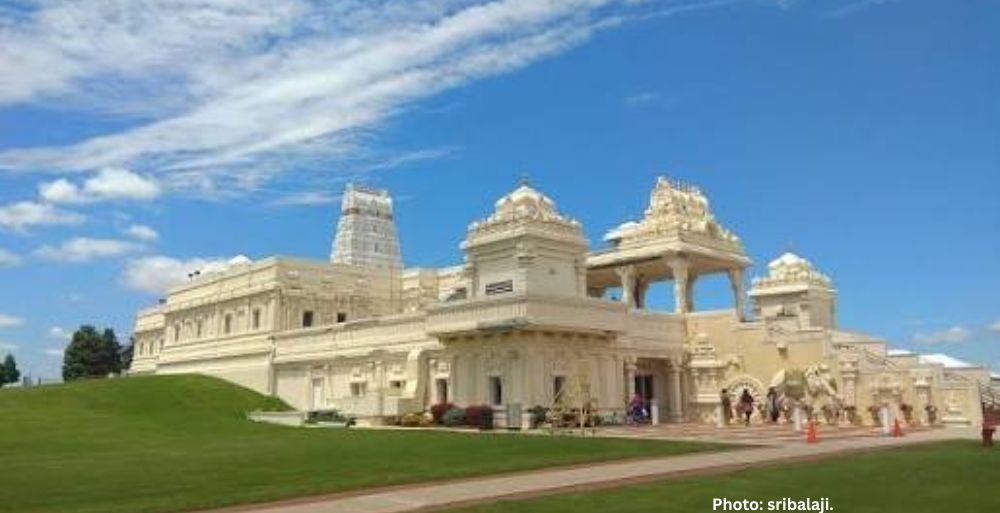
The incident transpired during the weekend celebration of Navaratri at the Sri Venkateswara Swami (Balaji) Temple in Aurora, a spiritual hub that draws thousands of congregants from across the Midwest. According to charging documents filed by prosecutors in Cook County, 19-year-old Alexandros Paporakis of Palatine drove to the temple property equipped with body armor and carrying an unregistered semi-automatic rifle accompanied by extensive ammunition magazines.
Law enforcement officials disclosed that the suspect positioned himself on the premises with the intent to fire upon worshippers. However, the attack was abruptly halted due to equipment failure: the suspect’s firearm jammed mechanically, rendering it inoperable. Unable to clear the malfunction on-site, the suspect fled the location before police were alerted.
Vigilant Coworkers and Rapid Law Enforcement Intervention
Rather than immediate police surveillance, the interception of the alleged plot relied heavily on bystander intervention. Following his departure from the Aurora temple, Paporakis reportedly returned to his workplace and engaged coworkers in conversation regarding the aborted attack. Witnesses told investigators that the suspect openly articulated neo-Nazi and white supremacist ideologies while threatening further violence against the community.
Recognizing the severity of the threat, the coworkers promptly contacted local law enforcement agencies. Officers from the Palatine Police Department, acting in close coordination with federal partners, located and apprehended Paporakis later that same afternoon near his residence.
Subsequent execution of search warrants yielded the firearm in question, tactical gear, hundreds of rounds of ammunition, and a handwritten manifesto outlining radical ideological motivations. A local magistrate ordered the defendant held without bond during an initial appearance at the Cook County courthouse.
Congressional Representative Recounts Presence at Scene
The gravity of the foiled attack resonated deeply within federal legislative circles, particularly for U.S. Representative Raja Krishnamoorthi (D-Ill.), whose congressional district encompasses the area. Krishnamoorthi revealed publicly that he and members of his immediate family were inside the Balaji sanctuary participating in worship services at the exact time the armed suspect was outside.
“I am horrified that a white supremacist attempted to carry out a mass shooting targeting Indian Americans at the Hindu temple in Aurora where my family worships. My family and I were there when the attack was attempted last Sunday,” Krishnamoorthi stated during a press conference addressing the community.
The congressman emphasized the psychological toll of the event while expressing gratitude toward the individuals whose vigilance prevented bloodshed. “I am grateful to the suspect’s coworkers who alerted police and commend the law enforcement officers who intervened. Every American deserves to live and worship without fear, and we must stand together against hatred in all its forms,” he added.
Federal authorities echoed these sentiments regarding interagency cooperation. Ryan Whalen, special agent in charge of the FBI’s Chicago field office, underscored the bureau’s posture toward ideologically motivated threats.
“The FBI aggressively works alongside our local and state law enforcement partners to identify, investigate, and dismantle any threats of violence driven by radical ideologies,” Whalen noted in a formal statement confirming the joint investigation.
International Repercussions and Diplomatic Condemnation
The news of the attempted mass shooting swiftly reached diplomatic channels in Washington and New Delhi, prompting swift expressions of concern from foreign officials. Vinay Mohan Kwatra, India’s Ambassador to the United States, released a formal statement denouncing the hostile rhetoric underlying the incident.
“The attempted mass shooting at the Hindu temple in Aurora is deeply disturbing. Racist violence, including anti-Hindu and anti-India hate has no place in a civilized society,” Ambassador Kwatra wrote via social media channels.
The episode adds to a growing catalog of security concerns cited by diaspora organizations regarding anti-Hindu sentiment and xenophobic violence in Western nations. Previous reports of vandalism and intimidation at religious facilities in Ohio and other states have heightened sensitivity among community leaders.
In response to the Aurora arrest, several advocacy bodies—including the Hindu Mandir Empowerment Council, the Foundation for India and Indian Diaspora Studies, and the Coalition of Hindus of North America—issued coordinated security advisories. These networks encouraged temples nationwide to audit their physical access controls, establish direct communication linkages with municipal police departments, and maintain heightened vigilance during public gatherings.
As local and federal prosecutors prepare formal indictments, legal experts anticipate that the case will prompt renewed legislative discussions surrounding domestic terrorism statutes, hate crime enhancements, and the regulation of firearm access for individuals exhibiting radicalized behavioral indicators.