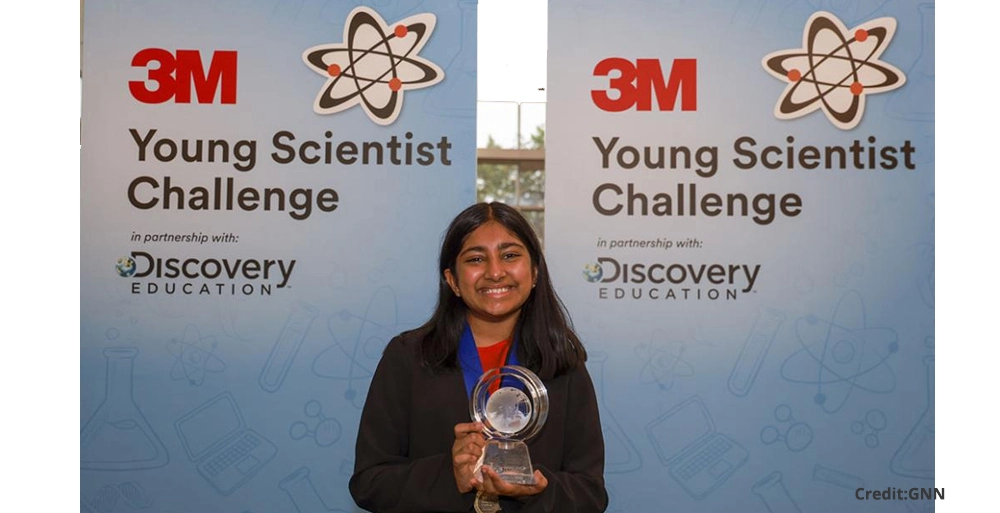
A 13-year-old from Farmington, Connecticut, has been awarded the title of America’s Top Young Scientist for her innovative project aimed at combating ocean acidification.
FARMINGTON, CT — Raji Doshi, a 13-year-old eighth-grader from Farmington, Connecticut, has been named America’s Top Young Scientist after winning the 2026 3M Young Scientist Challenge. Her project, designed to address the critical environmental issue of ocean acidification, earned her a cash prize of $25,000 and the prestigious title during the competition held at 3M’s global headquarters in St. Paul, Minnesota, on October 12-13, 2026.
The announcement of the award was made on October 14 by 3M and Discovery Education, following a competitive series of events featuring ten finalists from across the United States. These young scientists, aged 11 to 14, showcased their innovative solutions to pressing real-world problems, demonstrating exceptional creativity, scientific knowledge, and the application of STEM (science, technology, engineering, and mathematics) principles.
Understanding Ocean Acidification
Doshi’s project addresses a critical and urgent environmental issue: ocean acidification, which poses a significant threat to marine life. This phenomenon occurs when seawater absorbs excess carbon dioxide (CO2) from the atmosphere, leading to chemical changes that adversely affect marine organisms, particularly shellfish and corals. These changes complicate the ability of these creatures to build and maintain their shells and skeletons, ultimately threatening marine ecosystems.
Her interest in this topic stems from her passion for collecting seashells and her deep concern about the effects of changing ocean chemistry on marine organisms. Doshi’s innovative solution, named ALKACORE, combines the cultivation of macroalgae with aragonite, a naturally occurring mineral form of calcium carbonate. Her project, titled Engineering a Novel Durable Algae-Aragonite Alkalinity System to Reduce CO2-Driven Ocean Acidification, explores whether combining algae with natural mineral buffers can offer a sustainable and cost-effective approach to mitigating coastal acidification.
According to the competition organizers, Doshi’s research findings indicated that the addition of aragonite significantly increased algae biomass, effectively removing carbon dioxide while substantially lowering dissolved carbon dioxide levels in her experimental setup. Furthermore, she developed a computational model to ascertain the optimal amount of aragonite needed, enhancing the practicality of her approach for potential real-world applications in coastal communities.
Competition Details and Evaluation
The 3M Young Scientist Challenge, now in its 19th year, aims to inspire middle school students to engage with scientific challenges and develop innovative solutions under the guidance of professional scientists. Each participant submitted short videos detailing the specific problems they aimed to address and their proposed scientific methodologies. Finalists were evaluated based on multiple criteria, including creativity, scientific knowledge, communication skills, ingenuity, and the effective application of STEM principles.
Throughout the summer leading up to the final competition, each finalist collaborated individually with a 3M scientist to refine their ideas into working prototypes. Doshi was paired with Deborah Isabelle, a product engineering specialist at 3M, who emphasized the significance of Doshi’s passion for marine life in driving her project. “Raji’s project reminds us that when you’re passionate about something, you can use that interest to change the world,” Isabelle stated. “It was that passion that led her to create ALKACORE to address the ocean acidification issue.” This mentorship experience highlights the importance of guidance and support in fostering young scientific talent.
Recognition and Future Implications
William Brown, chairman and CEO of 3M, praised all finalists for their contributions to addressing real-world challenges through scientific research. “The 3M Young Scientist Challenge highlights the incredible potential of young people to tackle real-world challenges through science,” Brown remarked, congratulating Doshi on her remarkable achievement. Previous winners of the competition have gone on to file patents, establish nonprofit organizations, deliver TED Talks, and earn recognition on platforms such as the Forbes 30 Under 30 list.
For Raji Doshi, receiving national recognition for her work on ocean acidification not only comes with a substantial cash prize but also with the title of America’s Top Young Scientist. This honor underscores her contributions to a pressing environmental issue and highlights the importance of encouraging young innovators in the field of science. It also serves as a reminder of the potential for young minds to drive change and influence future scientific research and policy surrounding environmental protection.
The 3M Young Scientist Challenge continues to promote STEM education among youth, fostering critical thinking and problem-solving skills that are vital in today’s rapidly evolving world. It encourages students like Doshi to explore scientific problems and develop potential solutions that could shape the future of environmental science and sustainability.
More information about the competition and its mission can be found at youngscientistlab.com. As environmental challenges continue to escalate globally, the work of young scientists such as Raji Doshi may play an essential role in future conservation efforts and the protection of marine ecosystems.