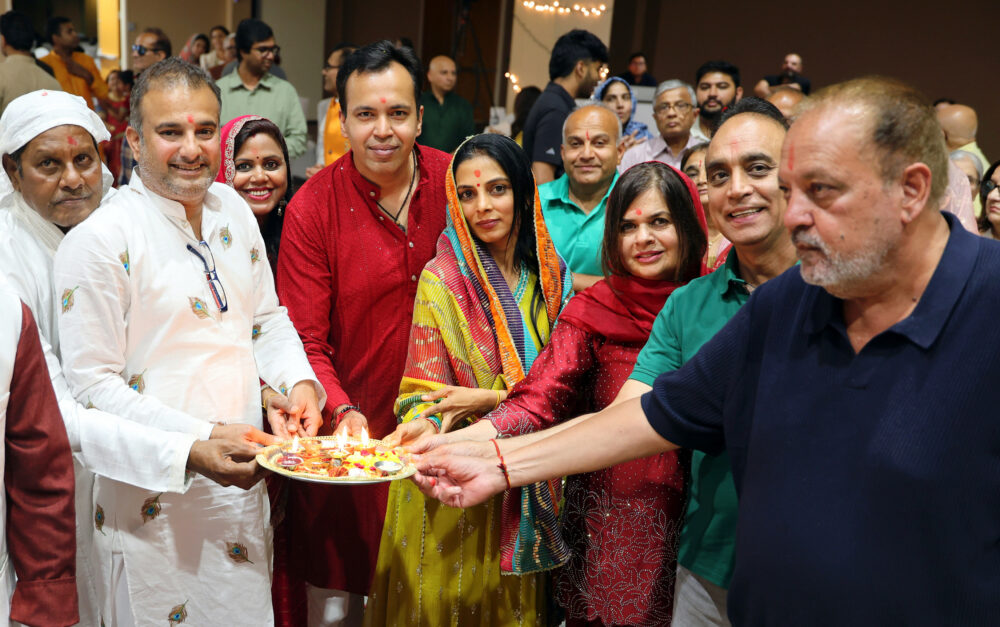
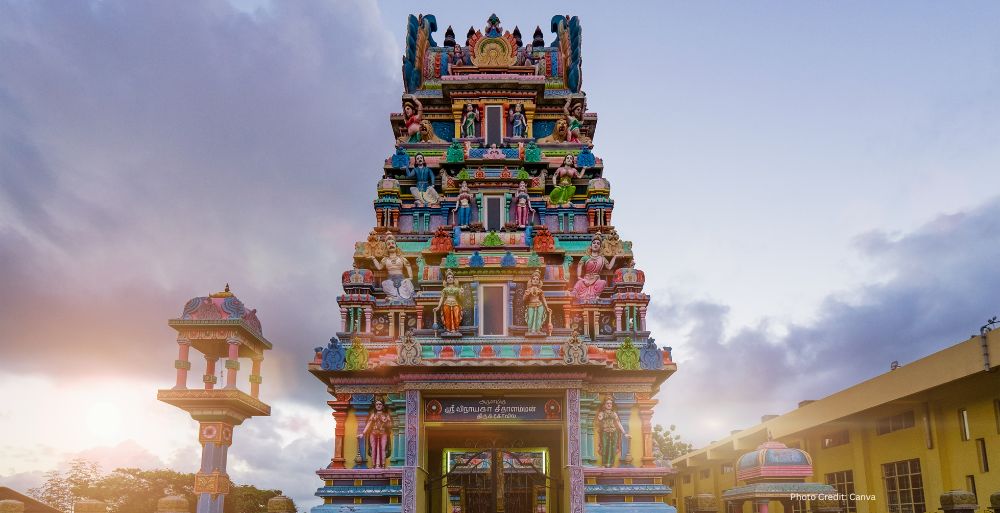
As Hindu families across the United States celebrate Navratri, concerns about safety and rising anti-Hindu sentiment loom large following a thwarted attack on a prominent temple in Illinois.
This year, as Hindu families in the Chicago area and across the United States celebrate Navratri—a festival dedicated to the worship of Devi, the goddess in her many forms, including Durga—many are grappling with an unsettling question: Is it safe to attend the festivities? Recent events have heightened this anxiety, particularly a thwarted attack on a Hindu temple in Aurora, Illinois, that has raised alarm across the community.
On October 11, the first day of Navratri, 19-year-old Alexandros Paporakis was arrested and charged with making a terrorist threat and unlawfully possessing a short-barreled rifle. According to court documents, Paporakis is alleged to have driven to the largest Hindu temple in Aurora, where he attempted to open fire. His weapon jammed, preventing a potential mass shooting, and he fled the scene before police apprehended him.
Prosecutors revealed that a coworker overheard Paporakis express a desire to kill Indian people. Investigators uncovered electronic communications and an eight-page manifesto attributed to him, in which he identified as a “sociopathic white supremacist neo-Nazi.” The manifesto contained violent rhetoric against Indian, Jewish, and African American communities, describing these groups as “subhumans.” On the day of his intended attack, the Sri Venkateswara Swami (Balaji) Temple was filled with thousands of worshippers celebrating the festival.
Pattern of Anti-Hindu Hate Crimes
While law enforcement officials believe Paporakis acted alone, his attack is part of a disturbing trend of anti-Hindu and anti-Indian hate incidents across the United States. Recent years have seen multiple instances of vandalism targeting Hindu temples, including incidents in Melville, New York, and in Sacramento and Chino Hills, California, where local authorities are treating the vandalism as hate crimes. In a separate instance, a Vadtal Dham temple in Richmond Heights, Ohio, suffered a brick attack in broad daylight just weeks before Navratri.
The rise of the “great replacement theory,” a debunked and racist ideology, has contributed to targeting South Asian American communities. Proponents of this theory claim that white Americans are being displaced by immigrants and people of color, fueling misinformation and inciting discrimination and violence. For instance, Bo French, the Republican nominee for Texas Railroad Commissioner, recently faced scrutiny for suggesting that South Asian fans at a University of Texas football game displaced American citizens—a remark that aligns with this insidious rhetoric.
Historical Context of Race and Religion
The intersection of race and religion in America has profound historical roots. The expulsion of Native Americans, the enslavement of Africans, and the treatment of Chinese laborers have all been justified through both racial and religious lenses. Early U.S. naturalization laws explicitly limited citizenship to “free white” individuals of “good moral character,” intertwining racial identity with moral worth—a standard often grounded in Christian values.
This historical context sheds light on why anti-Hindu hatred manifests as both racism and religious intolerance. For individuals like Indian American Hindus, being perceived as “foreign” due to skin color can coincide with being labeled “idolatrous” because of their religious practices. This duality means that attackers may not need to choose between racial or religious motivations; both can fuel acts of violence against Hindu temples.
The Broader Implications of Hate
The ramifications of such attacks extend beyond immediate threats to physical safety. Psychologically, the festive atmosphere of Navratri has been overshadowed by fear. Families who have long awaited this season of joy, marked by vibrant celebrations and community gatherings, now find themselves questioning their safety. Many are left wondering who might be lurking in the shadows of their temple grounds and whether unfamiliar faces represent a threat or a neighbor. This tension is exacerbated by the reality that nearly one-third of Indian Americans intermarry, meaning that community members might be viewed with suspicion based solely on their appearance or the racial identity of their spouse.
Economically, the implications are also significant. Temples, which traditionally rely on volunteer labor and community donations, are now diverting resources toward security measures. Funds that could have supported community initiatives—such as feeding families and educating children—are instead being allocated to surveillance and safety training. This shift not only affects the temples but also the wider communities they serve.
Looking Ahead: A Call for Civic Duty
Protecting places of worship is essential, yet it should not overshadow the larger societal issue at play. The burden of addressing these threats should not rest solely on families preparing for religious festivals. It is imperative to confront the political rhetoric that marginalizes brown Americans and to engage in a national discourse that acknowledges the role of religion in shaping racial identities. Resistance to naming these dynamics only perpetuates the cycle of hatred.
As Navratri culminated with Vijayadashami, a celebration of the triumph of good over evil, the hope remains for a future where families can gather at temples without fear of violence or discrimination. Until that vision is realized, the responsibility falls on all citizens to reject the narrative of the “foreigner” and to embrace the protection of all houses of worship as a shared civic duty, rather than a mere favor to a minority community.