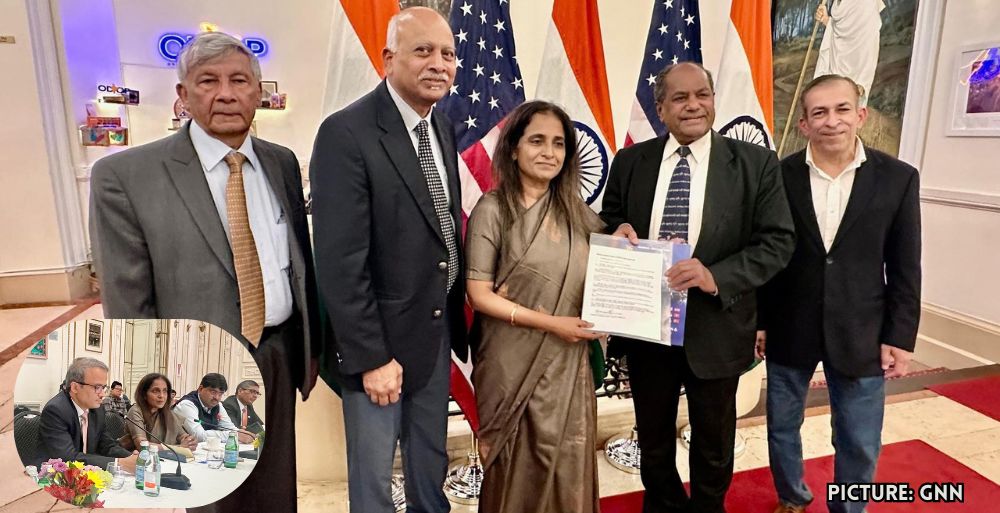
A high-level delegation representing major Non-Resident Indian (NRI) and Overseas Citizen of India (OCI) organizations met with Senior Ministry of External Affairs officials at the Consulate General of India in New York to deliver a comprehensive memorandum detailing core administrative, financial, and cultural priorities.
NEW YORK — Representatives from more than a dozen leading Indian diaspora organizations convened at the Consulate General of India in New York for an interactive strategy session with Ambassador Sripriya Ranganathan, Secretary for Consular, Passport, Visa, and Overseas Indian Affairs (CPV & OIA) at the Ministry of External Affairs (MEA).
Organized by the Indian Consulate, the diplomatic dialogue served as a formal forum for community stakeholders to submit a consolidated memorandum outlining critical legislative, financial, and administrative challenges facing overseas Indians. The delegation was led by the Global Organization of People of Indian Origin (GOPIO) alongside a broad coalition of national, regional, and specialized community groups, including the American India Foundation (AIA), Federation of Indian Associations (FIA), American Association of Physicians of Indian Origin (AAPI), Federation of Kerala Associations in North America (FOKANA), Telugu Association of North America (TANA), Bihar Jharkhand Association of North America (BJANA), Indian Diaspora Council, Friends of Madhya Pradesh, India Cultural Association of North America, Chhatrapati Foundation, Kannada Koota, and World Vegan Vision.
The discussions spanned a wide spectrum of systemic topics, ranging from everyday consular friction to macro-level institutional recommendations, including the establishment of an Indian Diaspora Museum in New Delhi and dedicated indentureship memorials.
Institutional Representation and Strategic Memorandum
The community presentation was anchored by GOPIO Chairman Dr. Thomas Abraham, GOPIO-Connecticut President Mahesh Jhangiani, and GOPIO-Manhattan President Prof. Raj Vanagapty. The leadership team submitted a comprehensive memorandum compiled from feedback gathered across community forums, town halls, and regional diaspora chapters.
Joining Ambassador Ranganathan on the Ministry of External Affairs panel was Anken Banerjee, Joint Secretary for the MEA’s Diaspora Engagement Division. The presence of senior leadership from New Delhi signaled the Ministry’s ongoing commitment to institutionalizing direct feedback channels with North American diaspora hubs.
The meeting room reflected a focused, pragmatic atmosphere as community leaders presented detailed policy proposals rather than ceremonial remarks. Diplomatic officials maintained an active listening posture, taking detailed notes on regulatory hurdles that impede diaspora contributions to India’s social and economic sectors.
Regulatory and Financial Barriers to Diaspora Philanthropy
A primary focus of the memorandum was the regulatory friction hindering financial contributions from overseas Indians to domestic development projects. Community leaders raised concerns regarding the denial of Foreign Currency Non-Resident (FCNR) account mechanisms and Foreign Contribution Regulation Act (FCRA) compliance complexities that affect educational institutions, healthcare trusts, and social service organizations operating in India.
Over the past decade, regulatory tightening under FCRA frameworks has increased scrutiny on foreign inflows, aiming to enhance transparency across nonprofit sectors. However, diaspora representatives noted that these measures have inadvertently created operational bottlenecks for legitimate philanthropic projects. Educational institutions and social welfare funds backed by overseas donors frequently encounter delays or outright rejections when attempting to move non-resident capital into domestic programs.
The delegation urged the MEA to work closely with the Ministry of Finance and the Reserve Bank of India (RBI) to establish clear, expedited clearinghouses for diaspora-led philanthropic transfers. Streamlining these channels, delegates argued, would unlock hundreds of millions of dollars in private capital for rural education, healthcare infrastructure, and vocational training across Indian states.
Banking Friction and Digital Identity Access
The memorandum also addressed practical operational challenges faced by naturalized citizens living outside India. Representatives detailed routine difficulties encountered during cross-border banking transactions, including account freezes, re-KYC (Know Your Customer) compliance hurdles, and restrictive protocols surrounding NRE (Non-Resident External) and NRO (Non-Resident Ordinary) accounts.
To resolve these recurring identity verification issues, the delegation strongly advocated for the universal issuance of Aadhaar cards to all Non-Resident Indians (NRIs) and Overseas Citizen of India (OCI) cardholders.
While the Unique Identification Authority of India (UIDAI) allows NRIs holding valid Indian passports to apply for Aadhaar upon arrival in India without waiting the standard 182-day period, OCI cardholders—who are foreign citizens of Indian origin—remain largely excluded from the standard biometrics-backed identity system. Community leaders emphasized that extending Aadhaar eligibility to the broader OCI population would streamline property management, local banking compliance, tax filings under the Pan-Aadhaar linkage requirement, and digital service access within India.
Heritage Preservation and Youth Engagement
Beyond administrative and legal reforms, the dialogue highlighted long-term cultural initiatives designed to connect younger generations of the diaspora with their ancestral roots. The coalition presented two major infrastructural recommendations to the Government of India:
- Establishment of an Indian Diaspora Museum: Proposed for New Delhi, the institution would document the historical migration patterns, economic contributions, and cultural impact of the global Indian diaspora, which currently numbers over 32 million people worldwide.
- Creation of Indentureship Memorials: Dedicated historical sites to honor the legacy of 19th and early 20th-century indentured Indian laborers who were transported to the Caribbean, Fiji, Mauritius, South Africa, and Reunion Island.
The delegation also called for the expansion of cultural tourism programs targeted at diaspora youth. While initiatives such as the MEA’s Know India Program (KIP) have historically offered young adults of Indian origin a three-week orientation tour of the country’s economic and cultural landscape, community leaders suggested scaling these initiatives through university exchange partnerships and modern immersive heritage tours.
By addressing both immediate administrative friction and long-term socio-cultural connections, the interactive session reflected an evolving, multi-tiered diplomatic relationship between New Delhi and its global diaspora.