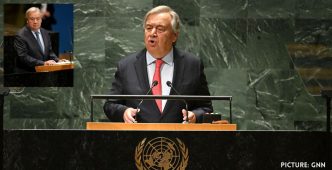
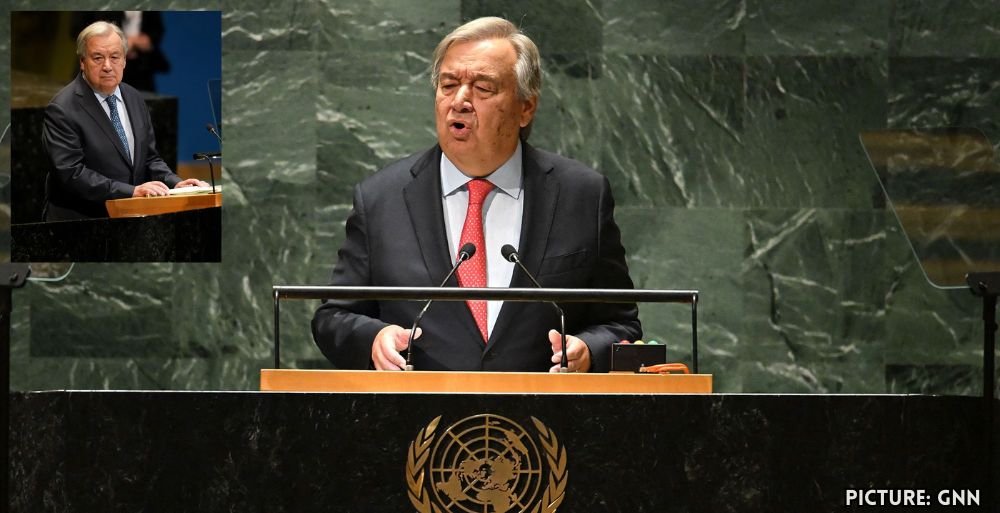
In a recent address, UN Secretary-General António Guterres outlined pressing global challenges, advocating for international cooperation on AI governance and Security Council reform while emphasizing the need for urgent action to address inequality and climate change.
UNITED NATIONS – In a comprehensive address marking his tenure’s final 100 days, UN Secretary-General António Guterres emphasized the interconnectedness of the world’s crises, framing them as manifestations of a broader struggle over power dynamics. His remarks were delivered during the presentation of his annual report on the state of the world, where he articulated his concerns over the erosion of international norms and the shifting landscape of global authority.
Guterres stated, “The greatest power is not the power to dominate. It is the power to build a future that works for everyone,” underscoring the ethical dimensions of leadership in a time of profound global challenges.
Shifting Power Dynamics
The Secretary-General identified three significant trends reshaping global power: the emergence of new state actors, the transfer of authority from governments to private entities, and the growing role of artificial intelligence (AI) and autonomous weapons in decision-making processes traditionally reserved for humans. Guterres warned, “The faultlines in our world are widening. Cracks have become canyons,” highlighting the urgent need for collective action.
He cautioned against the fragmentation of the international order, which he described as a potential pathway toward rival blocs with disparate economic and security systems—a scenario he refers to as the “Great Fracture.” Guterres called for a revitalization of global cooperation grounded in interdependence and shared governance.
Cascading Crises and Humanitarian Concerns
Addressing the ongoing crises in the Middle East, Ukraine, Sudan, and Myanmar, Guterres criticized the superficial nature of many ceasefire agreements, which he described as often amounting to “lesser fires” that fail to protect civilians. He reiterated the necessity for compliance with International Court of Justice (ICJ) orders regarding the Gaza conflict and condemned the expansion of Israeli settlements in the West Bank, arguing that such actions threaten the viability of a two-state solution.
Guterres also denounced Russia’s invasion of Ukraine as a blatant violation of the UN Charter, further complicating international relations and humanitarian efforts. His remarks reflect longstanding concerns about the impact of geopolitical conflicts on civilian populations.
Calls for Security Council Reform
In his address, Guterres renewed his calls for reforming the UN Security Council, specifically highlighting the absence of permanent African representation as “unjust and indefensible.” He noted that the Council was established in a vastly different geopolitical context and emphasized the need for it to adapt to contemporary realities.
The Inequality Gap and Calls for Action
Guterres drew attention to the stark contrast between record global wealth and the billions who lack essential resources such as food, clean water, and healthcare. He framed inequality not merely as an economic issue but as a matter of power over opportunities and self-determination. He advocated for expedited debt relief for developing nations, more proactive multilateral development banks, and equitable access to Special Drawing Rights from the International Monetary Fund (IMF).
Highlighting a significant achievement, Guterres announced that the UN has reached full gender parity across its senior leadership and staff for the first time in its history. He asserted, “Equality is not a dream; it is a decision,” emphasizing that progress is possible when entrenched power dynamics are challenged.
Climate Change and the Future of AI
Turning to climate change, Guterres referred to the crisis as the “most profound intergenerational power imbalance,” warning of an impending breach of the 1.5°C threshold. He called for developed nations to significantly increase their adaptation funding, as major oil companies continue to profit amid the global energy crisis exacerbated by geopolitical tensions.
In relation to AI, he expressed concern over the concentration of power in data and algorithms, stressing that technology must be governed with accountability. “The danger is not technology,” he stated. “The danger is technology without accountability.” He urged for the establishment of a multilateral AI risk management framework, underscoring that life-and-death decisions must never be relegated to machines.
Conclusion and Future Outlook
In his concluding remarks, Guterres reaffirmed that peace, development, and human rights are inseparable pillars of the UN Charter. He emphasized that the United Nations must remain a strong force capable of addressing current global challenges and promoting a future built on hope rather than fear. He vowed to carry the “spirit of resolve” through his remaining time in office, advocating for the UN’s core values even beyond his tenure as Secretary-General.
Guterres concluded, “The world does not need a weaker United Nations. It needs a UN strong enough to face the world as it is and determined enough to build the world as it should be.” His remarks underscore the urgency of collaborative action and reform as the international community navigates an increasingly complex global landscape.