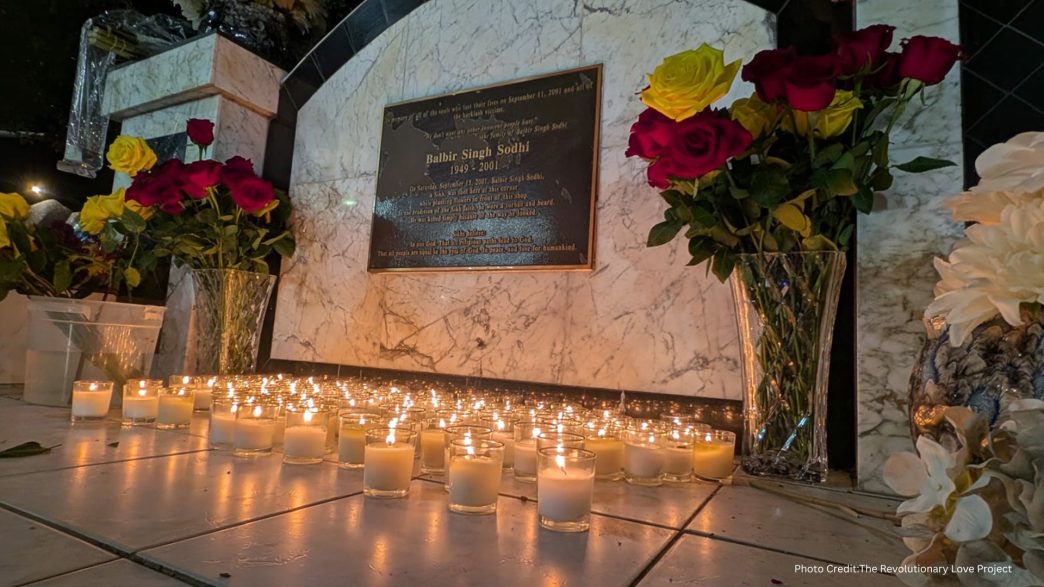
Twenty-five years after Balbir Singh Sodhi was killed in the first post-9/11 hate crime, his family and an interfaith coalition held a memorial vigil in Mesa, Arizona, to honor his legacy of love and forgiveness. The milestone anniversary comes amid heightened concern among civil rights advocates, driven by a recent surge in anti-Sikh hate crimes and xenophobic government rhetoric.
Twenty-five years after Balbir Singh Sodhi was murdered in what is widely recognized as the nation’s first post-9/11 hate crime, his family, civil rights leaders, and an interfaith coalition gathered on Tuesday to remember his legacy amid renewed concerns over rising anti-Sikh hostility and xenophobic rhetoric.
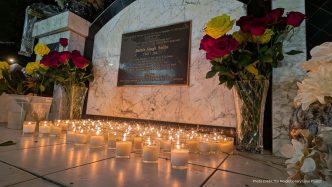
The milestone memorial took place outside the Chevron gas station where Sodhi, a 52-year-old Sikh immigrant and father of five, was shot and killed on September 15, 2001. Sodhi was planting flowers in front of his business to honor the victims of the terror attacks when Frank Roque, an enraged gunman who mistook Sodhi’s turban and beard for Arab Muslim attire, fired five shots. Roque, who had earlier vowed to target people wearing head coverings and declared himself a “patriot” upon arrest, was convicted and died in prison in 2022.
Organized by the family alongside the Sikh Coalition and the nonprofit Revolutionary Love Project, the 25th annual vigil drew relatives, community members, musicians, and faith leaders representing Sikhism, Islam, Hinduism, Christianity, and Judaism.
“While we could not prevent this gas station from becoming part of the map of hate violence in America, that is not the only story this place holds,” said Deepa Iyer, a senior director at the Building Movement Project. “Look at what has bloomed here and spread everywhere: a site of remembrance and conscience, a community of care and a future where everyone belongs.”
The anniversary arrived as advocates warn that the challenges facing Sikh Americans are escalating rather than receding. An analysis of FBI statistics revealed that anti-Sikh hate crimes climbed roughly 25% from 2024 to 2025—rising from 142 incidents to 177—even as overall hate crimes across the United States saw a downward trend.
Tensions deepened further last week after the Department of Homeland Security (DHS) published, and subsequently deleted, an AI-generated image mocking Sikh truck drivers. The graphic portrayed a transformer confronting a Sikh man, accompanied by phrases telling him to “self-deport or find out” and “get off our roads, you don’t know how to drive, Mr. Singh.”
The Sikh surname, universally adopted by men of the faith as a testament to equality and a rejection of the caste system, is prominent in the national freight sector. According to the North American Punjabi Trucking Alliance, approximately 150,000 Sikh long-haul truckers operate in the U.S., making up 20% of the country’s trucking workforce and 40% in California. The Sikh Coalition noted there is no evidence suggesting immigrant truck drivers cause more collisions, with state data indicating the reverse.
While DHS previously claimed the image targeted a specific individual described as an undocumented immigrant from India, civil rights advocates denounced the post as harmful institutional stereotyping.
“An official government agency should not be targeting a whole group of people,” said Rucha Kaur, a managing director at the Sikh Coalition, which was formed immediately after 9/11 to track anti-Sikh violence. “We’ve seen over all these years how that kind of profiling only leads to more hate and more fear in our society.”
Despite the persistent hostility, Tuesday’s vigil centered on reconciliation and resilience. Years after the killing, Sodhi’s brother, Rana Singh Sodhi, famously contacted Roque in prison to offer forgiveness, later reaching out to Roque’s family with condolences following the gunman’s death.
The memorial emphasized that shared humanity: attendees joined a Baptist preacher in singing “Wade in the Water,” and organizers embraced Sodhi’s widow onstage before a crowd gathered under the gas station lights.
“What if we made the values that Balbir Singh Sodhi died for—the values that his brother and his family have lived for—our north star?” asked Valarie Kaur, founder of the Revolutionary Love Project and a longtime family friend. “If this family can sing a song of a revolutionary kind of love, then so can we.”