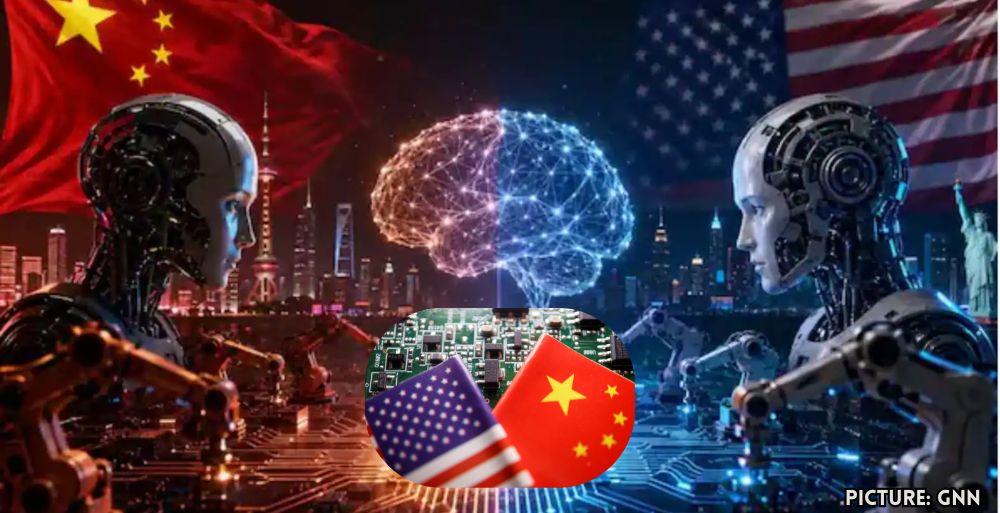
As global leaders in technology, China and the U.S. aggressively invest in artificial intelligence, quantum computing, and critical minerals, while India faces significant challenges in securing its position in the Fourth Industrial Revolution.
Chinese President Xi Jinping is scheduled to visit Washington, D.C., on September 24, amid escalating calls from major industry leaders for nations to advance on the frontier of artificial intelligence (AI). This visit comes at a time when Beijing has accused the U.S. of engaging in scaremongering tactics aimed at stifling its progress in AI technologies. The technological rivalry between the two nations has intensified, with China reportedly leading in 69 of 74 critical and emerging technologies, according to the Australian Strategic Policy Institute’s Critical Technology Tracker.
Critical technologies are defined as current and emerging technologies that have the potential to significantly enhance or threaten a country’s economic interests, social cohesion, and national security. As the global tech race unfolds, India finds itself at a crossroads, questioning its ability to assert itself in the era of Industry 4.0 before opportunities slip away.
Investment Disparities in AI
AI technology, which has attracted unprecedented levels of capital investment, is at the forefront of this technological race. In the Union Budget 2026, India allocated approximately Rs 10,000 crore (about $1.05 billion) to the IndiaAI Mission over five years, with Rs 1,000 crore earmarked for the current fiscal year. While private sector pledges exceeding $250 billion by 2035 were announced at the AI Impact Summit in New Delhi earlier this year, these figures paled in comparison to the commitments made by China and the U.S.
China has unveiled a national AI infrastructure plan valued at 2 trillion yuan (approximately $295 billion) for the next five years. Meanwhile, U.S. investments in AI are projected to reach 2% of GDP by 2026, accounting for over 80% of this year’s anticipated $800 billion in global AI expenditures. Investment estimates from financial institutions such as Bridgewater Associates, Goldman Sachs, and TS Lombard suggest U.S. AI infrastructure spending could range between $650 billion and $800 billion, positioning it as one of the largest infrastructure projects in American history.
American private investment in AI alone is forecasted to reach $285.9 billion by 2025, dwarfing China’s projected $12.4 billion in the same timeframe. In contrast, nations like Norway and Saudi Arabia are set to invest only 0.7% of their GDP in AI, while China’s data center spending is approximately 0.4% of its GDP, behind Malaysia and Sweden. According to the World Economic Forum, India ranks eighth out of eleven countries in AI investment as a share of GDP from 2010 to 2024, with projections indicating an investment range of 1.2% to 1.8% of its GDP compared to China’s 1.7% to 2.6% and the U.S.’s 3.4% to 5.1%.
Challenges in Quantum Technology
The disparities in technological investment are starkly evident in the realm of quantum technology. An ITES report from the Office of the Principal Scientific Adviser released in April 2022 acknowledges that China’s National Natural Science Foundation leads in all four areas of quantum science research funding, with its lead in quantum computing estimated at approximately 2:1 over the U.S. National Science Foundation.
Global funding figures illustrate the scale of investment: China commits approximately $15.3 billion to quantum research, while Germany, the UK, the U.S., and other nations lag significantly behind. India’s National Quantum Mission, with a budget of Rs 6,000 crore (around $0.7 billion) over eight years, stands in stark contrast to China’s and the EU’s commitments, which are nearly double and four times greater, respectively.
Semiconductor and Critical Minerals Investment
In the semiconductor sector, the U.S. CHIPS and Science Act has authorized around $280 billion to bolster domestic research and manufacturing. Conversely, China’s Integrated Circuit Industry Investment Fund has amassed nearly $100 billion across three phases of investment, with the third phase accounting for approximately $47 billion. India’s semiconductor mission, by comparison, has a fiscal outlay of Rs 2.03 lakh crore (about $21 billion).
The situation becomes even more dire when examining the availability of critical minerals essential for technological infrastructure. China has invested upwards of $24 billion in lithium, cobalt, and nickel operations across multiple countries, thereby securing 80-95% of its imports of these crucial minerals. The International Energy Agency’s Global Critical Minerals Outlook for 2025 reveals that China dominates the refining of 19 out of 20 strategic minerals, holding an average market share of 70%.
India’s National Critical Minerals Mission, with an outlay of Rs 34,300 crore (nearly $3.6 billion) over seven years, faces the immense challenge of catching up to China, which has spent two decades establishing a firm grip on global supply chains.
Biotechnology and Genomics Landscape
In the fields of genomics and biotechnology, India’s market is projected to reach $1.86 billion by 2033, growing at a compound annual growth rate of 16.6%. However, this growth appears modest when compared to the global genomics market, which is valued at $32.65 billion in 2023 and is expected to soar to $94.86 billion by 2030. According to the Organisation for Economic Cooperation and Development (OECD), China surpassed both the U.S. and the EU in impactful biotech publications in 2016 and further expanded its lead by 2022, producing three to four times as many publications as Europe.
In 2023, China led globally in highly cited research across various subfields of biotechnology, including synthetic biology, genomic sequencing, and biological manufacturing. The collection of genetic data at scale supports these research initiatives, with the Biosecurity Law of 2020 designating human genetic material as a national strategic resource.
As President Xi Jinping and former U.S. President Donald Trump prepare to engage next week, their nations are investing hundreds of billions into critical technologies. India, however, remains constrained to single-digit billion expenditures in these essential sectors. While India possesses a vast demographic advantage and an engineering talent pool, the absence of sufficient capital investment poses a significant barrier to realizing its potential.
The trajectory of the remaining 74 years of the 21st century will likely be determined by those nations that emerge as leaders in the Fourth Industrial Revolution.