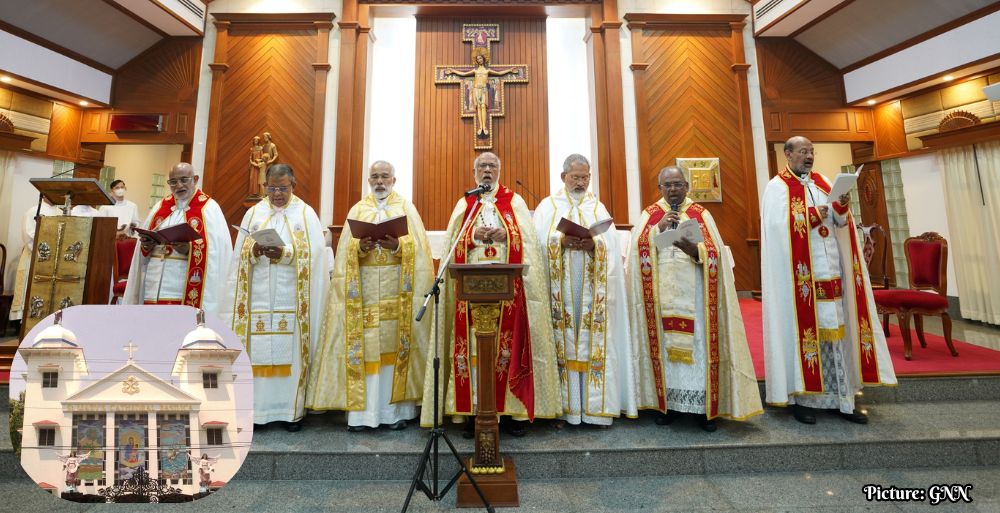
A significant milestone in the ongoing liturgical dispute within the Syro-Malabar Church was achieved on August 30, 2026, when the Eucharist was celebrated facing the congregation for the first time in four years, highlighting a compromise aimed at reconciliation.
KOCHI, India – On August 30, 2026, the Syro-Malabar Church held a historic Eucharistic celebration at the Cathedral Basilica of St. Mary in Kochi, marking the first instance in four years that the celebrant faced the congregation during the liturgy. This event is seen as a crucial step toward resolving a protracted conflict over liturgical practices that has divided the church since late 2021.
Origins of the Dispute
The conflict within the Syro-Malabar Church emerged in November 2021 when the church’s governing body, the Syro-Malabar Bishops’ Synod, attempted to standardize liturgical practices across its communities. The Synod proposed a mixed solution where the celebrant would face the altar throughout the entire Eucharistic prayer. However, this decision was met with fierce opposition from many clergy and parishioners in the Archdiocese of Ernakulam-Angamaly, who preferred to maintain the tradition of having the priest face the congregation during the Mass.
The resistance escalated into significant protests, with some factions going as far as to close the Cathedral Basilica temporarily. Fr. Kuriakose Mundadan, secretary of the Archieparchy’s Council of Priests, remarked on the turmoil, stating, “The Cathedral has experienced many ups and downs in the wake of the Syro-Malabar Bishops’ Synod’s decision to implement the ‘unified rite’, bringing an end to Mass celebrated facing the congregation.” The inability to reconcile differing preferences on how the Eucharist should be celebrated has led to a prolonged and contentious situation.
A New Leadership and a Path to Consensus
The appointment of Archbishop Joseph Pamplany in 2025 marked a pivotal moment in the ongoing dispute. Under his leadership, a new consensus began to emerge within the Archieparchy. The revised framework allowed for the celebration of Mass in a synodal form on Sundays and holy days, validating other Masses celebrated with the priest facing the congregation. This compromise aimed to accommodate the diverse liturgical preferences among the faithful while adhering to the Synod’s overarching guidelines.
Despite attempts at reconciliation, tensions persisted, particularly within St. Mary’s Cathedral, where a vocal group opposed to the celebrant facing the congregation created disruptions. Legal proceedings were initiated in the High Court of Kerala as factions within the church sought judicial intervention to resolve the conflict. Fr. Mundadan noted, “When the court clarified that there was no ban, the two opposing factions reached an agreement extending the approach adopted in the parishes to this cathedral as well.” This clarification from the court played a crucial role in paving the way for dialogue and compromise.
The Compromise Agreement
The agreement reached at the Cathedral Basilica stipulates that both wedding services and solemn Masses in the synodal form can be celebrated for parishioners who formally request it from the parish priest. This resolution reflects an effort to balance the diverse liturgical preferences within the Syro-Malabar Church while adhering to the Synod’s intention of a ‘unified rite.’ The compromise underscores the importance of dialogue and understanding as the church navigates its internal conflicts.
Implications for the Syro-Malabar Church
The return to the conciliar rite at the Cathedral represents more than just a liturgical adjustment; it signifies a broader movement toward reconciliation within the Syro-Malabar Church. This moment is emblematic of the ongoing struggle to reconcile traditional practices with contemporary interpretations of active participation in liturgical celebrations, a principle emphasized by the Second Vatican Council.
The events of August 30 could herald a new chapter for the Syro-Malabar Church, fostering an environment conducive to further dialogue and understanding among its members. Observers and church leaders alike will be watching closely to see how this compromise influences future liturgical practices and the overall governance of the church. It remains to be seen whether this reconciliation will lead to lasting unity or if further challenges will emerge as different factions within the church continue to assert their preferences.
As the Syro-Malabar Church moves forward, the focus will likely be on maintaining unity among its diverse congregants while respecting the variety of worship styles that exist within the community. The recent celebrations and the new agreements may serve as a foundation for future discussions, potentially leading to a more inclusive and harmonious church environment.