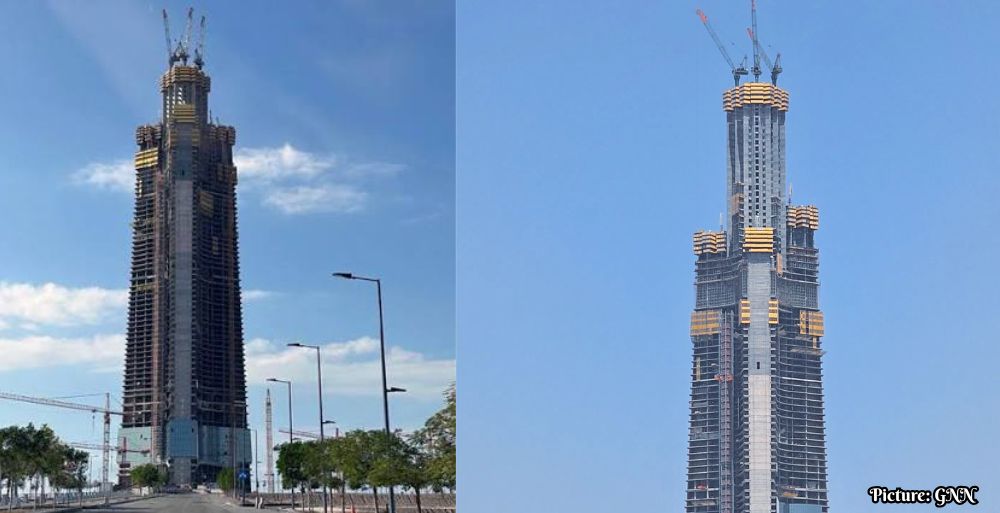
The JEC Tower in Jeddah, Saudi Arabia, has achieved a height of 430 meters, marking a significant milestone in its construction journey toward becoming the tallest building in the world, with completion expected in 2028.
The Jeddah Economic Company (JEC) Tower, currently under construction in Jeddah, Saudi Arabia, is rapidly progressing toward completion, recently reaching a height of 430 meters (1,410 feet). This landmark achievement marks a pivotal moment in the endeavor to surpass the current tallest structure in the world, the Burj Khalifa, which stands at 828 meters (2,717 feet). With approximately 570 meters (1,870 feet) remaining, the JEC Tower is poised to redefine the skyline of Jeddah and establish itself as a symbol of architectural ambition upon its anticipated completion in 2028.
The tower has now ascended to 107 floors, a remarkable achievement highlighted by Saudi Prince Al Waleed bin Talal Al Saud, the CEO of the Kingdom Holding Company, which is overseeing the project’s development. This accomplishment places the JEC Tower among a select group of skyscrapers worldwide that have surpassed the 100-floor threshold, underscoring its significance as a monumental architectural endeavor.
Architectural Design and Engineering Challenges
The architectural design for the JEC Tower is crafted by the esteemed firm Adrian Smith + Gordon Gill Architecture, renowned for their work on the Burj Khalifa. Once completed, the JEC Tower is expected to encompass at least 157 floors, making it nearly double the height of the One World Trade Center in New York City, which reaches 541 meters (1,776 feet). This ambitious design not only reflects the aesthetic aspirations of its creators but also embodies the engineering challenges inherent in constructing a supertall structure.
Thornton Tomasetti, the engineering firm responsible for ensuring the tower’s structural integrity, has outlined the complexities involved in the project. They emphasize that the JEC Tower will be the first human-made structure to exceed 1 kilometer (3,280 feet) in height, presenting unprecedented engineering challenges. In their statement, they noted, “As the first human-made structure to reach 1 kilometer (3,280 feet) in height, the design of Jeddah Tower is truly a pioneering engineering achievement.” The firm elaborated on critical considerations, including managing wind loads at extreme elevations and ensuring the building’s stability over time.
Interior Features and Planned Amenities
Beyond its impressive stature, the JEC Tower is designed to be a multifaceted space. The lower floors are planned to accommodate office spaces, while the upper levels will house a luxury hotel comprising 200 rooms. Above the hotel, the tower will feature serviced apartments, a sky lobby, and several residential units. Notably, the residential spaces are designed to increase in size and price as one ascends the building, catering to affluent residents. The structure will also include multiple observation decks, providing stunning views of the surrounding cityscape, along with a helicopter pad for convenient access.
Project Timeline and Broader Implications
Despite facing significant challenges with other major Saudi projects, such as The Line and Mukaab, the JEC Tower continues to rise at an impressive pace. The timeline for completion remains set for 2028, marking the culmination of years of planning and construction. This project is part of Saudi Arabia’s broader strategy to diversify its economy through mega-projects aimed at attracting tourism and investment. The JEC Tower symbolizes the kingdom’s aspirations to enhance its global standing as a hub of modern architecture and urban living.
The rapid development of the JEC Tower is emblematic of the larger transformation occurring within Saudi Arabia’s urban landscape. As the nation invests heavily in infrastructure and construction, the tower serves as a focal point for the country’s ambitions to establish itself as a leader in innovative architecture. The project not only showcases engineering prowess but also highlights the cultural and economic aspirations of Saudi Arabia as it seeks to position itself on the global stage.
Conclusion
As the JEC Tower continues to ascend toward its record-breaking height, it embodies a spirit of innovation and resilience amidst the complexities of modern construction. With its completion on the horizon, the tower promises to be not merely a landmark of height but also a testament to the progress and ambition of the Kingdom of Saudi Arabia. As the world watches this monumental project unfold, the JEC Tower stands as a beacon of what is possible in the realm of architecture and engineering.