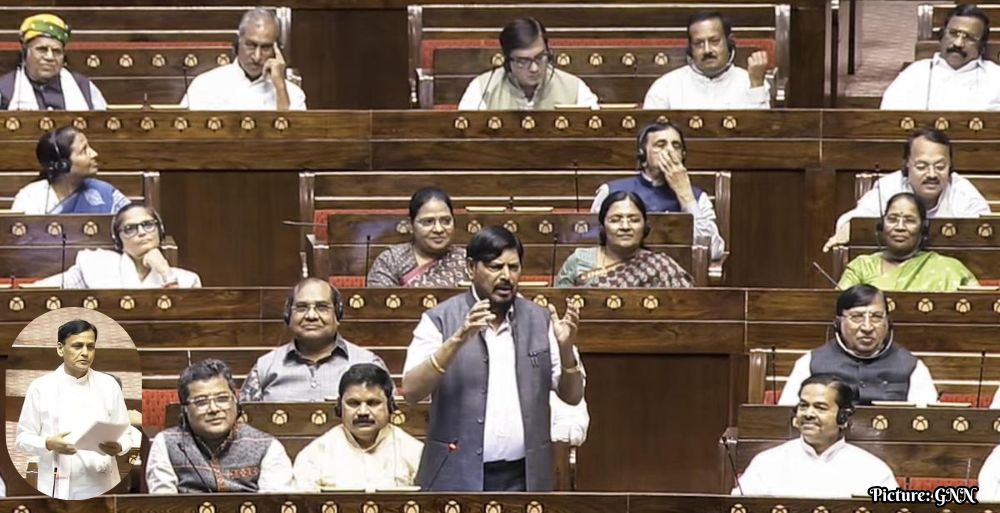
The Rajya Sabha has approved the Prevention of Insults to National Honour (Amendment) Bill, imposing penalties for disrupting the rendition of ‘Vande Mataram’, amidst a significant opposition boycott.
NEW DELHI: On Wednesday, the Rajya Sabha passed the Prevention of Insults to National Honour (Amendment) Bill, which prescribes penalties of up to three years in prison and/or fines for individuals who prevent or disturb the rendition of the national song ‘Vande Mataram’. This legislative action occurred amidst a walkout by opposition parties, highlighting ongoing tensions between the ruling government and various political factions.
The opposition coalition, which includes prominent parties such as the Congress, Trinamool Congress (TMC), Dravida Munnetra Kazhagam (DMK), Rashtriya Janata Dal (RJD), Left parties, and Shiv Sena (UBT), staged the walkout in protest against the government’s handling of police actions related to recent protests over the National Eligibility cum Entrance Test (NEET) paper leak. Opposition members demanded a statement from Home Minister Amit Shah regarding the police’s aggressive response to demonstrators, which they characterized as excessive and unjustified.
Parliamentary Dynamics
During the session, opposition MPs vocally expressed their dissatisfaction, chanting slogans and calling for accountability from the government. TMC MP Derek O’Brien was notably seen attempting to approach Deputy Chairman Harivansh to raise a point of order, but intervention by Parliament security personnel prevented his approach, underscoring the charged atmosphere within the chamber.
As the debate unfolded, the Chair invited opposition MPs who had submitted notices to speak. However, figures such as DMK’s Tiruchi Siva, TMC’s Sagarika Ghose, and RJD’s Manoj Kumar Jha redirected the discussion towards the police’s use of force against the student protesters, emphasizing their concerns over civil liberties and the treatment of dissenters. This shift in focus reflected the ongoing tensions surrounding the bill, as many opposition politicians viewed the government’s actions as part of a broader trend of suppressing dissent.
Although the bill is categorized under the Home Ministry’s jurisdiction, it was Junior Home Minister Nityanand Rai who presented it in Amit Shah’s absence. In his remarks, Rai criticized the opposition, particularly targeting the Congress party for allegedly undermining the significance of ‘Vande Mataram’. He argued that opposing the national song aligns with supporting divisive forces, referencing the controversial slogan “Bharat tere tukde honge,” often associated with secessionist sentiments.
Responses from Various Political Entities
Notably, the Aam Aadmi Party (AAP) opted not to join the opposition walkout. MP Sanjay Singh utilized the opportunity to question the Rashtriya Swayamsevak Sangh’s (RSS) long-standing practice of not hoisting the national flag at its headquarters for over five decades, presenting a contrasting narrative on patriotism and national symbols.
Supporters of the bill, particularly from the Bharatiya Janata Party (BJP), have welcomed the legislation, arguing that it is necessary to uphold the dignity of national symbols. AIADMK MP also voiced concerns regarding the practice in Tamil Nadu, where the state anthem is played following ‘Vande Mataram’, suggesting that this could detract from the significance of the national song.
Contextual and Historical Significance
The passage of this bill occurs within a broader narrative of increasing nationalism and debates over national identity in India. ‘Vande Mataram’, originally penned by Bankim Chandra Chatterjee in the late 19th century, has historically served as a rallying cry for the Indian independence movement, symbolizing the struggle for sovereignty and unity. Its invocation today continues to elicit strong emotions across the political spectrum, with proponents viewing it as a cornerstone of national pride and identity, while critics caution against legislating reverence towards symbols of national significance.
Critics of the bill argue that criminalizing dissent regarding national symbols poses a threat to free speech, potentially creating a chilling effect on public discourse. The implications of such legislation extend beyond mere legal consequences; they raise critical questions about the balance between national pride and democratic values, particularly the right to dissent.
The recent events in the Rajya Sabha illuminate the complexities of navigating national identity amidst pressing social issues. As the government amplifies its nationalistic agenda, concerns regarding civil liberties, political dissent, and the role of parliamentary democracy become increasingly salient. The opposition’s walkout not only underscores the rifts in Indian politics but also raises fundamental questions about the effectiveness of legislative dialogue in addressing the needs and grievances of citizens.
In conclusion, the developments surrounding the Vande Mataram bill reflect broader societal tensions and the ongoing struggle to balance national pride with the essential democratic principles that underpin India’s political framework. The implications of these legislative actions will likely resonate well beyond the walls of Parliament, influencing public discourse and civic engagement in the months to come.