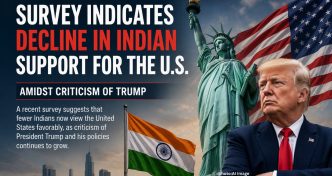
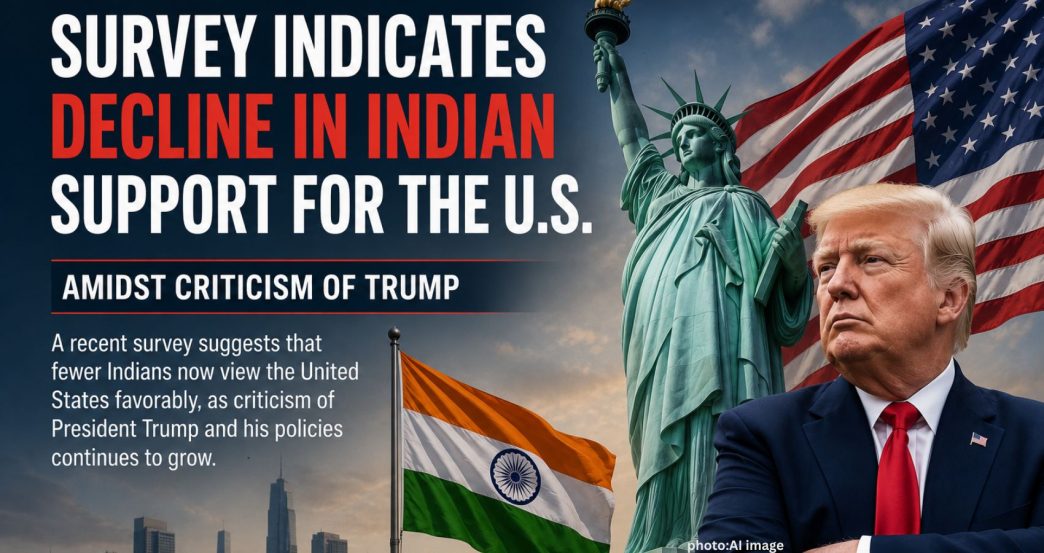
The latest Pew Research Center survey reveals a significant decrease in favorable views of the United States and President Donald Trump among Indian respondents, reflecting broader global trends in public sentiment regarding U.S. foreign policy.
Public opinion in India towards the United States has markedly declined over the past year, as indicated by a recent international survey conducted by the Pew Research Center. The survey, which was carried out between February 8 and May 13 across 36 countries, found that only 45 percent of Indian respondents now hold a favorable view of the U.S., a decrease from 54 percent in the previous year. Concurrently, the share of Indians expressing an unfavorable opinion of the U.S. has risen to 31 percent.
The survey also highlighted a significant erosion of confidence in President Donald Trump among Indian respondents. Only 39 percent of those surveyed expressed trust in Trump’s ability to handle global affairs, a decline from 52 percent a year earlier. Meanwhile, 36 percent indicated they had little or no confidence in him, with the remainder either undecided or choosing not to respond.
Trade Policies and Immigration Perspectives
Trump’s trade policies emerged as one of the least popular aspects of his administration among Indian respondents. A mere 18 percent approved of his tariff measures, which had previously imposed tariffs of up to 50 percent on certain Indian imports before being halted by the U.S. Supreme Court. In contrast, Trump’s immigration policies garnered the highest approval rating in India, with 32 percent of respondents expressing support. Approval ratings for Trump’s policies on other global issues were notably lower, with 28 percent supporting his stance on Iran, 26 percent on Ukraine, followed by Greenland (23 percent), Gaza (18 percent), and Venezuela (17 percent).
Comparative Global Leadership Views
The survey also assessed Indian perceptions of several prominent world leaders. Notably, Russian President Vladimir Putin received the highest levels of confidence, with 51 percent of Indians believing he would act appropriately in global affairs. Following Putin were Israeli Prime Minister Benjamin Netanyahu at 34 percent, French President Emmanuel Macron at 33 percent, Chinese President Xi Jinping at 25 percent, and Ukrainian President Volodymyr Zelensky at 20 percent.
Furthermore, nearly half of the Indian respondents, specifically 47 percent, expressed the belief that the U.S. interfered significantly in the domestic affairs of other nations, while 30 percent disagreed with this assertion. The Pew Research Center noted that the percentages reported may not sum to 100 due to some respondents either not expressing an opinion or opting not to respond.
Global Context and Comparative Attitudes
Despite the decline in favorable views toward the U.S. and Trump, perceptions in India remain more positive than the median across the 36 countries surveyed. The Pew report indicated that overall global attitudes towards the United States have worsened over the past year, with a median of 57 percent of respondents across all countries expressing an unfavorable view of the U.S. The median favorable rating for the U.S. also dropped from 49 percent to 37 percent when comparing the same 24 countries surveyed in both years.
Confidence in President Trump remains low on a global scale, with the survey revealing that a median of 76 percent of respondents across all surveyed nations expressed little or no confidence in his ability to manage international relations, while only 23 percent expressed trust in his leadership.
Interestingly, a notable 54 percent of Indian respondents maintained that the U.S. government respects personal freedoms, suggesting a more nuanced perspective on U.S. governance among the Indian populace compared to the overall sentiment toward Trump.
Regional Perspectives: Pakistan and China
The survey also examined attitudes in neighboring Pakistan, where views of both Trump and the U.S. were starkly negative. An overwhelming 82 percent of Pakistani respondents held an unfavorable opinion of Trump, with only 12 percent expressing a positive view. Similarly, 81 percent of Pakistanis reported an unfavorable opinion of the U.S., and 76 percent believed that the U.S. interfered in the affairs of other countries.
In contrast, China’s global image appears to be on the rise. Favorable perceptions of China increased from 38 percent last year to 46 percent this year across the surveyed nations, while favorable views of the U.S. fell from 48 percent to 36 percent. In India specifically, favorable opinions of China have also seen a slight increase, rising from 21 percent last year to 23 percent this year.
The findings of this survey reflect a significant shift in public sentiment in India, highlighting the challenges faced by the U.S. in maintaining favorable international relations amidst domestic and global political shifts. As the U.S. navigates its foreign policy and international image under the Trump administration, the implications of these changing attitudes could influence diplomatic and economic ties moving forward.