The institution believes that healthcare innovation is not solely about developing new technologies but also about applying time-tested medical traditions within modern clinical practice. Through its educational programs, CCA aims to equip healthcare professionals with additional tools to support comprehensive patient care while preserving the scientific and philosophical foundations of Ayurveda.
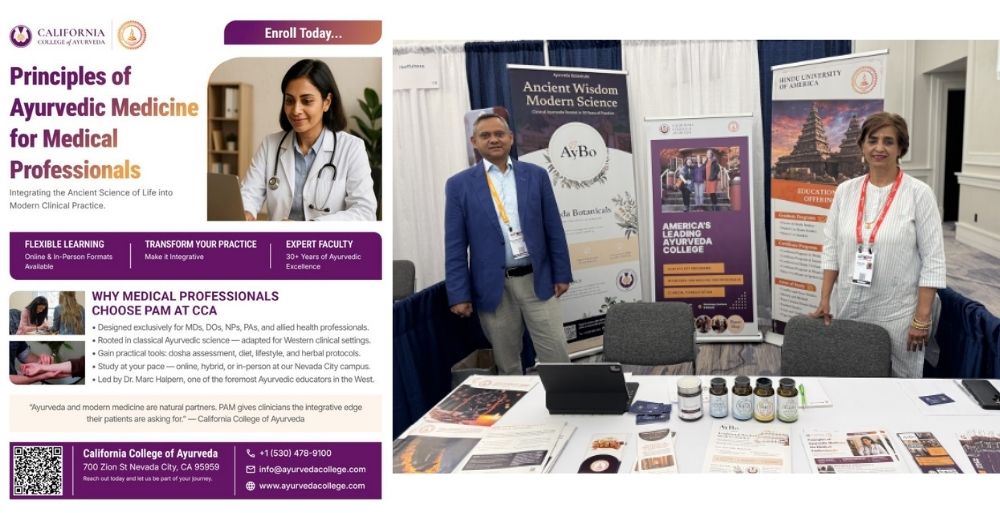
The California College of Ayurveda (CCA), one of the oldest and most established Ayurveda institutions in the United States, showcased its educational programs for healthcare professionals during the recent American Association of Physicians of Indian Origin (AAPI) Conference, drawing attention to the growing role of Ayurveda in integrative medicine.
The institution was represented by Dr. Mahadevan Seetharaman, Dean of the California College of Ayurveda, who discussed the college’s mission of integrating classical Ayurvedic knowledge with contemporary healthcare education.
Founded in 1995 by Dr. Marc Halpern, the California College of Ayurveda, located in Nevada City, California, became the first Ayurvedic training program outside India to receive state approval. Over the past three decades, the institution has developed professional education programs focused on clinical practice, preventive healthcare, and whole-person wellness.
CCA is affiliated with the Hindu University of America (HUA), an institution dedicated to advancing Hindu knowledge systems—including Ayurveda, Yoga, Sanskrit, Vedanta, and Dharma studies—within academic and professional settings. Under the leadership of Shri Kalyan Viswanathan, President of HUA, the partnership seeks to preserve India’s traditional knowledge while making it relevant to modern education and healthcare.
During the conference, Dr. Seetharaman emphasized that CCA’s programs are designed not as an alternative to modern medicine but as a complementary approach for physicians, nurses, pre-medical students, and other healthcare professionals interested in integrative care.
“These are not alternative questions,” Dr. Seetharaman said. “They are essential healthcare questions.”
According to the college, Ayurveda encourages healthcare providers to examine factors such as sleep, digestion, nutrition, stress, daily routine, constitution, emotional well-being, and lifestyle—areas increasingly recognized as important in the prevention and management of chronic disease.
CCA’s curriculum introduces healthcare professionals to Ayurvedic concepts related to preventive medicine, metabolism, digestive health, resilience, and patient-centered care while maintaining compatibility with evidence-based medical practice.
For physicians, the programs provide additional perspectives on chronic disease prevention and lifestyle-based interventions. For nurses, they offer practical approaches to supporting patient recovery through nutrition, routine, stress management, and holistic care. Pre-medical students are introduced to broader concepts of health that complement conventional medical education.
The college’s campus in Nevada City reflects Ayurveda’s emphasis on nature, simplicity, and healing. Organizers describe the environment as one that supports both academic learning and experiential understanding of Ayurvedic principles.
CCA’s founder, Dr. Marc Halpern, is widely recognized for helping establish structured Ayurveda education in the United States at a time when formal training opportunities outside India were limited. Today, the institution continues to expand its focus through clinical education, research, consultations, and community outreach.
The discussions at the AAPI Conference reflected a broader interest among physicians in preventive and lifestyle medicine as healthcare systems increasingly confront chronic illnesses, metabolic disorders, stress-related conditions, and aging populations.
Rather than presenting Ayurveda as a wellness trend or cultural practice alone, CCA positions it as a structured knowledge system that can contribute to contemporary conversations on integrative healthcare.
The institution believes that healthcare innovation is not solely about developing new technologies but also about applying time-tested medical traditions within modern clinical practice. Through its educational programs, CCA aims to equip healthcare professionals with additional tools to support comprehensive patient care while preserving the scientific and philosophical foundations of Ayurveda.
For Indian-origin physicians in particular, the college also provides an opportunity to reconnect with a medical tradition that many encountered through family or cultural heritage, but may not have had the opportunity to study formally.
To learn more about the California College of Ayurveda’s educational programs for physicians, nurses, and pre-medical students, visit www.ayurvedacollege.com.