
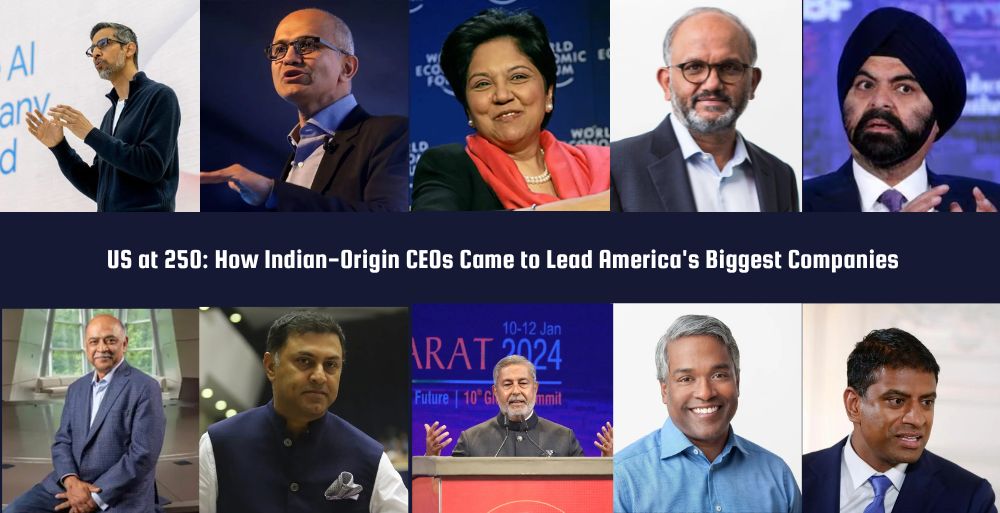
As the United States approaches its 250th anniversary, Indian-origin executives now lead many of America’s most influential corporations, reflecting how global talent has helped shape the country’s technological innovation, economic growth and corporate leadership in the 21st century.
As the United States approaches the 250th anniversary of its independence in 2026, one of the defining stories of its modern corporate landscape is the rise of Indian-origin executives to the highest levels of business leadership.
Over the past two decades, leaders born or educated in India have taken charge of some of America’s most influential companies, including Microsoft, Google, Adobe, IBM, Mastercard, Palo Alto Networks, Micron Technology, Google Cloud and Novartis. Their leadership has coincided with major transformations in cloud computing, artificial intelligence, cybersecurity, digital payments, semiconductors and healthcare.
While they represent different industries, these executives collectively illustrate a broader shift within Corporate America, where global talent increasingly leads companies that shape the world’s digital economy and technological innovation.
Satya Nadella‘s appointment as CEO of Microsoft in 2014 marked a turning point for the technology giant. He repositioned the company around cloud computing, enterprise software and artificial intelligence, helping Microsoft surpass a market valuation of $3 trillion. Under his leadership, Azure became one of the world’s leading cloud platforms, while Microsoft’s investments in AI placed the company at the center of one of the industry’s most significant technological shifts.
Sundar Pichai became CEO of Google in 2015 before assuming leadership of parent company Alphabet in 2019. During his tenure, Google has expanded its investments in artificial intelligence and cloud computing while navigating increasing regulatory scrutiny in the United States and Europe. Alphabet continues to be one of the world’s largest technology companies, with AI now central to its long-term strategy.
Indra Nooyi, who served as PepsiCo’s CEO from 2006 to 2018, transformed the company through her “Performance with Purpose” strategy, linking business growth with sustainability and healthier consumer choices. Her leadership helped redefine how multinational corporations approached environmental responsibility and long-term value creation.
At Adobe, Shantanu Narayen oversaw one of the software industry’s most significant business transformations by shifting the company from selling packaged software to a subscription-based cloud model. Although initially met with investor skepticism, the move ultimately established Adobe Creative Cloud as the global standard for creative professionals and significantly increased the company’s value.
Ajay Banga led Mastercard through a period of rapid expansion in digital payments while championing financial inclusion initiatives aimed at bringing more people into the formal banking system. In 2023, he became President of the World Bank, where he now focuses on mobilizing private-sector investment to address global development, infrastructure and climate challenges.
Arvind Krishna became IBM’s CEO in 2020 after leading the company’s landmark acquisition of Red Hat. Since taking over, he has reshaped IBM around hybrid cloud computing and artificial intelligence while modernizing one of America’s oldest technology companies.
Nikesh Arora has led Palo Alto Networks since 2018, steering the cybersecurity company through a series of strategic acquisitions and product expansions. As cyber threats have grown more sophisticated, the company has strengthened its position as one of the world’s leading providers of cybersecurity solutions for governments and enterprises.
Sanjay Mehrotra, CEO of Micron Technology since 2017 and co-founder of SanDisk, has guided one of the world’s largest memory-chip manufacturers during the rapid growth of artificial intelligence. Micron has emerged as a major supplier of high-bandwidth memory chips used in AI servers and advanced data centers, making it a critical player in the global semiconductor supply chain.
Thomas Kurian joined Google Cloud as CEO in 2019 after more than two decades at Oracle. Under his leadership, Google Cloud has significantly expanded its enterprise business, becoming one of Alphabet’s fastest-growing divisions and strengthening its position against competitors Amazon Web Services and Microsoft Azure.
In the healthcare sector, Vasant Narasimhan has led Novartis since 2018, focusing on advanced medicines, gene therapies and technology-driven drug development. His leadership has included the restructuring of the company and increased investment in innovative pharmaceutical research.
The success of these executives reflects more than individual achievement. Their rise highlights the increasingly global character of Corporate America and the important role that immigrants and international talent continue to play in driving innovation, economic growth and technological leadership.
Many of these leaders began their academic journeys in India before building careers in the United States, underscoring India’s growing contribution to global business leadership across technology, finance, healthcare and manufacturing.
As America prepares to mark 250 years of independence, the presence of Indian-origin CEOs at the helm of some of its largest corporations illustrates how international talent has become an integral part of the country’s economic success and its continued leadership in the global innovation economy.