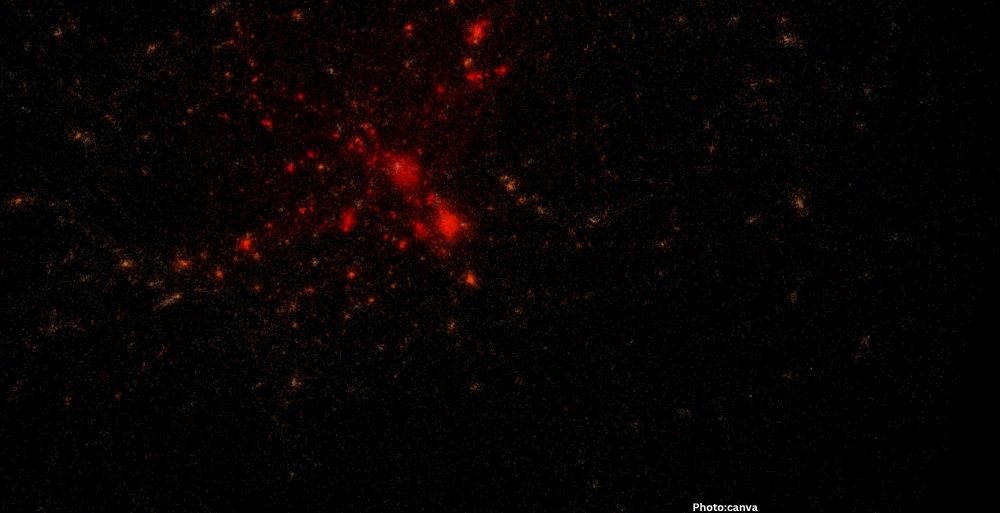
A Chinese-led international team has successfully created the largest-ever cosmological simulation, named ‘HyperMillennium’, which provides groundbreaking insights into cosmic evolution.
BEIJING, April 23 (Xinhua) — An international research team spearheaded by Chinese scientists has introduced the largest cosmological simulation to date, a monumental project dubbed “HyperMillennium.” This ambitious endeavor is expected to serve as a powerful digital framework for scientists as they seek to understand the complex processes governing cosmic evolution.
The HyperMillennium simulation encompasses an immense cubic volume of space measuring 12 billion light-years per side, utilizing an unprecedented 4.2 trillion virtual dark matter particles. By employing a method known as N-body numerical simulation, researchers were able to recreate the evolution of large-scale structures in the universe over a remarkable span of 10 billion years. This simulation effectively constructs a virtual cosmos within a supercomputer, beginning its journey just after the Big Bang and meticulously tracking the gravitational influences that shape cosmic entities.
Technological Innovations and Computational Demands
The HyperMillennium simulation empowers researchers to effectively “rewind time” and examine how galaxies and other cosmic structures formed throughout the universe’s history. By integrating sophisticated physical models of galaxy formation, the simulation generates a detailed catalog of galaxies, outlining their positions, brightness, and other fundamental characteristics. This innovative work not only bolsters theoretical research on dark matter and dark energy but also enhances new-generation galaxy survey initiatives, including the China Space Station Telescope and the European Space Agency’s Euclid mission.
Wang Qiao, a researcher at the National Astronomical Observatories of the Chinese Academy of Sciences (NAOC), highlighted the simulation’s significance, stating, “The simulation was completed with high force resolution and time accuracy and also made a breakthrough in computational scale. It allows scientists to study extremely rare, massive cosmic structures in fine detail while maintaining strong statistical power.” This level of detail is crucial for enhancing the understanding of fundamental cosmic phenomena and for validating existing cosmological theories.
Resource Intensive Project
Creating such a large-scale simulation necessitates enormous computing resources. The research team developed specialized software called PhotoNs, tailored specifically for China’s domestic supercomputers. After over a decade dedicated to refining algorithms and optimizing computational processes, the team achieved efficient calculations using more than 10,000 accelerator cards. The project consumed upwards of 100 million CPU core-hours and 10 million accelerator-card hours, resulting in approximately 13 petabytes of both raw and processed data.
Global Recognition and Implications
The significance of the HyperMillennium simulation has garnered recognition from prominent figures in the field. Mike Boylan-Kolchin, a professor at the University of Texas at Austin, referred to the simulation as a “computational marvel” that will play a pivotal role in unlocking the mysteries surrounding dark energy and the early universe. He emphasized that the simulation’s unprecedented size and resolution will serve as a benchmark for research communities for years to come.
Volker Springel, the director of the Max Planck Institute for Astrophysics in Germany, expressed admiration for the project’s scale and accuracy, indicating that it redefines the boundaries of numerical cosmology. He remarked, “I am extremely impressed by the team’s effort in realizing such an incredibly large and highly accurate simulation, which allows for new high-precision tests of the standard cosmological model.” This validation of existing theories signifies a substantial advancement in the field, providing a robust framework for future research.
Research Contributions and Data Availability
The initial research findings stemming from the HyperMillennium project have been published in the journal Monthly Notices of the Royal Astronomical Society. As part of demonstrating the simulation’s capabilities, the research team compared simulation results with actual observations of Abell 2744, a notable galaxy cluster located approximately four billion light-years from Earth. The correlation between the simulated data and real observations was striking, affirming that the standard cosmological model holds true even in the complex environments of colliding galaxy clusters.
According to the NAOC, the first batch of simulation data has already been made available to the global scientific community through the National Astronomical Data Center. This platform serves as a vital resource for astronomy research, education, and data-driven applications, facilitating further exploration and discovery within the field. As scientists and researchers across the globe access this data, it is anticipated that new insights into cosmic evolution will emerge, potentially reshaping current understanding and paving the way for future discoveries.
The HyperMillennium simulation represents a significant leap forward in cosmological research, combining advanced technology with innovative methodologies. As the scientific community continues to analyze the vast amounts of data generated by this groundbreaking project, it is likely that the implications will extend far beyond current theoretical frameworks, offering new perspectives on the origins and structure of the universe.