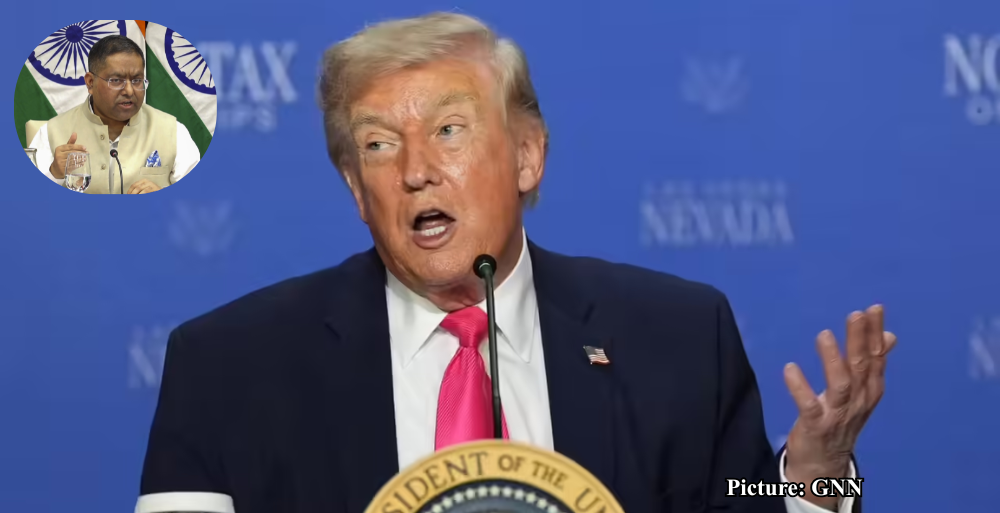
India’s Ministry of External Affairs has acknowledged U.S. President Donald Trump’s derogatory remarks about the country, made in the context of an anti-immigration social media post, but refrained from issuing a detailed response.
NEW DELHI: In a measured response to U.S. President Donald Trump’s controversial remarks labeling India and China as ‘hellholes,’ the Ministry of External Affairs (MEA) of India stated on Thursday that it has seen reports of Trump’s comments but has opted not to elaborate further. This statement was made amid a growing discourse on immigration and national identity in the United States, highlighting the delicate nature of U.S.-India relations.
During a media briefing, MEA spokesperson Randhir Jaiswal remarked, “We have seen some reports. That’s where I leave it.” This response reflects a cautious approach from the Indian government in managing the fallout from Trump’s incendiary remarks while balancing diplomatic sensitivities.
Trump’s Social Media Post and Its Implications
Trump’s derogatory comments originated from a post he reshared on his social media platform, Truth Social. The post criticized U.S. immigration practices and included disparaging terms regarding several nations, notably India and China. It stated, “A baby here becomes an instant citizen, and then they bring the entire family in from China or India or some other hellhole on the planet.” Such rhetoric has incited significant backlash, particularly among Indian officials and the public.
In addition to the offensive language, the post accused new immigrants of lacking loyalty to the United States, claiming that the integration seen with earlier European immigrant groups has ceased. It further characterized the U.S. immigration system as a “cash in pot,” implying that the nation has shifted away from being a melting pot of cultures to one that commodifies immigration.
Political Reactions in India
The reaction from India’s political landscape has been swift and sharp. The Congress party, one of the country’s primary opposition parties, condemned Trump’s remarks as “extremely insulting and anti-India.” In a statement, Congress urged Prime Minister Narendra Modi to issue a firm response to the comments, stating that Trump’s words “hurt every Indian.”
Congress representatives have expressed frustration over what they perceive as Modi’s consistent silence in the face of derogatory remarks made by Trump in the past. One spokesperson pointedly remarked, “Given his track record so far, it cannot be expected that he will say anything in front of Trump,” suggesting a growing concern about the implications of Modi’s approach to U.S.-India relations.
Historical Context of U.S.-India Relations
The relationship between the United States and India has experienced significant evolution over the past few decades, transitioning from a period of skepticism during the Cold War to a more collaborative partnership focused on trade, defense, and strategic interests. However, statements such as Trump’s can provoke nationalistic sentiments in India and complicate diplomatic ties, particularly in light of shared interests in combating terrorism and fostering economic growth.
In recent years, the two nations have engaged in various bilateral initiatives aimed at strengthening their ties, particularly in the defense sector, where the U.S. has become one of India’s top arms suppliers. Yet, inflammatory comments about immigration can resonate deeply in India, where nationalism is a potent political force, leading to potential repercussions for diplomatic engagement.
Broader Implications on Immigration Discourse
This controversy also raises broader questions about the perception of immigrants from India and China within the U.S. The American public remains divided on immigration issues, with a notable segment perceiving Trump’s remarks as reflective of a wider sentiment against immigrants from these countries. A recent poll indicated a significant divergence in opinions, revealing that many Americans are receptive to views that characterize immigration from these nations as problematic.
As the U.S. continues to grapple with immigration reform, Trump’s comments may exacerbate existing tensions and influence public discourse. The characterization of immigrants as a burden rather than contributors can impact legislative agendas and shape the experiences of Indian and Chinese nationals in the U.S. communities.
Conclusion and Future Outlook
As the situation unfolds, it will be crucial to observe how Indian officials navigate the diplomatic landscape in the wake of Trump’s remarks. The Ministry of External Affairs’ restrained response may suggest a strategic decision to avoid escalation while maintaining a dignified stance. Nonetheless, the implications of Trump’s comments extend beyond mere political theater; they touch upon fundamental issues of identity, immigration, and international relations.
In summary, the ongoing discourse surrounding Trump’s remarks underscores the complexities of U.S.-India relations and the intertwined narratives of nationalism and immigration policy that define contemporary political climates in both countries. As both nations proceed, the handling of such sensitive issues will likely remain a barometer for the health of their diplomatic interactions.