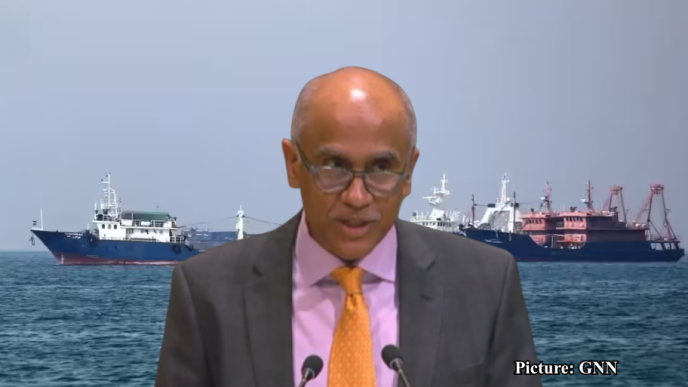

Michael Beckley, a political science professor at Tufts University, asserts in his new book that the United States will remain the world’s sole superpower for decades, despite challenges from China and Russia.
Medford, MA – In the face of growing international tensions and the rise of rivals like China and Russia, Michael Beckley, an associate professor of political science at Tufts University, presents a counter-narrative in his recent publication, Unrivaled: Why America Will Remain the World’s Sole Superpower. Beckley argues that the United States is poised to maintain its position as the world’s preeminent power for the foreseeable future, citing a combination of economic, geographic, and demographic advantages that he believes will endure.
Beckley’s thesis comes at a time when many analysts and commentators express concern over the U.S. potential decline. He acknowledges the risks associated with domestic political divisions and corruption but emphasizes that the United States is likely to thrive relative to its competitors.
U.S. Advantages Over Rivals
According to Beckley, the United States enjoys a substantial lead in critical measures of national power, with China being the only potential rival. He notes that the U.S. economy is three times larger than China’s, while its military capabilities are five times greater. He asserts that even under adverse conditions, it would take decades for China to close this gap.
“The United States has the best long-term economic growth prospects among the major powers,” Beckley stated, attributing this advantage to factors such as geography, demography, and political institutions. The U.S. is characterized as a natural economic hub, rich in resources, with favorable geographic advantages that support trade and military defense.
In demographic terms, Beckley highlights that the U.S. workforce is not only large but also young and highly educated. He points out that while the U.S. workforce is projected to grow throughout this century, China is expected to lose 200 million workers and face a significant increase in its elderly population over the next thirty years.
Comparative Analysis of Governance
Beckley contrasts the U.S. political system with that of China, asserting that while the U.S. is a flawed democracy, China’s oligarchic structure under a single-party rule presents greater long-term challenges. “Institutionally, the United States is a mess, but China’s system is worse,” he remarked, emphasizing the inefficiencies and corruption inherent in the Chinese Communist Party’s governance model.
When examining Russia’s role in global politics, Beckley acknowledges that while Russia poses threats to U.S. interests—such as its military posturing in Eastern Europe and its support for adversaries like Iran—he does not view it as a potential superpower rival akin to the Soviet Union. He notes that Russia’s military budget is significantly smaller than that of the United States, and its economy is less robust.
Potential Alliances and Global Dynamics
Beckley addresses the perception of a burgeoning alliance between China and Russia, suggesting that while they may cooperate on certain issues, historical and geopolitical factors hinder the formation of a genuine alliance. He refers to their shared border and competing interests in Eurasia as key barriers to a cohesive partnership.
Despite these limitations, Beckley warns that the coordinated efforts of Russia and China to undermine U.S. interests—such as media manipulation and election interference—could stretch U.S. military resources if conflicts were to arise simultaneously in Taiwan and Eastern Europe.
The Benefits of Superpower Status
Beckley articulates several advantages of being the world’s sole superpower, most notably the ability to project military power without domestic repercussions. He notes, “As the only country that can carry out a major war abroad, the United States has the luxury of dealing with foreign threats ‘over there,’ far from its homeland.” This strategic advantage allows the U.S. to manage conflicts without the direct impact of warfare on its population.
Additionally, Beckley highlights the economic benefits of superpower status, as other nations are inclined to support U.S. debt and enter into favorable trade agreements. He explains that the U.S. dollar’s status as the world’s reserve currency attracts foreign investment and talent, further enhancing the country’s economic position.
Public Perceptions and Future Risks
While Beckley presents an optimistic outlook for the U.S., he acknowledges the prevailing narrative of American decline. He attributes this perception to a combination of media focus on U.S. failures and an exaggerated fear of rising powers. “The grass tends to look greener on the other side,” he remarked, noting that Americans are often more aware of their own challenges than those facing other nations.
Looking ahead, Beckley warns that internal decay could pose a significant risk to U.S. power. He highlights growing political polarization and systemic issues such as economic inequality and deteriorating infrastructure as potential factors that could undermine America’s standing on the global stage.
In conclusion, Michael Beckley’s analysis in Unrivaled presents a case for the enduring strength of the United States in the face of global challenges. His insights invite a reconsideration of the narrative surrounding American decline and emphasize the country’s unique position in the international order.