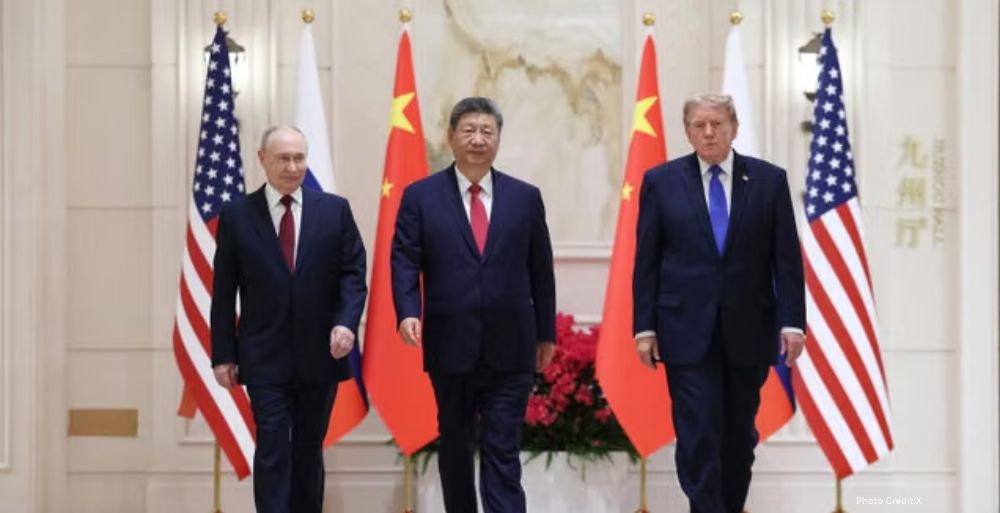
A trilateral summit in Shenzhen, China, culminated in a significant four-point declaration by the leaders of the U.S., China, and Russia focused on international cooperation and peace.
In an unprecedented gathering on Thursday, President Donald Trump, Chinese President Xi Jinping, and Russian President Vladimir Putin met in Shenzhen, China, for a historic trilateral summit that resulted in a joint four-point declaration aimed at addressing urgent global issues. This summit marks a notable moment in international diplomacy, as it is one of the few instances where the leaders of the three major nuclear powers have convened in such a manner.
The declaration, released by both Chinese and Russian officials, addresses key areas of mutual interest, including reform of the United Nations, oil production and supply, the role of the International Criminal Court (ICC), and nuclear conflict prevention. As permanent members of the United Nations Security Council, the leaders expressed their commitment to reforming the U.N. to ensure it can respond more effectively to contemporary global challenges.
Key Tenets of the Peace Declaration
The four-point declaration includes several significant commitments:
- The three nations will work to enhance the production and supply of refined petroleum products for the benefit of all nations.
- There is a collective understanding that the International Criminal Court and similar institutions must not misuse their jurisdiction.
- All three leaders reaffirmed that a nuclear war must never be fought and agreed to dialogue aimed at reducing nuclear risks and preventing the proliferation of nuclear weapons.
During the 90-minute meeting, President Trump emphasized the importance of maintaining open and respectful dialogue among nations. He stated, “We have a special responsibility to maintain open, respectful, and productive dialogue on issues impacting not just our people but the entire planet.” This approach represents a departure from the policies of previous U.S. administrations, which often shied away from engaging with nations perceived as adversaries.
In the lead-up to the summit, Trump indicated he sought to engage in discussions regarding the ongoing conflict in Iran, the Russia-Ukraine war, and the critical issue of denuclearization. The United States has firmly supported Ukraine in its efforts to counter Russian aggression, while China has provided considerable backing to Russia throughout the conflict. Furthermore, both Russia and China have been involved in aiding Iran amid its contentious relationship with the U.S.
Nuclear Nonproliferation and Broader Implications
The summit’s discussions on nuclear nonproliferation highlighted the complex geopolitical dynamics at play. Historically, China has been resistant to international checks on its own nuclear arsenal, complicating discussions surrounding arms control. However, President Xi Jinping made a significant statement during the summit, advocating for a nuclear-free world and stating, “nuclear weapons should be comprehensively banned and thoroughly destroyed,” as reported by China’s state-run Xinhua news agency. This assertion could open avenues for future dialogue on disarmament, albeit amid skepticism regarding its implementation.
The meeting occurs against the backdrop of heightened geopolitical tensions, particularly in light of the ongoing conflict in Ukraine and the evolving U.S.-China relationship. The interactions among the three leaders are further complicated by Iran’s strategic partnerships with both Russia and China, particularly regarding its own conflicts with the United States and its nuclear ambitions.
As the summit concluded, the implications of the leaders’ discussions are substantial and still unfolding. The declaration could signal a shift towards a more collaborative approach among these major powers in addressing longstanding global challenges. However, political analysts express caution regarding the practical execution of these commitments, given the differing national interests and priorities of each country.
Future Outlook and International Reactions
The international community is likely to scrutinize the outcomes of this summit closely. Observers are particularly interested in how the commitments made in the declaration will translate into concrete actions in the coming months. The leaders’ ability to navigate their respective national interests while fostering cooperation will be critical in determining the success of this initiative.
In addition, the summit’s implications extend beyond the immediate concerns addressed in the declaration. The unity displayed among these three nations could signal a new geopolitical realignment, challenging existing international norms and power structures. As global tensions persist, particularly in regions such as Eastern Europe and the Middle East, the effectiveness of this trilateral cooperation will be closely monitored.
The historic summit in Shenzhen not only represents a convergence of interests among the U.S., China, and Russia but also serves as a reminder of the complexities inherent in international diplomacy. As the world grapples with pressing issues such as climate change, security, and economic stability, the commitment to dialogue and collaboration among these influential powers may play a pivotal role in shaping the future of global governance.