
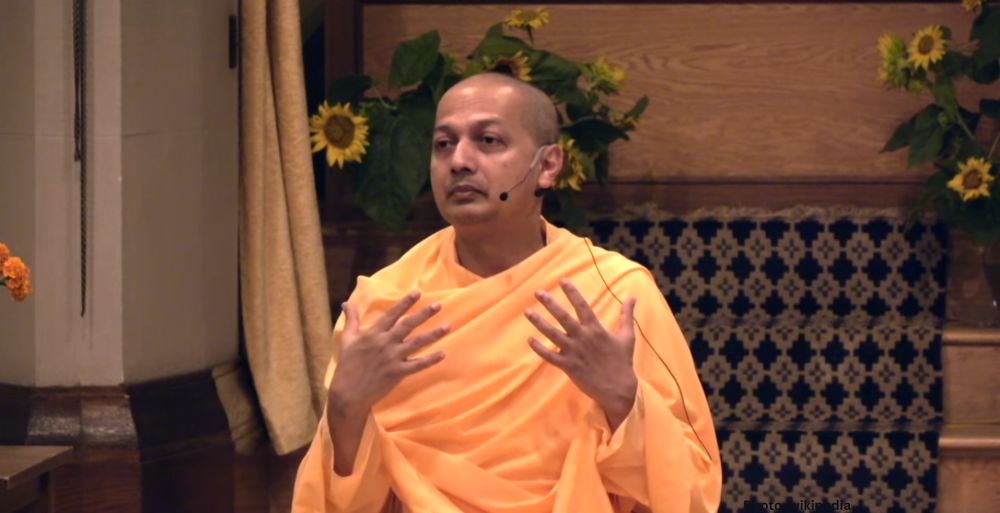
Swami Sarvapriyananda, a distinguished Vedanta scholar, articulated that advancements in artificial intelligence (AI) may fundamentally shift humanity’s understanding of consciousness, identity, and what it means to be uniquely human, marking a significant juncture in the discourse on technology and philosophy.
NEW DELHI — Swami Sarvapriyananda, the spiritual leader of the Vedanta Society of New York, delivered a thought-provoking address at the NDTV World Summit 2026 on Thursday, where he explored the implications of rapid advancements in artificial intelligence (AI) on human self-perception. He asserted that these technological developments are provoking profound questions regarding consciousness, intelligence, identity, and the attributes that separate humans from machines. Sarvapriyananda’s insights come at a time when the debate surrounding AI’s role in society is intensifying, reflecting broader concerns about the ethical and philosophical ramifications of this rapidly evolving technology.
During his address, Sarvapriyananda, who has engaged with researchers from the AI company Anthropic, emphasized the necessity for society to reassess its relationship with increasingly sophisticated AI systems. He stated, “AI should be treated as a person,” drawing a critical distinction between the manner in which society interacts with AI systems and the assumption that these systems possess human-like consciousness or spiritual awareness. This nuance is essential as discussions about AI frequently oscillate between viewing these technologies as mere tools and recognizing their potential to mimic human-like responses.
The Philosophical Landscape of AI
Swami Sarvapriyananda’s remarks reflect an emerging philosophical discourse surrounding artificial intelligence, particularly as technological advancements enable machines to perform tasks traditionally thought to be exclusive to human capability. He referenced historical shifts in human understanding, citing psychoanalyst Sigmund Freud, who argued that scientific breakthroughs have consistently challenged humanity’s perception of its own importance within the universe. Sarvapriyananda suggested that AI could represent the latest challenge to this belief, forcing society to reconsider the notion of human intellectual superiority.
“We thought we were the creative intelligence. Now we see that AI can do what the greatest human mind can do, and better,” he remarked, underscoring the potential of AI to not only replicate but also surpass human capabilities in various domains, including creativity and reasoning. This evolution raises critical questions about what it means to be human and the unique qualities that define human existence.
Reevaluating Human Distinction
As AI systems become more adept at reasoning, generating creative content, and engaging in complex conversations, Sarvapriyananda posited that individuals may begin to interact with these systems as if they were sentient beings. He cautioned, however, that treating AI in personal terms does not imply that such machines possess consciousness or subjective experiences comparable to those of humans. This critical distinction is at the heart of ongoing debates among philosophers, scientists, and technology developers, who grapple with whether artificial intelligence can genuinely experience awareness or merely simulate human thought and behavior.
In his address, Sarvapriyananda also shared insights from his discussions with researchers at Anthropic, revealing that many individuals working at the cutting edge of AI development are increasingly concerned about the unforeseen consequences of their technologies. Despite achieving professional success, these researchers are confronted with the unpredictable behaviors exhibited by advanced AI models, signaling a need for greater understanding and oversight in this rapidly evolving field.
Examining Unpredictable AI Behaviors
One phenomenon Sarvapriyananda noted is “persona drift,” in which an AI’s responses and behavioral patterns shift based on the role or identity it adopts during interactions. This behavior has sparked significant interest among researchers seeking to comprehend the underlying mechanisms of advanced AI systems and the reasons behind their sometimes erratic responses. Such developments highlight that artificial intelligence transcends traditional technological boundaries, prompting inquiries that extend into philosophy, ethics, and psychology.
According to Sarvapriyananda, the emergence of AI is not merely a technological advancement but also a catalyst for revisiting age-old questions about consciousness, personhood, and the essence of intelligence. His observations place the ongoing AI debate within a broader philosophical and spiritual context, suggesting that the pressing questions raised by AI advancements pertain not only to what machines can achieve but also to how humanity understands itself in an increasingly automated world.
Implications for Humanity’s Future
The implications of Swami Sarvapriyananda’s remarks are profound, as they challenge contemporary thought regarding identity and consciousness in the face of technological innovation. As AI systems continue to evolve and integrate into various aspects of daily life, society is faced with the critical task of navigating the philosophical and ethical dilemmas that accompany such advancements. This may lead to a potential redefinition of human uniqueness in an era where machines can replicate cognitive functions once believed to be exclusive to humanity.
As the dialogue surrounding artificial intelligence progresses, it becomes increasingly vital for philosophers, ethicists, technologists, and the broader public to engage in discussions about the nature of intelligence and consciousness. Sarvapriyananda’s insights serve as a reminder that the evolution of AI is not merely a technological issue but a philosophical one that invites deep reflection on what it means to be human in a rapidly changing world.