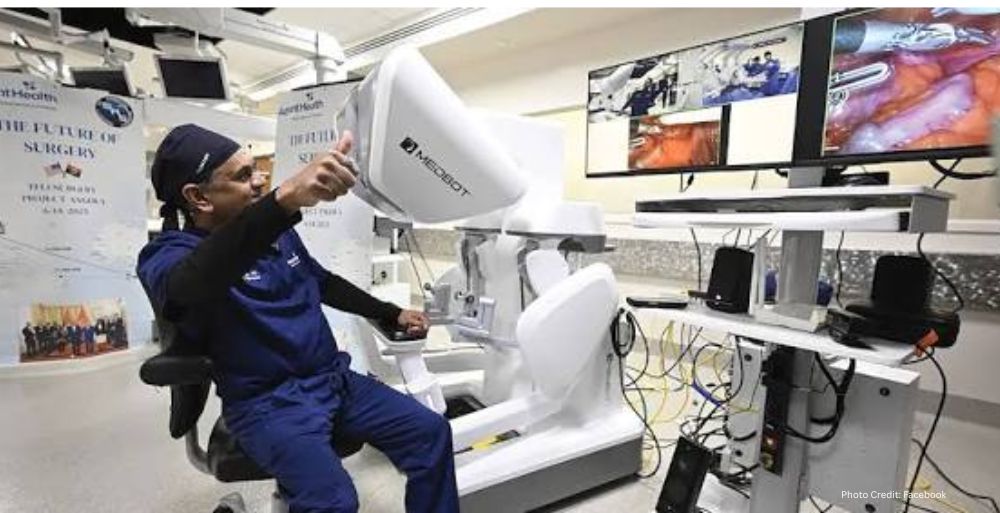
A Florida surgeon has successfully conducted the first telerobotic surgery between two hospitals in the United States, removing the prostate of a cancer patient from 35 miles away. This pioneering operation marks a significant milestone in telemedicine and robotics.
In a groundbreaking advancement for surgical technology, Dr. Vipul Patel, the founder and medical director of the Global Robotics Institute at AdventHealth Celebration, executed a robotic prostatectomy on a 66-year-old patient on Sunday. The procedure took place remotely, with the patient, referred to as Mark, located at an AdventHealth facility in Minneola, Florida, while Dr. Patel operated from another AdventHealth facility in Celebration, approximately 35 miles away.
This operation is part of a clinical research study focused on evaluating the capabilities of a robotic telesurgery system. Mark volunteered for the study, which aims to explore new frontiers in surgical procedures. During the surgery, Dr. Marcio Moschovas, the study’s co-principal investigator, provided essential on-site support to ensure patient safety and procedural success. Following the surgery, AdventHealth reported that Mark was recovering well.
Regulatory Framework and Clinical Study
The robotic prostatectomy was performed under an investigational device exemption from the U.S. Food and Drug Administration (FDA). This exemption allows researchers to study new medical devices in a clinical setting without granting full FDA approval or clearance for general use. The procedure on Mark follows ten earlier investigational telesurgeries conducted between Orlando, Florida, and Luanda, Angola, marking a critical expansion of the study into U.S. hospitals.
Dr. Patel emphasized the significance of this research, stating, “For generations, access to highly specialized care has often depended on where a patient lives. This study allows us to evaluate whether telesurgery could one day help reduce geographic barriers to specialized treatment.” His remarks underscore a growing ambition within the medical community to leverage technological innovation to enhance healthcare accessibility, particularly for patients who reside in rural or underserved areas.
Implications of Telesurgery
Telesurgery enables surgeons to control robotic instruments from a distance, which could improve patient access to specialized care. However, the technology is still undergoing rigorous evaluations to assess its safety, reliability, and potential cybersecurity vulnerabilities. AdventHealth noted that prior to this operation, no documented telesurgery had been performed between two locations within the United States, highlighting the uniqueness of this achievement. Notably, the surgery does not validate the general clinical performance of the technology; further studies will be necessary to establish its efficacy.
Risks and Challenges
As with any surgical procedure, robotic prostatectomy carries inherent risks, including bleeding, infection, incontinence, and erectile dysfunction. Additionally, there remains the possibility of needing to convert to traditional open surgery if complications arise. The introduction of telesurgery adds another layer of complexity, introducing risks such as equipment malfunctions, connection failures, and cybersecurity threats. Consequently, the presence of an on-site surgical team is critical for managing any unforeseen issues that may arise during the procedure.
Global Context and Technological Advances
The recent surgery in Florida follows a notable operation earlier this year when a surgeon in London successfully performed a prostatectomy on a patient in Gibraltar, approximately 1,500 miles away. That procedure was particularly remarkable for its minimal latency, with only a 0.06-second delay between the surgeon’s commands and the robot’s actions. This showcases the potential for real-time surgical interventions across vast distances, further underlining the advancements in robotic surgery.
This pioneering telerobotic surgery not only highlights significant advancements in surgical technology but also raises essential questions about the future of remote healthcare delivery. As the medical community continues to explore the efficacy and safety of telesurgery, there is optimism that such innovations could alleviate disparities in access to specialized care, particularly for patients in geographically isolated regions.
Looking ahead, the implications of telerobotic surgery could extend beyond prostatectomies, potentially revolutionizing various surgical disciplines. However, successful implementation will require ongoing collaboration among medical professionals, regulatory bodies, and technology developers to address the multifaceted challenges posed by remote surgical procedures.
As research progresses and additional data becomes available, the healthcare industry will be better equipped to evaluate the full potential of telesurgery, with the aim of enhancing patient outcomes and expanding access to cutting-edge medical treatments across diverse geographic landscapes. The endeavor to integrate advanced technology into everyday medical practices represents not only a leap forward in surgical capabilities but also a step toward a more equitable healthcare system.