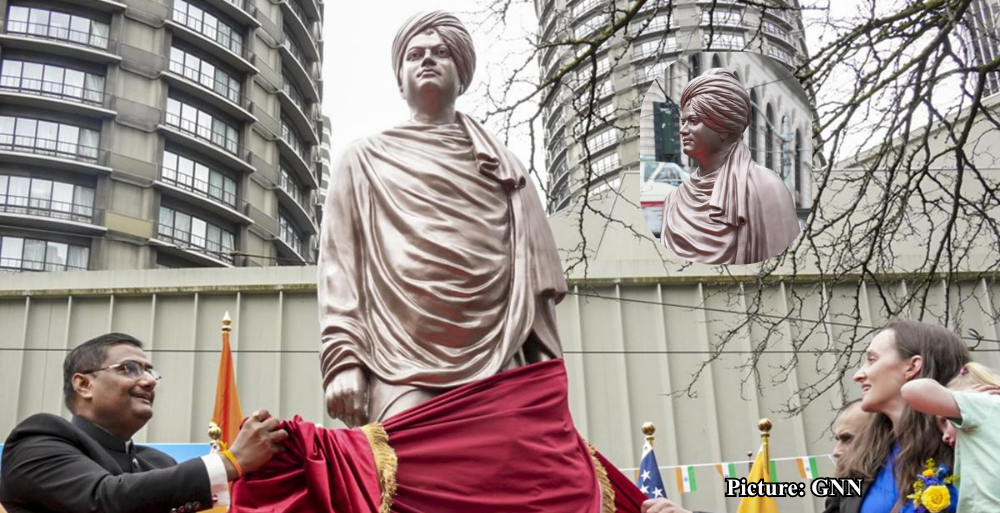
A life-size statue of Swami Vivekananda was unveiled in Seattle’s Westlake Square, marking a significant cultural milestone for the Indian American community and enhancing cultural ties between the United States and India.
A life-size bronze statue of Swami Vivekananda was unveiled on October 12, 2023, at Westlake Square in downtown Seattle, a move officials have described as a historic installation, being the first of its kind hosted by a city government in the United States. The ceremony was attended by Seattle Mayor Katie Wilson and Prakash Gupta, the Consul General of India in Seattle, along with several political leaders from the Greater Seattle area, including mayors from neighboring cities such as Kent, Auburn, Tukwila, Normandy Park, and Kirkland.
The statue is strategically located in Westlake Square, a bustling public space that attracts over 400,000 visitors daily and millions monthly. It is in proximity to significant landmarks, including the Amazon headquarters, the Seattle Convention Center, and the Seattle Center Monorail, making it an ideal site for cultural representation.
Significance of the Monument
This installation is emblematic of Seattle’s “inclusive spirit,” as stated by Mayor Wilson during her remarks at the unveiling ceremony. She emphasized the city’s commitment to strengthening cultural ties with India, particularly in a region known for its diverse and globally connected technology ecosystem. The statue has been gifted by the Indian Council of Cultural Relations (ICCR), which recognizes Seattle’s multicultural character and aligns with broader efforts to deepen cultural engagement between India and the United States.
The unveiling coincided with the celebration of ICCR Day, an event that underscores India’s cultural diplomacy initiatives aimed at reinforcing people-to-people connections. This initiative is particularly relevant in the Pacific Northwest, which has a strong Indian diaspora presence, contributing significantly to the area’s cultural fabric.
Artistic Contribution
The statue was sculpted by Indian artist Naresh Kumar Kumawat, who has created over 600 installations across more than 80 countries. His works are often viewed as cultural symbols that represent India’s heritage and philosophical traditions. The installation in Seattle is part of a broader trend of commemorating Vivekananda’s legacy in cities with significant Indian diaspora populations, further solidifying his status as a pivotal figure in promoting Indian philosophy and spirituality globally.
Cultural Diplomacy and Engagement
India and the United States have increasingly leveraged cultural diplomacy to complement their strategic partnership, which encompasses areas such as technology, defense, and economic cooperation. Initiatives like public monuments, cultural exchanges, and academic collaborations serve to deepen engagement beyond governmental interactions. The unveiling of Vivekananda’s statue reflects this trend and signifies a mutual appreciation of cultural heritage.
The Pacific Northwest, spearheaded by Seattle, has emerged as a key hub for such cultural engagement. The region’s burgeoning Indian-origin population plays a vital role in fostering connections between the two nations, particularly in technology and innovation sectors. The statue serves not only as a tribute to Swami Vivekananda but also as a reminder of the ongoing cultural dialogue between India and the United States.
The Legacy of Swami Vivekananda
Swami Vivekananda, a 19th-century Indian monk and philosopher, is widely recognized for introducing Indian philosophies of Vedanta and Yoga to the Western world. His address at the Parliament of the World’s Religions in Chicago in 1893 is often cited as a turning point in the global understanding of Hinduism and Indian culture. Vivekananda’s teachings emphasize the importance of self-realization and the oneness of humanity, ideals that continue to resonate with people around the world today.
The installation of his statue in Seattle not only honors his contributions but also highlights the growing importance of cultural exchanges between India and the United States. As global partnerships evolve, the significance of cultural heritage in fostering international relations becomes increasingly apparent.
Community Response and Future Implications
The unveiling ceremony was met with enthusiasm from the local Indian American community, with many attendees expressing pride in the recognition of their cultural heritage. Community leaders noted that this monument would serve as a beacon for future cultural events and dialogues, potentially leading to increased collaboration between local government and community organizations in promoting cultural understanding.
As cities across the United States continue to embrace diversity and inclusivity, the establishment of monuments like the one honoring Swami Vivekananda could serve as a model for similar initiatives nationwide. The statue not only represents a physical structure but also symbolizes the ongoing efforts to bridge cultural divides and foster mutual respect among different communities.
In conclusion, the unveiling of the Swami Vivekananda statue in Seattle marks a significant step in recognizing the contributions of the Indian American community and enhancing cultural ties between the United States and India. As the global landscape continues to evolve, such cultural landmarks will play an essential role in fostering understanding and cooperation across nations.